
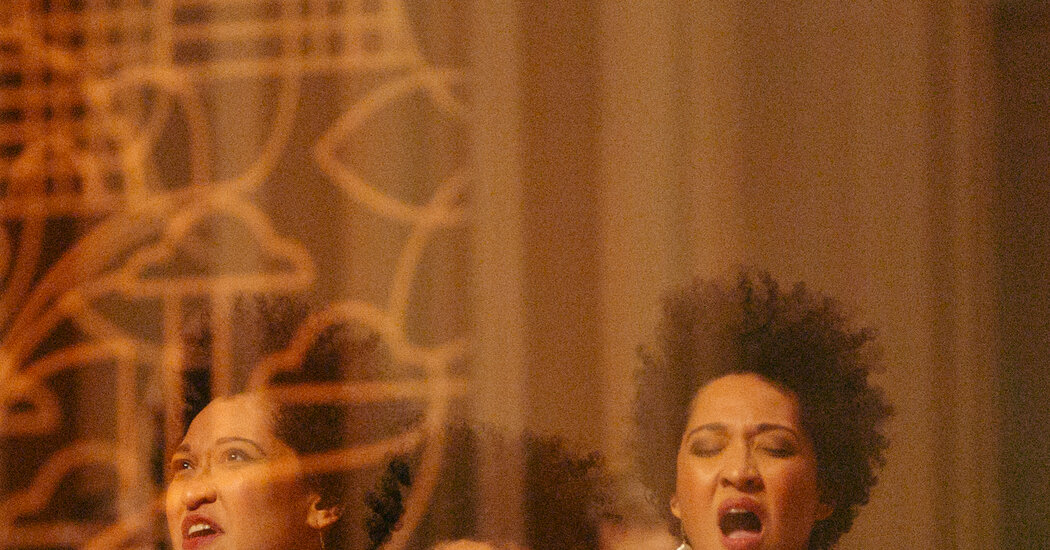
The May Festival in Cincinnati is among the nation’s oldest choral festivals, but it is by no means hidebound. Since 2024, it has invited a new artistic director each year to program the music and to dream up new community initiatives. Opting for greater artistic flexibility over steady leadership, the new model brings the festival into conversation with contemporary artists and musical issues.
The composer Julia Wolfe was the first to lead the festival in this reimagined format, followed by the singer Renée Fleming. This year, the soprano Julia Bullock, an established voice on American and European opera stages, was the artistic director of the two-week festival, singing in several of the concerts including the finale, which featured concert excerpts from Gershwin’s “Porgy and Bess,” as well as music by William Grant Still, Stephen Paulus, Leonard Bernstein and Handel.
“The first song I ever sang was a freedom song in an Episcopalian Church,” Bullock said in an interview, noting that she and her sister were the “only nonwhite people in that congregation.” Bullock, who is from St. Louis and lives in Munich, said her experience as a Black artist who often finds herself in predominantly white spaces was a central theme in her festival programming.
Both Bullock and the lithe-voiced bass-baritone Alfred Walker, who sang Porgy, performed with amplification to project over the Cincinnati Symphony Orchestra and the mostly volunteer 140-member May Festival Chorus (the symphony’s year-round chorus), bolstered that night by other community ensembles.
The conductor Anthony Parnther kept rhythms tight, and as Bess, Bullock made bewitching use of a little light rasp in her middle register, particularly in the aria “I Wants to Stay Here.” The chorus, though, seemed cautious in Gershwin’s blues-tinted melodies.
The racial politics involved in the creation of “Porgy and Bess” have made it a tricky work to stage today. Still, Parnther said in an interview before the concert, “this is not the first time that a predominantly white choir has sung ‘Porgy,’” adding that he approached teaching the opera’s stylized dialect the same way he would German or Italian diction.
Bullock addressed the matter head on, programming several festival performances with works intended to contextualize Gershwin’s opera and the festival’s history. (She also noted that it was the 70th anniversary of the first time Black singers appeared at the May Festival, when Leontyne Price and William Warfield performed “Porgy and Bess.”)
For this 153-year-old festival’s opening concert on May 15, Bullock paired music by Margaret Bonds, a contemporary of Gershwin’s who, Bullock said, was “unapologetic in commenting very pointedly on the exploitative elements” of his music, with works by the Austrian composers Bruckner and Zemlinsky as a nod to Cincinnati’s Germanic roots.
She also cobbled together an “Eclectic Mass” from masses by Bonds, Palestrina, Bach and the American composer Carlos Simon, whose organ playing during the performance brought a gospel flair, as did the “preaching” by Jason Alexander Holmes, the festival’s associate chorus director.
In another concert juxtaposing a white European composer and a Black American one, the Cincinnati Symphony, under its music director Cristian Macelaru, shimmered in Vaughan Williams’s Symphony No. 1, “A Sea Symphony,” capturing the work’s majesty and mystery with great swells of sound. The orchestra’s performance of Duke Ellington’s “The River Suite,” by contrast, lacked depth.
The only concert that wasn’t centered on race paired Stravinsky’s ballet-cantata “The Wedding,” invoking Russian folk traditions, with Carl Orff’s “The Songs of Catullus,” a lesser-known part of the “Carmina Burana” cantata trilogy that had the singers snapping rhythms and spitting the Latin verses with gusto. Members of the Cincinnati Ballet’s Second Company brought a chaotic energy to the work, whirling and cavorting to Orff’s tumbling rhythms.
There were moments during the festival that felt out of place, like Bullock’s more intimate recital at the smaller Memorial Hall that alternated musical settings of texts by Langston Hughes, a friend of Bonds’s and a hero of the Harlem Renaissance, with readings of his poetry. Its connection to the other concerts felt a little cursory. (Bullock created this program for the Metropolitan Museum of Art in 2018 during her residency there.)
But there were also times when the concerts felt like a conversation among people talking about the same ideas with different dialects, striving to connect and find common ground.
Next year, the conductor Marin Alsop will take the reins, inheriting a festival that has successfully maintained its audience even as its repertoire has become more unpredictable on a year-to-year basis.
To provide continuity, the festival’s director of choruses Matthew Swanson works with each new director while allowing his artistic partners license to make the festival their own. That way, he said, the festival can “introduce and reintroduce itself with must-see programs.”
He also noted the number of partnering organizations, which this year included schools and universities, the Cincinnati Art Museum, the ballet company and numerous choruses. These partnerships have an effect on festival attendance, perhaps even more than whoever is at the helm, said Julianne Akins Smith, the festival’s executive director, who oversees an annual budget of about $3.8 million. “The more collaborative in nature the performance, the higher the attendance,” she said.
A significant portion of Smith’s budget each year comes from a $33 million endowment, which has allowed the festival to experiment more freely. Bullock announced during the closing concert that the festival was exploring ways to build up its year-round programming, which the May Festival leadership confirmed.
At the closing concert, after the “Porgy” excerpts, Bullock paired Still’s “Plain-Chant for America” and excerpts from Stephen Paulus’s “Prayers and Remembrances” before sweeping bigger questions aside in favor of the optimism of “Let Our Garden Grow” from Bernstein’s “Candide,” closing out the festival’s longstanding tradition of a singalong of the “Hallelujah” Chorus from Handel’s “Messiah,” bringing the chorus and audience members to their feet in a final burst of music.

