
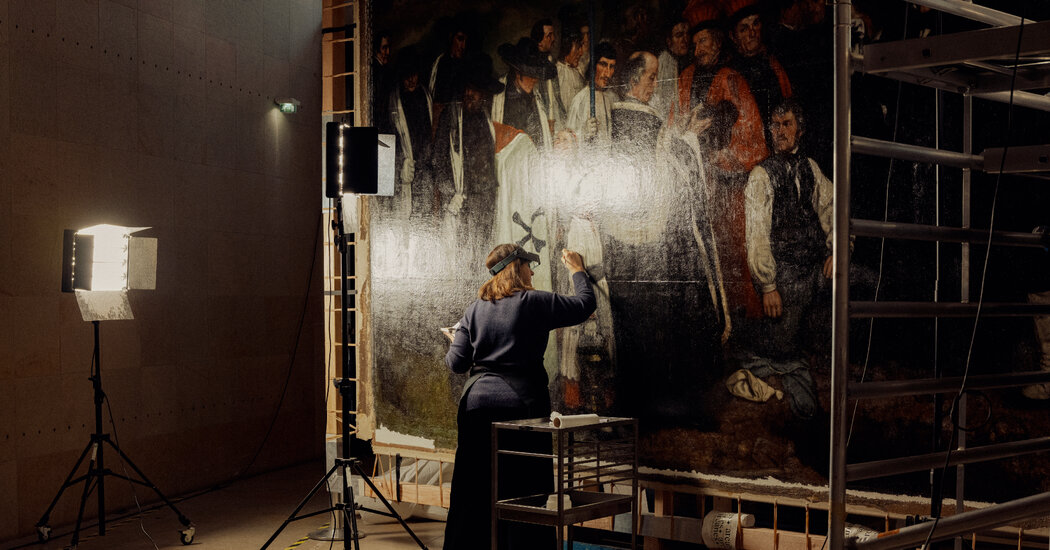
Restorations of great works of art usually happen quietly behind closed doors, but this time, the Musée d’Orsay got up close and personal. Over the past year, it has welcomed visitors to interact with a team of restorers as they transformed one of its largest and most important paintings: “A Burial at Ornans” by Gustave Courbet.
The museum built a makeshift atelier behind a huge plexiglass barrier on its ground floor so that visitors could come inside and watch the painstaking process. Restorers explained how they had marked off small rectangles for testing on the mid-19th-century painting, cleaned off grime and dust from its surface, dissolved layers of thick yellow varnish underneath, filled in cracks and touched up empty spaces with dabs of paint.
They showed how they strengthened the wavy, loosely woven canvas, which Courbet had dismantled, moved and reframed too many times. They stitched and repaired holes and tears, and flattened out the painting’s edges. Then they laid out the reinforced canvas and pulled it taut with elastic bands into a temporary new frame.
The Orsay had cast restorers as performers once before: They worked behind glass before an audience when Courbet’s “The Painter’s Studio” was restored more than a decade ago.
This time, the restorers set up rows of folding chairs and gave free lectures every Thursday with slides and time-lapse videos followed by up-close tours around the painting itself. Every Monday, when the museum is closed, they welcomed student groups from all around France to observe.
The initiative to welcome visitors directly into the process of bringing this painting back to life was launched by Sylvain Amic, the museum director, who died suddenly last year.
“He wanted to make visitors active players in what we do, to demystify the museum,” said Annick Lemoine, the current director. “To be with the restorers as they work, to share their joy, their passion, their discoveries — it’s magic.”
A Realist Rebel
Many visitors to the Orsay come to see its vast collection of paintings by Impressionists like Monet, Renoir and Degas, not necessarily those of Courbet, the father of realism in French painting who preceded them.
The Museums Special Section
He is probably best known today for “The Origin of the World”: the startling, open-legged close-up of a naked woman from breast to mid-thigh painted in 1866. But it was Courbet’s large-format paintings of gritty daily life that catapulted him into fame — and the fury of the art critics of his time.
A torrent of insults rained down on him at the Paris salon of 1850-51 when he first exhibited “A Burial at Ornans” set in the village where he was born in eastern France.
The painting features more than 40 villagers gathered for the interment of a figure whose identity is unknown. A priest, flanked by altar boys and sextons, offers a blessing. In the forefront are a dog, a gravedigger and two older men in knee breeches. On the left, pallbearers carry the coffin. The focus of the painting is an open grave at the bottom center of the canvas.
He painted his figures life-size, a privilege previously reserved for biblical or mythological figures. He did not prettify them.
Critics attacked him for daring to celebrate the unvarnished reality of daily life on a large scale previously reserved for paintings of important historical events. They mocked the “vulgar ugliness” of his figures and the “glorification of odious triviality.”
Born into a wealthy landowning family in Ornans, Courbet grew up comfortable, cocky and contemptuous of the art bureaucracy. He ignored the insults.
A brand-builder of his time, he boasted that he was “the proudest and most arrogant man in France.” A self-promoting entrepreneur, he took “A Burial at Ornans” on the road after the Paris salon, exhibiting it — and charging admission — around France. When the 1855 Universal Exposition rejected it, he built and financed a separate solo pavilion to exhibit it along with other works and advertised the show with posters throughout Paris. Again, he charged admission.
“If I am making art, it is first of all to make a living from it,” he once wrote.
‘The Italian With the Golden Fingers’
The project to restore “A Burial at Ornans” began in 2018 when experts at France’s art restoration authority, based in the Louvre, came to the Orsay to conduct infrared light and ultraviolet fluorescent analyses that revealed elements of the painting that were invisible to the naked eye. Two years later, a total radiographic study was carried out. The museum launched a fund-raising campaign, and the Bank of America financed the restoration with an undisclosed sum.
The work was led by the Italian-born Cinzia Pasquali, who runs her own art restoration company in the Montmartre neighborhood of Paris and is sometimes called “the Italian with the golden fingers.”
Trained in Rome at the oldest restoration institute in Europe, Pasquali, in her 60s, dresses in black, with heavy rubber-soled shoes and a long apron. Her only adornment is her signature Italian-made gold earrings with carved angels and dangling pearls.
She cannot guess how many canvases, frescoes and sculptures she has touched in more than 40 years in the field. “There’s no creativity in being a restorer,” she said. “The light shines on the painter, and only on the painter. If you ask me to do something original, I don’t know how.”
She is best-known for the dramatic restoration she did all on her own of “Virgin and Child With St. Anne,” a Leonardo da Vinci that hangs in the Louvre. That project sparked a battle among art historians and the Louvre’s own restoration advisory committee over how aggressive the cleaning should be. “In the end, as always happens, we reached a compromise,” Pasquali said at the time.
A ‘Mille-Feuille’ of Secrets
That calm assurance marked her approach to “A Burial at Ornans,” which posed different challenges.
Courbet’s mother found long pieces of canvas in Ornans and family members sewed them together in four horizontal strips so that Courbet could begin work on a canvas that exceeded 22 feet in width and 10 feet in height.
His determination to achieve a “reality effect” defined his technique. He used both brushes and the flat side of a knife to layer the canvas with different thicknesses of paint to make skin tones and materials lively, but the technique made the paint crackle and split. The painting subsequently suffered from several caked-on layers of both natural and synthetic yellow varnish, some of them poorly applied in previous interventions.
“There was layer upon layer of varnish,” said Robert Merlo, the project’s logistics coordinator. “Like a mille-feuille pastry.”
The restoration revealed a deep secret about Courbet’s method: He had doubts — or at least second thoughts — about the painting.
The scientific studies showed that he painted then covered over figures who, in the restoration process, reappeared like ghostly apparitions. The priest and other figures moved around on the canvas, but Courbet never changed the focal point of the painting: the burial pit in the center at the bottom.
Then there was the signature he signed in enormous orange letters in the lower left corner of the canvas. After critics mocked its audacity, Courbet covered it up. It reappeared during the restoration.
The bottom of the canvas was so damaged that about two inches of it had been folded up and hidden by a stretcher that fit into the frame. Varnish — both blackened and bleached — further obscured what could be seen. Now, more of the burial pit is visible; details, like the handle of a pickax, a skull and a piece of jaw, are more pronounced.
“The burial pit is the revelation at the heart of the painting,” said Isolde Pludermacher, an Orsay curator and Courbet expert. “Its restoration has given the work a dramatic sense of mystery.”
Letting Light In
The restoration also revealed that, far from being drab and solemn, the painting was full of color and light.
Based on scientific imaging, the team knew roughly what varnish had to be removed. It started with tests to see what could easily be dissolved using small drops of several solvent mixtures.
Layers of dark yellow surface coating were so thick that, little by little, the knee-high stockings of an elderly mourner in his French Revolution uniform went from dull green to turquoise blue.
In other transformations, the dull brown holy water vessel became bright gold. A yellowish dog turned white; the sky turned lighter. A veil became more transparent; hats and robes redder, faces rosier.
“The painting was always very dark, very somber — you really felt like you were at a burial,” Merlo said. “But then, bright light poured in.”
As he spoke, two restorers, high up on scaffolding, filled in holes with soluble resin paints. Lead and salt residue from Courbet’s pigments had created tiny eruptions on the canvas. Pasquali sat on a white plastic stool, strapped a pair of blue magnifying glasses around her head and shone a portable fluorescent light close to the canvas. “There are loads of them everywhere, do you see?” she said. “Like pimples or eczema.”
When the museum shows the restored work to the public in late summer or early fall, the Orsay hopes that it will look much the same as it did when Courbet presented it for the first time.
But not necessarily forever.
“Every time we do a restoration,” Pasquali said, “it’s as stable as possible, but always reversible. We use paints that can be easily removed. They need to be replaced every 50 to 100 years. The artwork outlives us.”

