
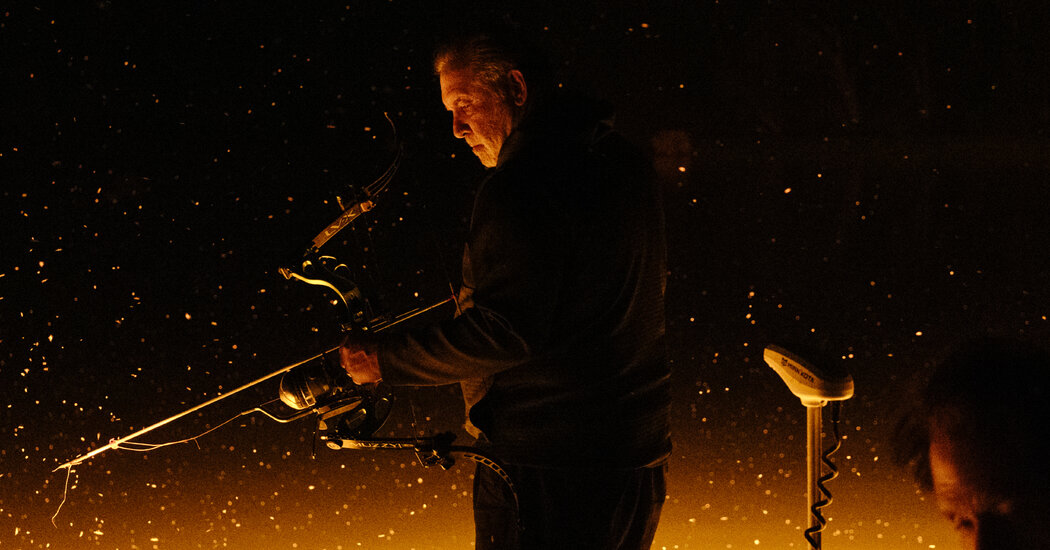
Bill Bates piloted his boat up and down the shallow tributaries of the Potomac River. It was night, and the river was buzzing. A beaver sliced across the murky water. Frogs croaked. Insects darted above the water’s surface.
But Mr. Bates was focused on his prey: an invasive fish that can survive out of water and slither on land. The Northern snakehead, whose sharp teeth, eyes atop a flattened snout and patterned scales give it the look of a python, has appeared in a growing number of waterways, edging out native fish and causing chaos in local fisheries.
To try to control the population, the state of Maryland is encouraging fishermen like Mr. Bates to rid the waters of large snakeheads by fishing with high-powered compound bows and arrows that prove more effective than a rod and reel.
“Nine o’clock, nine o’clock,” Bates yelled at his five clients nervously gripping high-powered bows, which use a pulley system rather than traditional flexible tips, on the front deck. “Snake, snake!”
Four arrows zipped into the water. None hit. So Mr. Bates, the captain, grabbed a bow himself and fired, pulling up wriggling 35-inch, 12-pound snakehead. Loriann Bowman Bates, his wife and co-captain, grabbed the fish, yanked out the arrow and plopped it into a cooler.
A native of the Yangtze River Basin in China, the snakehead was most likely introduced to the United States by hobbyists who released them from aquariums when they got too big. Since the fish was first spotted in a Maryland pond in 2002, it has inspired no less than three films, “Snakehead Terror,” “Frankenfish,” and “Swarm of the Snakehead.” It has proliferated throughout the Chesapeake Bay and reached waterways in Pennsylvania, Delaware, New Jersey, New York, Florida, Arkansas and Missouri.
Warmer water temperatures and increasing periods of intense rainfall, both signs of climate change, are helping the species expand its range as the fish follow rain-swollen creeks upstream to new habitat, experts said.
Snakeheads have also figured out how to swim around locks and dams on the Potomac and Susquehanna rivers. And they have a primitive lung that allows them to breathe for up to four days out of water, wriggling across land like reptiles. Adult snakeheads can eat turtles, birds and small mammals.
“They are a crafty critter,” said Joseph Love, a fisheries biologist at the Maryland Department of Natural Resources. “They’re very good at moving through shallow water, they can move across land or can cross the road in some cases.”
Snakeheads, which can reach three feet in length and nearly 20 pounds, are taking advantage of shorter winters and a longer spawning season in which females can lay up to 50,000 eggs twice a year. Snakeheads are good parents; both males and females protect their eggs and young after hatching.
Fisheries managers have all but given up on eradicating the snakehead from the Mid-Atlantic region, but they now say bow fishing may be the most effective way to slow their expansion.
In a recent peer-reviewed study, Dr. Love wrote that bow fishing was more effective than hook-and-line fishing to reduce snakeheads in the Chesapeake Bay, where they have displaced native species like white perch and shad.
The study, published in Integrated and Comparative Biology, also found that bow fishing was particularly successful in removing large pregnant females, an important factor in slowing the population.
The authors estimated that bow fishing was helping to push overall snakehead mortality toward 25 percent, an amount that could start to reverse the animal’s staggering population growth in the Chesapeake Bay and Potomac River.
Federal officials have been removing snakeheads from the Chesapeake Bay watershed with electro-fishing, a method that uses a specially-designed boat that introduces a small electrical charge into the water, stunning the fish, which are then netted and scooped up. Snakeheads are kept and killed while other species like bass are released unharmed.
Federal agents removed 1,200 snakeheads from the watershed between 2023 and 2025 using electro-fishing, but the program has been reduced this year because of federal staffing cuts, according to Jason Hanlon, a fisheries technician at U.S. Fish and Wildlife Service.
To get more fishermen involved, agents have also been attaching small plastic tags to some snakeheads since 2022. Blue tags are worth $200 and yellow ones are worth $10, and fishermen have to call a number on the tag and report that they have killed the fish. Since the state began the reward program, it has distributed $17,000, money that comes to Maryland from the federal government.
Despite the efforts to enlist bow fishermen to control the snakehead population, not all are good sports.
Some have killed species like largemouth bass, which are not supposed to be taken with arrows, leaving bloody carcasses on boat launches. Waterfront residents and campers have complained about the nighttime noise and lights of bow fishing trips, according to Dr. Love.
Mr. Bates, who participated in the fisheries study, agreed that some of his fellow bow fishermen have caused trouble. He said he carries plastic garbage bags in his truck to pick up trash and dead fish left by others.
“We give ourselves a black eye sometimes the way we treat other people and the way we carry ourselves,” Mr. Bates said. “Some of us are professional, some of us are the rudest people ever.”
Mr. Bates and his wife lead charter trips several nights a week from May to November that last until early morning. By the end of this night, Ken Mudrick, a Baltimore resident, had caught a snakehead as well as a carp, a blue catfish and a longnose gar.
It was his first time using a bow to catch fish and he noted that it wasn’t the same as a quiet evening of fishing while paddling down the river.
“It’s not as peaceful of an experience,” Mr. Mudrick said. “It’s lot more efficient killing method, but it’s also maybe not quite as sporting.”
Unlike shooting an arrow toward a target on land, Mr. Mudrick quickly learned to aim several inches below the fish to account for the visual distortion of the water’s surface. That eyeballing of the target wasn’t so easy.
“I still would do it again,” he said about the six-hour river trip.
Ms. Bates said that some people think of bow fishing as cheating because it’s as easy as, well, shooting fish in a barrel. But scanning the water’s surface for hours, seeing a fish and hitting the target takes patience and skill, she said.
“It’s definitely a lot more like hunting than fishing,” she said as she packed up the gear as the boat returned to the dock at 3 a.m. The haul for the night was four snakeheads, a modest catch for the first outing of the season. The couple’s record is 57 fish in one night.
To encourage a market for snakeheads, Maryland legislators passed a law in 2024 officially changing its name from northern snakehead to “Chesapeake Channa,” a nod to its scientific name Channa argus. After a year, however, local restaurants said they either had dropped the new name or were using both.
“Our customers ask for it by name,” said Hilarey Leonard, owner of Leo, an Annapolis farm-to-table restaurant that serves snakehead and grits with a smoky tomato broth.
Ms. Bates and her husband keep all the fish they catch, turning some into a meal with a dense white texture.
“It’s a really delicious fish,” Ms. Bates said about the snakehead. “I just sauté it with butter and herbs.”

