
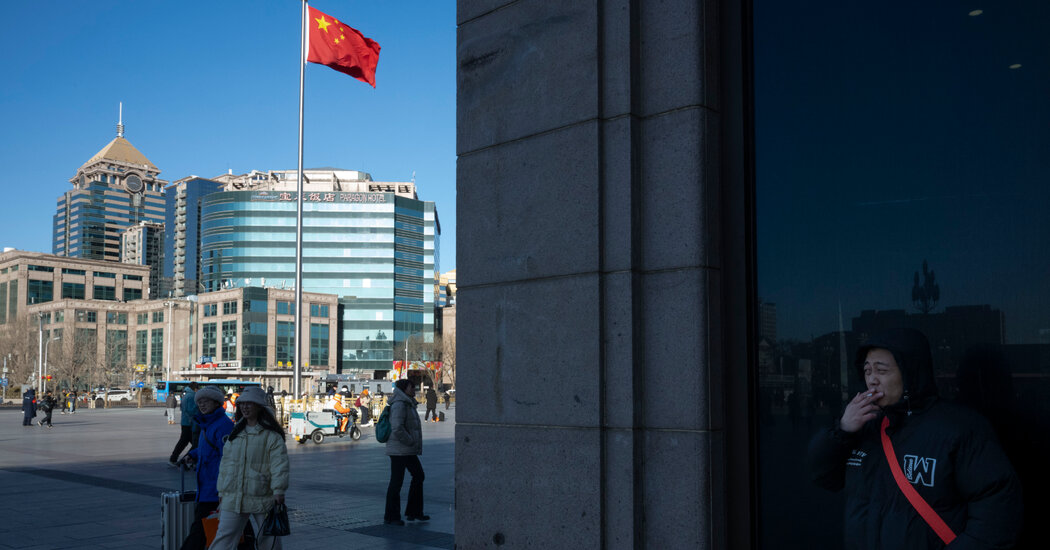
On a warm spring day in 2012, Xi Jinping, then China’s vice president, met with Bill Gates in Beijing. As the men were walking out of the meeting room, the conversation turned to smoking in a country that consumes nearly half the world’s cigarettes.
Mr. Xi, a former smoker, said he felt much better after quitting years earlier and described tobacco use as a serious problem for China, recalled Dr. Ray Yip, then head of the Gates Foundation in China. Mr. Xi, who would become president the next year, promised to “do something about tobacco,” Dr. Yip said.
Days later, Mr. Gates appeared at an antismoking event with Peng Liyuan, the Chinese leader’s wife and a celebrity singer. Both wore red shirts emblazoned with an antismoking slogan.
Yet in the 14 years since, as Mr. Xi has become China’s most dominant leader in decades, Beijing has made only slow progress curbing tobacco use or enacting a national indoor smoking ban. While cigarette sales have fallen across much of the world, China has moved in the opposite direction.
Cigarette consumption in China rose 39 percent from 2003 to 2023, even as it fell 26 percent in the rest of the world. The 2.4 trillion cigarettes sold in China each year account for nearly half the global total, according to a report by a nongovernmental organization founded by former officials from the Chinese Center for Disease Control and Prevention.
The percentage of smokers has declined over the last 13 years, as fewer young people smoke, but cigarette sales have steadily grown. Cigarettes prices are low: A pack costs about $3 on average, roughly one-third the price in the United States.
The failure to slow cigarette sales is a measure of the clout wielded by China’s State Tobacco Monopoly Administration, which both regulates the industry and operates the country’s dominant cigarette maker, the China National Tobacco Corporation.
The company generated roughly $244 billion in profit and tax revenue in 2025, about 7 percent of national government revenue and nearly what China says it spends on defense.
With economic growth slowing and a prolonged property slump eroding local governments’ land-sale income, tobacco revenue has become even more essential. The agency has also channeled its profits to support several of Mr. Xi’s strategic priorities.
Last year, it injected more than $1 billion into one of China’s biggest banks to shore up the financial system. It has also been a major backer of a $100 billion national semiconductor investment fund.
The financial weight has translated into political influence. The agency’s chief administrator holds a rank equivalent to a deputy government minister. Seven former top administrators have been arrested on corruption charges in the past seven years.
In 2022, the agency expanded its authority to cover vapes, imposing far stricter rules, including limits on where they can be sold and bans on flavored products. Unlike in other countries, vaping has not eroded cigarette demand in China. Beijing ratified the World Health Organization tobacco-control treaty in 2005 but has never implemented its strictest provisions.
The administration’s clearest victory came around 2017 when it blocked a yearslong push for a national indoor smoking ban, shifting responsibility to local governments, where enforcement is often weak.
Today, many local smoking regulations are largely toothless and offer scant protection from secondhand smoke, particularly in less developed parts of the country. While cigarette packs in the United States and other Western countries carry impossible-to-ignore health warnings, packaging in China bears a single-line caution alongside images of national symbols like pandas and the Gate of Heavenly Peace.
A 2022 study published by the Chinese C.D.C. concluded that the country’s inability to rein in smoking was the result of interference by the state monopoly and the government’s “ambiguous attitudes” toward tobacco.
The influence of local branches of the State Tobacco Monopoly Administration deepened after the Covid-19 pandemic, when many governments were left financially strained by the cost of mass testing. Their lobbying is especially effective because cigarette production and consumption taxes are instrumental to local budgets.
A study by Zheng Rong, a professor at the University of International Business and Economics in Beijing, found that roughly half the revenue from each cigarette sold by Chinese manufacturers flowed into government coffers.
The dependence is acute in China’s largest tobacco-producing regions. In Kunming, the capital of Yunnan Province in southwestern China, tobacco taxes accounted for more than half the city budget in 2024. In Changde, a city in Hunan Province in central China, tobacco taxes accounted for 20 percent of its tax revenue in 2022.
Local tobacco bureaus fight to water down even modest antismoking initiatives.
In Xinyu, a city in Jiangxi Province, the local health commission proposed designating certain public areas as “smoke-free,” according to official documents posted online.
The proposal already excluded restaurants and bars, falling short of World Health Organization recommendations that all indoor public spaces be nonsmoking. But the local tobacco bureau suggested narrowing the definition of smoke-free schools to apply only to elementary and middle schools. After a public uproar, the bureau’s efforts were unsuccessful.
As government efforts have stalled, young people, especially women, have started organizing their own campaigns.
Alva Zhang, a 23-year-old influencer, created a social media account and WeChat groups encouraging followers to confront smokers in public venues and file complaints with authorities.
“Because there are only some regulations with barely any penalty, I and many others have experienced anger and helplessness,” Ms. Zhang said.
Public support appeared to be growing. A female comedian gained national attention and praise from health agencies after performing a routine that mocked inconsiderate smokers. Hundreds have shared their proposals for stricter smoking rules in China’s government surveys.
Early in his tenure, Mr. Xi appeared willing to challenge the tobacco industry.
After he came to power in 2013, the central government issued a directive forbidding officials to smoke during government activities or in public venues. It called on officials to show “exemplary compliance” with the rules.
Dr. Yip, the former Gates Foundation official, said the directive most likely had come directly from Mr. Xi and helped accelerate Beijing’s adoption of indoor smoking restrictions, making the capital one of the first major Chinese cities to enact such rules.
Two years later, in 2015, China raised tobacco taxes, pushing cigarette prices up more than 10 percent.
But the push for a national indoor smoking ban lost steam around the same time. It was also the last time Ms. Peng, China’s first lady, publicly championed antismoking efforts, appearing again with Mr. Gates in Seattle to assess research on helping people quit.
Dr. Yip and other experts point to one reason China’s antismoking momentum shifted. Beginning in 2015, China intensified its crackdown on foreign nongovernmental organizations, a major source of funding for antismoking campaigns.
Matthew Kohrman, a Stanford University professor who studies smoking in China, said the country’s economic slowdown had most likely driven more people toward nicotine as a “potent mood modulator,” while weak enforcement of smoking restrictions had made cigarettes easier to consume in public.
Since the pandemic, the National Health Commission has prioritized disease control over curbing tobacco use. China still officially aims to bring the smoking rate down to 20 percent by 2030 from the current 23 percent.
Wu Xiangtian, an official from the National Health Commission, acknowledged in 2024 how difficult that target would be.
“To be honest,” he said, “the pressure is immense.”

