
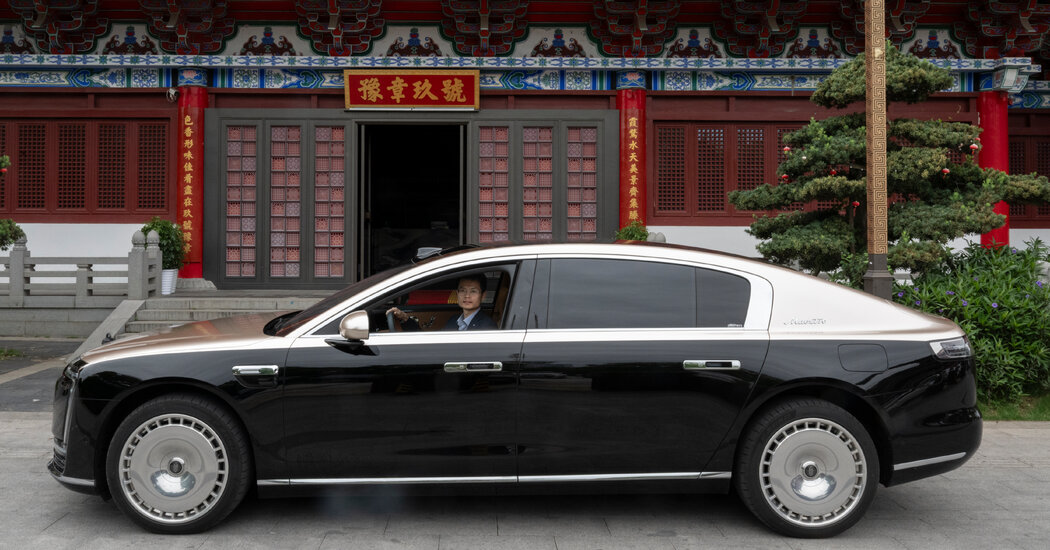
After years of driving a Mercedes-Benz and a BMW, Li Maozai made a choice that surprised even himself: He bought a Chinese luxury car.
Mr. Li, a partner at a law firm in the southern Chinese city of Nanchang, chose the Maextro S800, an 18-foot sedan built by Huawei and JAC Motors, for its sleek lines, elegant design and high-tech features that his German cars couldn’t match. At $140,000, it wasn’t cheap, but it was much less expensive than European luxury vehicles.
“This car changed our old belief that only BMW, Benz and Audi are luxury cars,” Mr. Li said in an interview.
Powered by devotees like Mr. Li, the Maextro has rapidly become China’s best-selling luxury car, outpacing Western rivals. Huawei said one out of every three luxury cars sold in China in April was a Maextro. It has come to embody the supercharged rise of Chinese brands across luxury retail — from automobiles to personal goods and hospitality — steadily squeezing out once-dominant European labels.
Even as the world’s second-largest economy contends with a property crisis and sluggish consumer spending, Chinese shoppers are flocking to Made-in-China luxury brands, drawn by more reasonable prices, cutting-edge technology and a cultural sensibility finely tuned to local tastes. The shifting sensibilities have unfolded alongside a rising nationalism and a deepening pride in the country’s economic ascent in recent decades.
Building on Maextro’s success, Huawei is preparing to release an even pricier model next month, starting at $220,000. Laopu Gold, a jewelry brand that incorporates motifs from the Forbidden City and imperial craftsmanship in its designs, tripled its revenue last year. And domestic leather handbag labels like Songmont and Truuzen are carving out a foothold as accessible luxury options.
As Chinese consumers have turned toward homegrown brands, century-old international luxury powerhouses have struggled. Richemont, the parent company of Cartier and Van Cleef & Arpels, reported a 23 percent sales decline in China last year. Porsche said it would close nearly half of its dealerships in the country by the end of the year.
“For decades, Western luxury brands had held the narrative power in the high-end consumer market,” said David He, a managing partner at BA Capital, a venture capital firm that invests in retail brands. “Today, Chinese consumers are no longer looking up to Western culture, but are beginning to look back at ourselves.”
Mr. Li, the Maextro owner, feels little nostalgia for the German luxury cars he used to drive.
He waxed poetic about the features of his new car that his old cars never offered: doors that open and close with a wave of his hand, a storage cabinet that warms his tea and his favorite feature of all, Huawei’s self-driving system that pilots itself on highway trips.
There is so much excitement about the brand that Mr. Li organized activities for the Maextro owners’ association in his home province, Jiangxi, alongside fellow business owners and professionals.
Laopu Gold, the jewelry company founded in 2009, has also quickly established itself as a force to be taken seriously in the luxury space. By reviving heritage gold techniques that emphasize traditional craftsmanship with prices ranging from $3,000 to millions of dollars, Laopu generates roughly twice the per-store revenue of Cartier, according to an HSBC research report.
Mr. He, the venture capitalist who invested in Laopu Gold in 2023, said the company’s ascent, driven in part by the surge in gold prices, had been propelled by a younger generation willing to pay for fine traditional craftsmanship and to “wear jewelry with symbols of Eastern aesthetics.”
One popular gold pendant, for example, is made from delicate gold fibers in the shape of a bottle gourd — a symbol of good luck in Chinese culture.
Perhaps the clearest sign that Laopu has arrived as a genuine challenger came from a competitor. Bernard Arnault, the chief executive of LVMH, the world’s largest luxury group, visited the storefronts of both Laopu Gold and Songmont, the handbag brand, in Shanghai last year.
Mr. Arnault’s visit to Songmont was all the more striking given how the brand has marketed itself as an affordable luxury label, offering minimalist premium leather bags priced around $500. During last year’s Double Eleven shopping festival, which is like China’s equivalent of Black Friday, Songmont overtook Coach as the top-selling handbag brand on Tmall, the premium-tier channel of China’s biggest shopping platform, Taobao. Truuzen, another homegrown label, claimed the No. 3 spot.
“We used to be puppets in the marketing of Western brands,” Cheng Baohua, the founder of Truuzen, said. He said the company’s sales doubled in 2025, but he thinks it is about more than value-minded shoppers in a cooling economy. “Over the years, more educated consumers have undergone an ideological awakening,” he said.
Mr. Cheng said he believed customers were drawn not only to the product’s quality but to the down-to-earth ethos the brand has promoted. Last year, rather than promoting exclusivity, Truuzen released a podcast and a documentary that spotlighted the lives of female workers in leather factories and celebrated the resilience of ordinary women.
Linda Xie, a public relations specialist, said in an interview that she considered her Truuzen bag higher quality than her Furla and Coach handbags, which she said had discolored over time, and that she carried it to work every day. Another Truuzen bag owner said the leather rivaled that of her Hermès bag.
A cultural pivot is also reshaping the hotel sector.
Rather than coveting stays at global chains with their one-size-fits-all service, 78 percent of high-net-worth Chinese individuals now prefer “unique cultural experiences” during hotel stays, according to a 2024 report by the Hurun Research Institute.
One trendy escape for China’s wealthiest urban dwellers is Songtsam, a hotel chain founded in 2001 by a Tibetan documentary director. Its name means “paradise” in Tibetan, and the chain has 20 properties scattered across the tranquil Tibetan Plateau, pairing stunning views with personalized cultural tours that can run upward of $10,000 per person.
Frances Li, a marketing professional who has stayed at Songtsam properties three times, said these tours were a treat for her. Though the hotel’s facilities may be less lavish or uniform than those of international chains, the warm, detail-oriented service from local staff reaches a luxury standard of its own. “At the end of the trip, I felt healed,” Ms. Li said.
Florence Li, Songtsam’s vice president of international sales and marketing (and no relation to Frances Li), said the company’s revenue rose 50 percent in 2025, propelled by surging demand for its tours. Domestic Chinese guests, who made up only a small fraction of the clientele in its early years, now constitute the majority, she added.
Ms. Li, who is also the hotel founder’s daughter, said its success reflected a broader shift among Chinese travelers, who were not only growing more confident in local brands but going out of their way to support them.
“It’s not only happening in the hotel industry,” Ms. Li said. “Even for myself, I’m also very interested in looking into domestic handbags.”

