
“The human face is the great subject of the cinema.” That’s Ingmar Bergman, in a widely cited quote. If he’s right, then what could possibly be the thinking behind the Mandalorian, a franchise-carrying hero permanently covered by a helmet?
I’m aware that opening a “Star Wars” spinoff review with a Bergman line may come off as sniffy. It would be cruel to judge “Star Wars: The Mandalorian and Grogu” — directed by Jon Favreau as a continuation of the story he built over three seasons of television — alongside works by the Swedish master. Blockbusters are, in many ways, a step removed from cinema, their universes so stacked with rules and narrative intricacy that they fall into a category all their own, in a galaxy far, far away from “Persona.”
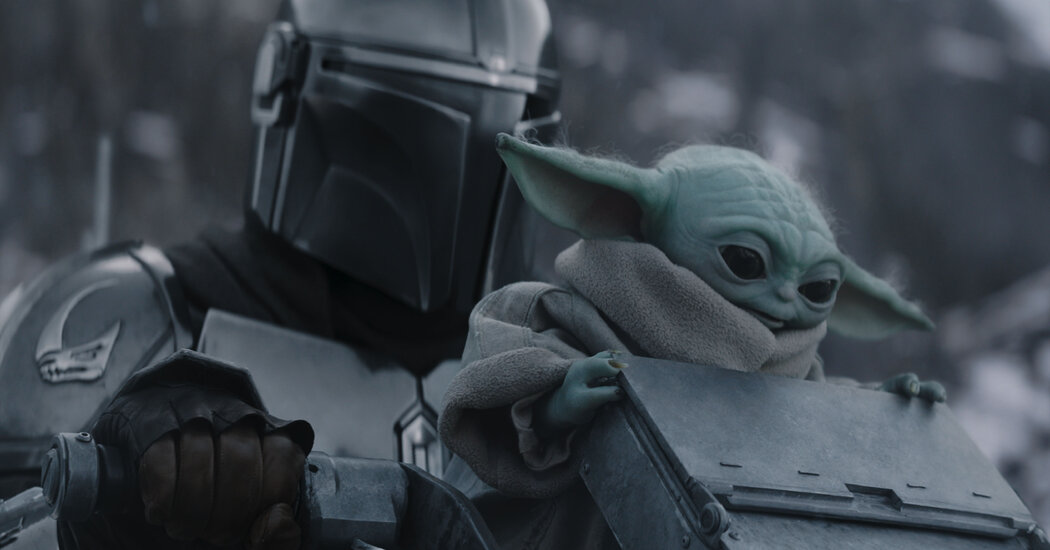
In this movie’s pocket of that galaxy, the Mandalorian is an armored bounty hunter who has taken to accepting one-off contract jobs for the New Republic — better known, from the franchise’s dualistic viewpoint, as the good guys. His given name is technically Din Djarin, but he mostly goes by Mando, and he is played with breakneck speed, vigorous brawn and flinty stoicism by the ever likable, and ever shrouded, Pedro Pascal. To remove Mando’s helmet is akin to an assault, a violation of his people’s sacred oath, and so, like a medical device or a lanyard at Comic-Con, the helmet stays on.
That’s bad news for viewers like me, who consider staring at a metal visor for over two hours a violation of our own sacred oath. Fortunately, there’s a second lead whose blinky eyes and perky ears are wholly visible: that precious, eucalyptus-colored protégé called Grogu by the lore and Baby Yoda by the fans. He is still here, and still cute, his creased face and waddling, animatronic frame offsetting the pixel polish found elsewhere in the frame.
The duo’s story kicks into gear once Mando accepts a mission from the New Republic’s Colonel Ward (Sigourney Weaver, on autopilot) to track down an elusive Imperial holdout. Because the bad guy’s identity is a mystery, Mando has to go through the devilish, delinquent Hutt Twins, those slimy, molluscoid brutes whose sibling alliance verges on incestuous. In exchange for the intelligence, Mando must rescue their kidnapped nephew, Rotta (voiced by Jeremy Allen White), a sinewy maverick who’s been coerced into competing in gladiatorial games on a distant planet.
As tangled “Star Wars” plots go, it’s a pretty straightforward affair, cleaving almost equally into discrete halves that could very well have been two episodes on a streamer. Like much of “The Mandalorian” series — not to mention nearly every big-screen action flick these days — the movie is more or less a chain of fight scenes: Mando versus transgressors; Mando versus a “Monsters, Inc.”-worth of ferocious beasts; Mando versus a spate of nameless henchmen. “I try to avoid violence,” the ordinarily taciturn hero deadpans at one point in a line meant to elicit chuckles.
The dialogue is almost uniformly mind-numbing, stuffed with filler like “good luck, you’re going to need it” and “we don’t have much time.” (The screenplay is by Favreau, Dave Filoni and Noah Kloor.) The movie’s best interlude eschews talking to instead trail Grogu on a miniature solo adventure. It has to do with Grogu’s enduring devotion to Mando, his long-established father figure, and the segment is unexpectedly touching.
The moment ends with a message about the covenant between generations, the responsibility of the parent to the child, and vice versa. It doesn’t totally land, mainly because Mando and Grogu only sometimes read as a mutually caretaking lone wolf and cub. More often, they suggest a buddy comedy, a trope brought to the “Star Wars” market long ago by the original outlaw and housebroken sidekick, Han Solo and Chewie. In a cloying touch, this installment doubles down on its claims to cuteness by tossing in extra creature companions: a foursome of Anzellans, those wiry gremlin gadgeteers who dismayingly make the case that what we’re watching is merely “Minions” to the third trilogy’s “Despicable Me.”
“Star Wars” is often seen as the prototype for today’s franchise hegemony, a model for Marvel and Minions and everything else. But uneasily attending “The Mandalorian and Grogu” is an extratextual suspicion: Amid a dizzying deluge of series and animated sidebars, has Disney diluted its biggest brand? As its return to the IMAX — I mean, silver — screen, the saga could do worse than this movie. With their main guy’s face behind metal, that’s a more than respectable showing.
Star Wars: The Mandalorian and Grogu
Rated PG-13 for the usual battles and bloodshed. Running time: 2 hours 12 minutes. In theaters.

