
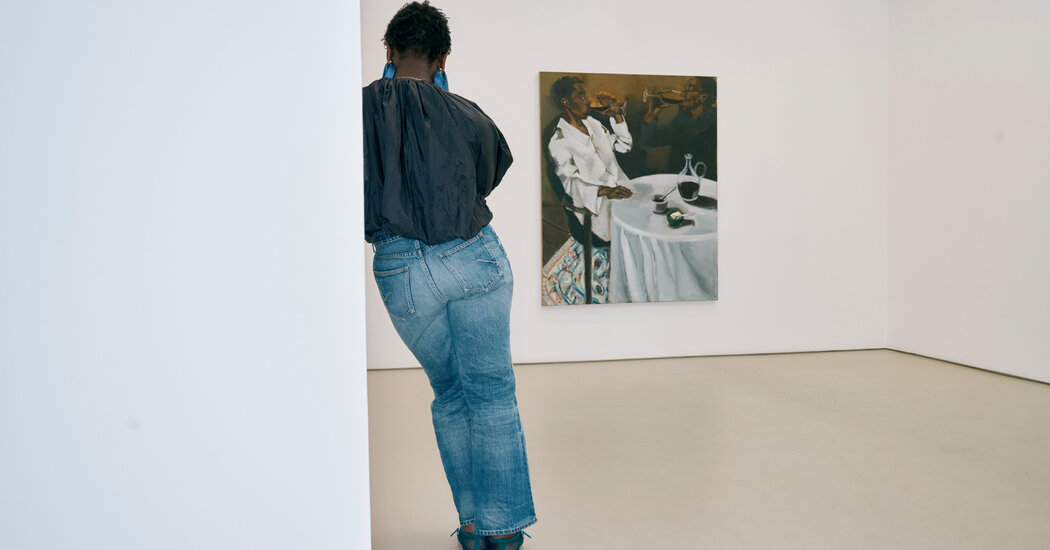
Four women with blue-tinted hair, seen from the back, chat while mostly ignoring a gold-framed landscape painting on the wall. A man carves an oddly animate roast pig at a dining table, with rows of dried fish hanging in the background. Two women sit, unspeaking, at a table out of a Manet still life, strewed with oranges and dishes. Men, rendered life size in charcoal, stand straight-backed and silent dressed in Ghanaian mourning robes.
These are some of the characters to be found in “Many a Moonlight Caveat,” an enigmatic and at times delightfully unruly exhibition of 46 new works by the British-Ghanaian painter Lynette Yiadom-Boakye. They hover between representation and something more conceptual, demonstrating what one observer, the painter Jennifer Packer, described to me as “the experience of painting as an alchemical process.”
On view at both locations of the Jack Shainman Gallery, it is Yiadom-Boakye’s first major showing in New York since 2019, after solo exhibitions at the Tate Britain in 2021-22 and the Guggenheim Museum Bilbao in 2023. It includes paintings, for which she is best known — figures captured in mid-action or mid-thought, alone and in groups — as well as, surprisingly, a large number of charcoal and sanguine drawings.
Who are these people? Though they may seem at first glance to be portraits, the images are not drawn from life. The painter conjures them, aided by a scrapbook of family and found photographs, snapshots she takes herself, postcards of famous paintings, and magazine clippings. Andrea Schlieker, former director of exhibitions at the Tate, has described Yiadom-Boakye’s method of envisioning her subjects “like a writer builds a character in a novel.”
As the artist said in an interview Shainman’s Lower Manhattan gallery, “It allows me to build a language that lets the paint to do the talking. My method is low-tech, a bit chaotic and impractical, but it feels right for me,” The artist is a warm presence, quick to laugh, and speaks about her work with a thoughtful precision.
Yiadom-Boakye’s approach lends her work a theatrical quality, especially in drawings like one of a male dancer caught mid-performance, his hands and feet rendered with such specificity that it’s hard to imagine he wasn’t drawn from life. He is called “Red-Capped Manakin,” the name of a bird; the avian reference is echoed in the feathered ruff around his neck. In the four-part work “Keep Me Coming, Stop You Going,” four nearly identical figures emerge through red velvet curtains, as if on a stage.
Instead of an artist’s statement there is a poem by Yiadom-Boakye. (The painter is also a poet and short-story writer; “I write about the things I can’t paint and paint the things I can’t write about,” she often says.) Here again we have birds — barn owl, night jar, corncrake, woodcock — who explain, in turn, that succumbing to the lures of the world and its temptations, or seeing oneself through its eyes, is to be consumed by it.
“The Nightingale Knows That To Be Unseen,/Is Ofttimes to Be Truly Free,” Yiadom-Boakye writes.
Remaining unseen has become increasingly difficult — yet increasingly important — for the artist. She came to prominence in the United States after a 2010-11 solo exhibition at the Studio Museum in Harlem. Her works have been collected by institutions including the Museum of Modern Art and the Tate. “Shoot the Desperate, Hug the Needy” (2010), highlighting two jubilant women in white, sold this week at Christie’s for $825,000, while her record was set in 2023 — $3.6 million for a 2015 painting, “Six Birds in the Bush,” at Sotheby’s London, a portrait of a fictional man gazing at the viewer in a setting that is timeless and ambiguous. As her fame has increased, she rarely does interviews and avoids having her photograph appear in articles alongside her work.
“It’s not an affectation,” she said. “It’s just that it’s so much more freeing. You want to feel that endless possibility without having to worry about putting into words what’s meant to be communicated by painting.”
Yiadom-Boakye’s compositions don’t court specific narratives. You get the feeling, for example, that the shirtless man in “The Diligent Crest of Midday” standing in front of a mirror, being photographed by a barefoot man seen in reflection, was composed primarily because of the opportunity to paint variations on the blue and white checkered floor tiles — a signature motif in her work, and a nod to Vermeer’s interiors. But the hands of the clock in the background point to 12, a hint at a potential symbolic reading too.
The men in “The Unbending Amaranthine” talk to each other, except for a white-haired character who gazes out of the picture inscrutably. Each one’s hands are held in a distinct fashion, recalling the care August Rodin took in his sculptural group “The Burghers of Calais.” Their feet dissolve into a lush flurry of brushstrokes, melding with the grass on which they stand, and the picture is painted on a herringbone-woven canvas, whose toothy texture never allows the paint to settle into a crisp outline. The recumbent male figures in “Three Yesses Closer to a No,” rendered in a red-brown iron-oxide chalk favored by the old masters, seem relaxed and alert at once.
“Whenever I look at Lynette’s work, there’s action happening,” said the artist Toyin Ojih Odutola, who specializes in intricate drawings of Black figures. “People are doing things. They’re not just being seen. They’re not just being consumed. They’re in their own worlds. They’re creating things. But whatever they’re doing, none of it is for us. It’s for themselves.”
Jennifer Packer, a painter who also focuses on figuration, sees Yiadom-Boakye as offering “an uncommodified Blackness, like an illegible Blackness,” she said. “Figures where Blackness is central to their lives, but isn’t the only way for them to be read.”
Odutola relates profoundly to Yiadom-Boakye’s hesitance about explaining her work, she said. “I think people are always going to misinterpret what we do, and they’re always going to project on us,” Odutola said. “Being unseen does not mean that you are unaccounted for. It just means that you’re free to roam.”
That freedom includes revisiting her older compositions. “My obsessions can be all consuming at times,” she said. Referring to a series of paintings — “Aux Myrtilles,” “Aux Framboises,” and “Aux Citrons” — she explained that she became fixated on the tart wedges the male figures were eating. “I began forming those wedges into broader compositions each time, shifting the size and shape. I did about five versions in total — the pie just kept moving around,” she said.
Eungie Joo, a curator and early champion of the artist’s work, said Yiadom-Boakye “often returns to the scene of the crime. She’ll return to a composition and do something slightly different in how they’re situated on the picture plane, how they relate to a background, how they relate to their clothing, or the color of their clothing, or the color of their clothing in relation to the color of the ground.”
“She’s deep in the formal aspects of making paintings,” Joo said.
Yiadom-Boakye seems to revel in the unruliness of her medium. She spoke of the challenges involved in making large drawings in her large studio and the particularities of her chosen medium, oil paint. “I’ve always loved the fact that oil is alive, it’s natural, it’s seeping, it’s rotting,” she said. “It’s of nature. It breathes differently than anything else, it moves differently, it ages differently.”
“It’s my poison,” she said. “Literally.”
Lynette Yiadom-Boakye: Many A Moonlit Caveat
Through July 31, Jack Shainman Gallery, 46 Lafayette Street and 513 West 20th Street, Manhattan; 212-645-1701, jackshainman.com.

