
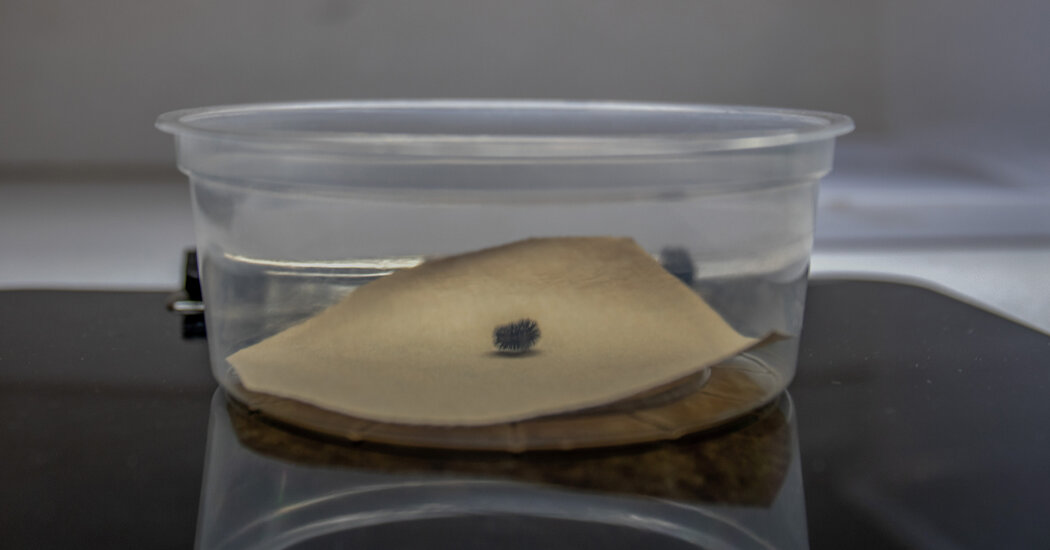
The last known caterpillar of its kind has died.
The insect, the critically endangered Sacramento Mountains checkerspot, was in human care at the ABQ BioPark in Albuquerque. Scientists hoped, against all odds, that it would transform into a butterfly and they would find it a wild mate, creating another generation.
A subspecies of the broader anicia checkerspot butterfly, the insect is found only in the Sacramento Mountains of New Mexico. A few decades ago, the showy butterflies could easily be seen.
But global warming, changes to wildfire, excessive grazing, invasive plants and recreation activities led to its decline, according to the U.S. Fish and Wildlife Service’s interpretation of the best available data. The insect has not been seen in the wild since 2022, but it may still exist.
While some amount of species extinction is natural, humans have sharply increased the rate by drastically altering the planet.
Short of extinction, many wildlife populations are showing alarming declines, affecting the role they play in ecosystems. In just the last 20 years, the United States has lost 22 percent of its butterflies, according to a groundbreaking study last year.
By August, the lone caterpillar in captivity was struggling. It had already lived three years without transforming into a butterfly, longer than the team caring for it had thought possible. It had stopped eating.
The caterpillar’s caregivers induced hibernation, hoping the insect would wake renewed in the spring.
The first few months were promising. Its hibernating body was coiled tight, just as it should be. But by April, when it was time to start warming the caterpillar back up, the coil had loosened. Its body seemed a little deflated.
It’s hard to tell the difference between a hibernating caterpillar and a dead one. Waking up takes time. So the researchers acted as if it were alive. They brought it up to temperature and examined it carefully. They offered it crushed leaves. They gently brushed its bristles. As hope drained, they gave it a couple of extra days, just to be sure.
On May 5, they declared it dead.
“It wasn’t a surprise,” said Quin Baine, the invertebrate species survival specialist at the New Mexico BioPark Society and a scientist in charge of its care. “It was just unfortunate.”
The caterpillar, which was never given a name, was born at the BioPark in 2022 after researchers captured four wild butterflies that year. Of more than 160 caterpillars produced by the those butterflies, it was the last survivor.
Researchers will look for the insect in the wild again this year. Across the region, Dr. Baine said, butterflies are emerging earlier, and so the team has moved its search up by two weeks.
Caterpillars’ diets are often restricted to a limited number of plants that they have evolved to eat. Sacramento Mountains checkerspot caterpillars are known to eat only New Mexico beardtongue, a plant with purple flowers.
Scientists have long worried that climate change would lead to perilous mismatches in ecosystems, causing animals to wake or migrate at times when the plants they rely on are not available. Species at high elevations, like the Sacramento Mountains checkerspot, are especially at risk because they often can’t flee to cooler habitats.
“It’s called the elevator to extinction,” Dr. Baine said. “Moving up and up and up the slope until there’s nowhere else to go.”
Dr. Baine was so prepared for the caterpillar’s death, she said, that she doesn’t feel terribly sad. Instead, she’s frustrated that interventions didn’t happen sooner.
The Center for Biological Diversity, a nonprofit that works to protect endangered species, first petitioned in 1999 for the insect to be protected under the Endangered Species Act. More than 20 years elapsed before it was classified in 2023 as endangered in.
“This checkerspot’s legacy is that it’s a canary in the coal mine,” Dr. Baine said, emphasizing that increased monitoring is essential. “This is likely happening to many other species at the same time and we just haven’t detected it yet.”
This week, she is out in the field near Taos, looking for a sister subspecies that’s believed to have carved out its niche in the southern Rockies. Scientists know so little about these butterflies that there are questions about their species classifications. They could be more similar, or more different, than is currently known.
The caterpillar’s body will be kept in frozen preservation at the Museum of Southwestern Biology, a part of the University of New Mexico, for potential genomic research.
Next month, Dr. Baine will join the team trying to find Sacramento Mountains checkerspots in the wild. During last year’s surveys, she said she saw some healthy habitat and felt optimistic. But early heat and a nearby wildfire this year have made her nervous.
Still, she said, “I think there’s a chance.”

