
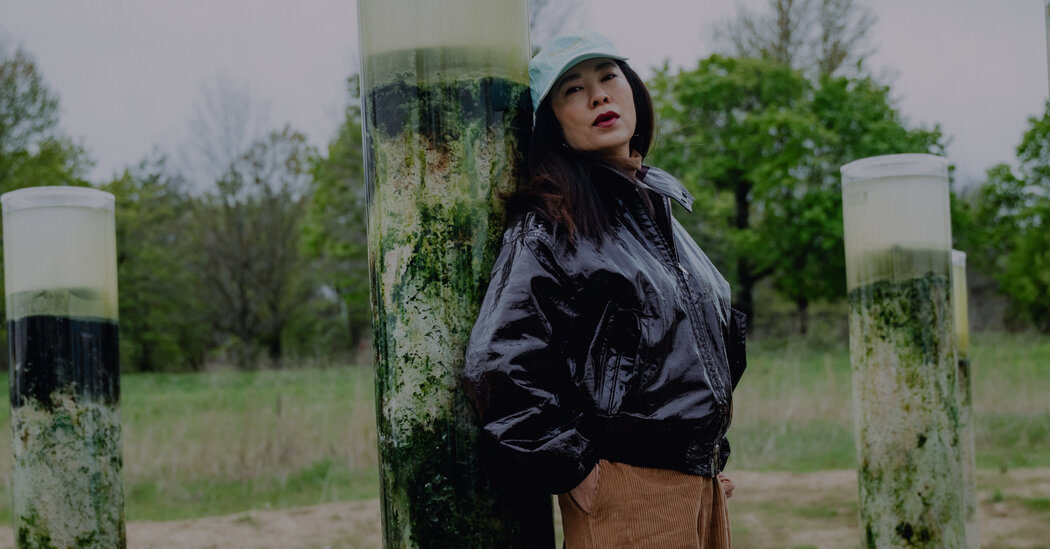
A bubble rose to the surface of a muck-filled column as the artist Anicka Yi approached. Nineteen acrylic cylinders, each six feet tall and teeming with bouquets of pond scum, caught the overcast spring light.
Their watery tops glowed Caribbean blue. Algal green organisms in their mottled tan midsections used the sun’s rays to metabolize carbon dioxide. Waste products filtered down to feed a black band of bacteria at each column’s base.
These colonies had been flourishing under UV grow lamps in a nearby shed since August 2024. On May 17, they debuted at the Storm King sculpture park in the Hudson Valley as part of “Message From the Mud,” a landscaped installation that resembles a futuristic construction site or ruin. Born in Seoul, and based in New York, Yi, 54, has had solo shows in museums from Houston to Beijing. This is her largest outdoor project to date.
The installation was underway. Yi, wearing sunglasses and a baseball cap that read, “Thinking About Not Thinking,” inspected the progress. The tubes were staggered around a kidney-shaped pit of gravel. Soon it would be filled to make a pond, an echo of the columns’ contents and a mini version of the lake across the road that provided the starter doses of bacteria, water and sediment. The artist hopes frogs and turtles will move in. From within the low berm of soil and sprayed concrete that forms the sculpture’s perimeter, enclosing the columns like an amphitheater, the traffic noise coming through the tree line was almost peaceful.
Storm King Art Center, founded in 1960, is known for its charismatic mega-sculptures, including several plate steel and I-beam constructions by the sculptor Mark di Suvero, as well as organic interventions like the rippling green “Storm King Wavefield,” by the architect and artist Maya Lin. Yi’s sculpture is a hybrid. The plastic and concrete are artificial, yet the piece is filled with life taken from the surrounding soil: Storm King’s microbiome has been extracted and put on display as abstract hues.
Yi has spent more than a decade mixing art and science. She doesn’t hold a degree in either discipline, and her work, including floating robots called aerobes and a perfume inspired by bullfrogs, tends to challenge the conventions of both: Instead of the respective stereotypes of messy self-expression and rigorous study, she offers technical art and whimsical science.
“If you talk to any scientists, they would say, all we do is traffic in uncertainty,” Yi told me during a studio visit last fall. “That’s what artists do.” In her view, too few people appreciate how much creativity science requires. At the same time, science-y artworks allow her to test artistic concepts in empirical ways.
Nora Lawrence, the director of Storm King, noted that artists have long been influenced by science and technology — especially sculptors. Looking through Storm King’s collection, it was remarkable how many postwar artists had been engineers, including George Rickey and David Von Schlegell. “Technological innovation has led to this interest in making work for the outdoors,” she said, as industrial techniques yield large-scale construction and durable materials.
Yi’s studio in Brooklyn is crowded with experiments — deep fried flowers, a jellyfish-shaped light fixture, kelp-based textiles. Standing in a corner by the computers was a prototype of the columns at Storm King; the side facing the window was bright green. “We can talk about all the theoretical things that are happening and percolating and brewing and cooking under our feet and in these columns,” Yi said. Meanwhile, irrespective of human theories, each cylinder supports an actual living system.
Yi’s new installation is essentially a setting for a classic experiment called a Winogradsky column. The simple device, developed in the 1880s by Sergei Winogradsky, a biologist from Kyiv, allows for a sustained cycle of bacterial growth as different layers of organisms feed on the byproducts of other layers. To jump-start the process, you combine a sample of pond water and sediment with various nutrients: Yi’s recipe calls for cellulose powder, calcium sulfate, calcium carbonate, sodium sulfate, ammonium chloride and potassium phosphate, as well as piles of diatomaceous earth and soil from Storm King.
With “Message From the Mud,” the microbes are the stars. “We put together this column, we dug up the soil, but there’s all this activity going on, this energy that’s being generated from the soil and the bacteria and the algae and all these other microorganisms,” Yi said. “We’re not really invited to the party. We’re just lurking.”
Much of Yi’s work tries to decenter humanity. For that matter, she said, consider the biomes thriving in our guts and on our skin. “By an order of magnitude, we have more microbial genes than we do human genes. So who’s to say that we are human?” A breakthrough project from 2015, “You Can Call Me F,” involved culturing bacteria gathered from 100 women.
The coronavirus pandemic was a personal and artistic turning point for Yi. “My comfort zone got annihilated,” she said. “I really had to question my relationship to art, my relationship to this entire ecosystem of distributing and transmitting that art.” She began studying Tibetan Buddhism. That philosophy chimed with her skepticism about the centrality of human beings. Certainly, dangerous viruses and bacteria emphasize how porous and vulnerable, and interconnected, all organisms are. Yi had been approaching her work from an “intellectual, theoretical perspective,” she said. But without an embodied understanding, “these ideas are painful and empty.”
In a way, the Winogradsky columns at Storm King are the end point of Yi’s collaborations with microbes. Now, she wants to create artificial life. “I’ve been floating at this intersection between art and STEM,” Yi said. Lately, “the propulsion of the universe is forcing me to actually do something about it.”
Her first major project in this vein, unleashed into the voluminous Turbine Hall at the Tate Modern in 2021, were “aerobes”: bulbous, helium-filled drones linked to artificial-intelligence software. They bob through the air, flexing their segmented tentacles and whirring their small propellers. They seem to react to stimuli like visitors, or one another.
Two of the animated drones, with human minders watching them from the ground, ply the rafters at the New Museum as part of the sweeping exhibition “New Humans.” In April, in a public discussion at the museum with the A.I. researcher and artist Kate Crawford and Massimiliano Gioni, the museum’s artistic director, Yi outlined her desire to make machines that are even more vulnerable.
The aerobes may look autonomous, and their routines do evolve over time, but they’re only following their programming. Drawing on neuroscience and A.I. engineering, her idea is that true intelligence won’t arrive from a piece of software, but will require a machine with a body, a physical form that it needs to sustain and protect. By this measure, she said, “A bee is more intelligent than ChatGPT.”
Not all humans are as comfortable as Yi with ceding their individuality to microbes and microchips. “The irony is, where she sees this joyful coexistence with nonhuman species, I actually see a future of drones and surveillance,” Gioni said in a phone interview. To him, Yi’s quirky robot blimps “are that type of ominous technology that actually camouflages as cute and playful,” something “very much of our time.”
Gioni suggested that the tech industry tends to overwhelm artists’ attempts to intervene in the march of progress. If there’s a silver lining, he said, “Maybe what we can contribute is this sense of fragility or bricolage, and a rethinking of efficiency altogether.”
Yi knows that her gurgling Storm King experiment is rudimentary. She wants to imbue technology with ideas of transience, failure and humility. As we walked past the lake, a groundskeeper deftly blended gravel and dirt around the berm and columns with the scoop of an excavator. “It’s humorous, you know?” Yi said of her sculpture. “But the soil is telling us a lot.”
The sculpture doesn’t just showcase the living goo of the glacial valley and wildlife corridor Storm King occupies; it also emphasizes that other organisms work on different time scales. The cylinders’ colonies of bacteria wax and wane. Close up, a few clots of orange and magenta microbes pop out from the earth-toned murk. It puts human struggle, like the quest for dopamine on social media apps or the planning and execution of a major public sculpture, in perspective.
Message From the Mud
Through Nov. 9, Storm King Art Center, 20 Old Pleasant Hill Road, New Windsor, N.Y., stormking.org.

