
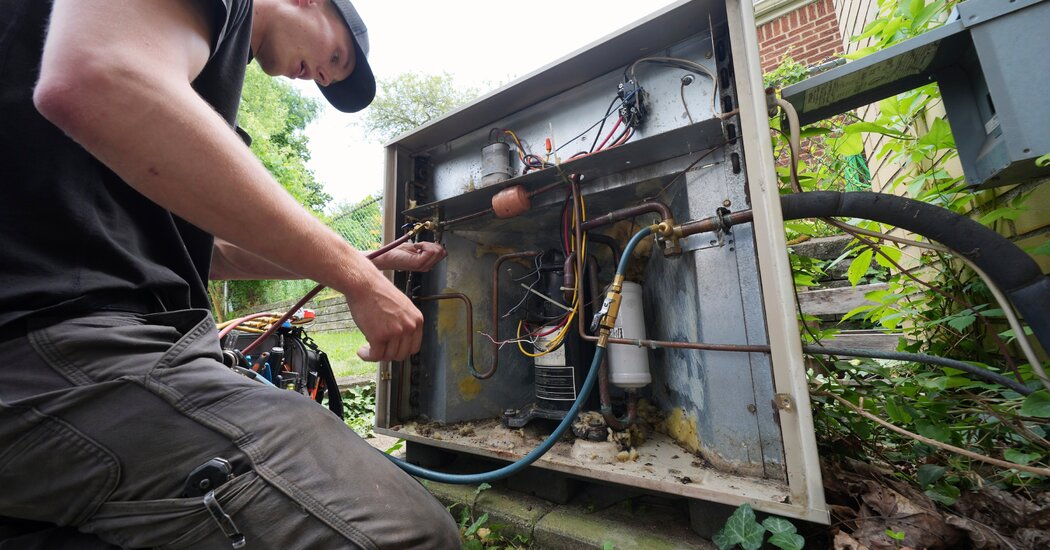
President Trump will announce Thursday that his administration is easing restrictions on the potent planet-warming chemicals used in air-conditioners and refrigerators — restrictions put in place because of a bipartisan law Mr. Trump signed during his first term in office.
The move would slow plans to phase out hydrofluorocarbons, synthetic substances sometimes referred to as “super pollutants” because of their enormous effect in driving climate change.
Lee Zeldin, the Environmental Protection Agency administrator, is expected to join Mr. Trump at the White House Thursday to announce new regulations that would relax existing requirements for grocery stores, air-conditioning companies, semiconductor plants and others to reduce production and use of the chemicals, which are known as HFCs.
“Today, the Trump E.P.A. is fulfilling President Trump’s promise to lower costs,” Mr. Zeldin said in a statement provided by the White House. “Our actions allow businesses to choose the refrigeration systems that work best for them, saving them billions of dollars. This will be felt directly by American families in lower grocery prices.”
The administration says relaxing the restrictions on HFCs would save businesses and families more than $2.4 billion. Mr. Trump faces growing political pressure to address the cost of living, especially as the war in Iran has driven up gas prices.
The regulations that are being eased stem from a 2020 law that was seen as a rare bipartisan success in tackling climate change. It was broadly supported by industry.
But the administration is blaming the Biden-era regulations for raising grocery prices as well as making it more expensive to transport refrigerated goods to grocery stores and restaurants.
HFCs are a huge contributor to human-caused global warming. While they linger in the atmosphere for a shorter time than carbon dioxide, they are hundreds to thousands of times more potent at trapping heat.
Phasing out HFCs worldwide could avert up to 0.5 degrees Celsius of global warming by the end of the century, which would go a long way toward keeping the worst consequences of climate change from becoming reality. More than 190 nations, including the United States, agreed to sharply reduce the production and use of hydrofluorocarbons.
The Biden administration aimed to cut the production and consumption of HFCs by 85 percent by 2036. Doing so would eliminate the equivalent of about three years’ worth of climate pollution from the electricity sector.
But Mr. Zeldin has said that regulation did not give companies enough time to switch to other refrigerants. He said the industry had faced shortages that left families sweltering without air conditioning in the summertime. The E.P.A. also maintained that if fully implemented, the Biden-era rule would make it impossible for grocery stores to afford equipment to store perishable foods and would cause semiconductor manufacturing to come to a halt.
The air-conditioning industry has said the Trump administration’s claims of shortages were exaggerated. “Our industry is watching this development with concern,” said Francis Dietz, vice president of public affairs at the Air-Conditioning, Heating, and Refrigeration Institute.
One rule expected to be finalized on Thursday would extend deadlines for phasing out the use of HFCs and make a wider variety of refrigerants available to businesses.
“This added flexibility will be felt by supermarkets, in home AC systems, the manufacturing of semiconductor chips, and in the transportation of medical supplies,” the E.P.A. said in a news release.
A second change would exempt the refrigerant transportation sector from a separate Biden-era rule that sought to reduce leaks of HFCs.
The U.S. Chamber of Commerce, the chemical lobby and the air conditioning, heating and refrigeration industry had all supported the original restrictions, saying less harmful chemicals were already available and that a shift toward those alternatives was already underway. It also was seen as a win for American companies like Honeywell and Chemours that produce and sell alternatives to HFCs.

