
RANCHO PALOS VERDES, Calif. — Few industries embrace buzzwords the way college athletics does, which is why — with spring sports coming to a close — the impending offseason is destined to be remembered as the moment of alleged “unsustainable” spending.
From Washington athletic director Pat Chun to Michigan State athletic director J Batt to Colorado coach Deion Sanders, “unsustainable” has become the decree of recent months. Heck, everyone from Charles Barkley to Ted Cruz to Nick Saban has dropped the U-word.
The place where unsustainable meets thriving is the Big Ten, which is hosting its spring conference meetings in Southern California this week. The ongoing paradox of college sports — high ratings and loud complaining, $5 million-plus deals for players countered by concerns about how to pay them — met with the conference’s championship realities here.
“What is unsustainable?” Maryland athletic director Jim Smith asked ESPN. “Is it three years? Five years? Ten years? Every time I hear when people say it’s unsustainable, I’m not sure what timeframe they’re talking about because clearly it keeps happening.”
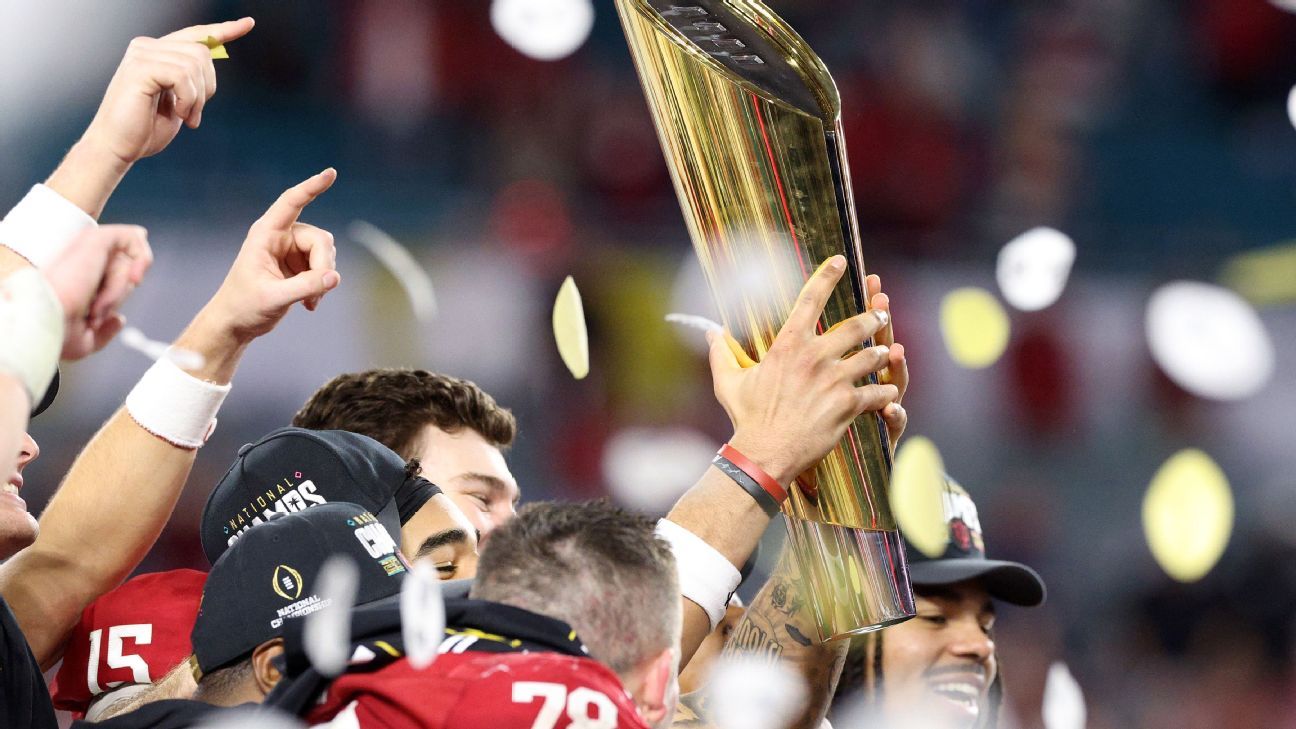
The Big Ten has the most cash flow from TV contracts, and it has also won the past three national titles in football. In April, Michigan won the league’s first men’s basketball title since 2000. UCLA won the women’s basketball title, the league’s first since 1999.
In a not-so-subtle move to show that the league’s titles, perhaps, mean more, the Big Ten displayed its football and men’s and women’s basketball trophies outside the meeting rooms. (As if the coaches and administrators didn’t remember who won).
So two existential questions hover over Big Ten leaders — and college sports as a whole — as they gather in the wake of their collection of glimmering trophies. What will slow the spending spree in college sports? And is it in the best interest of financial heavyweights in the Big Ten and SEC for spending to be capped or curbed?
“When you look at the money that’s being generated,” Michigan basketball coach Dusty May said, “how does it not eventually get to the players in some way, shape or form?”
How much has the spending spiked? Consider the Ohio State 2024 football roster that won the national title famously cost $20 million. At the time, it was branded with the zealous clutching of pearls as an outrageous amount.
Heading into 2026, that’s considered the minimum cost of doing business. Few teams in the 18-team Big Ten aren’t spending $20 million, and those not in that neighborhood are projected in the teens of the conference standings for 2026.
The new frontier for a football roster is flirting with $50 million for a single season. (Men’s basketball rosters are rocketing past $20 million.) And neither the College Sports Commission nor institutional austerity are keeping those football rosters in two years from climbing into the neighborhood of $80 million or $90 million.
“Nothing would surprise me at this point,” Iowa coach Kirk Ferentz told ESPN. “I’m not optimistic either. Based on the last three years. I don’t know how you do enforce it because the rules are so ambiguous. So that’s where the challenge is.”
He added: “One thing I miss about the NFL is a salary cap, and people having contractual obligations.”
What stops the spending? Nebraska coach Matt Rhule joked that he’s the guy with an opinion on everything — except this. “I honestly don’t know. I would say there’s not many times the NFL salary cap’s gone backwards. But I don’t know, honestly. Everything’s so in flux.”
This all comes, of course, amid an industry that for more than a century has treated rules as speed bumps, obstacles to work around rather than guidelines to follow. In college sports, fortune has never favored the rule followers.
No one is suggesting that the College Sports Commission is thriving or having much of a tangible impact. Few are worried about the constipation in the CSC system for deals, as they’ve lived a spending life of Peter Pan consequences, where punishments would come in Never Never Land. Are they really going to punish all the biggest brands spending the most? No one ever has, and probably ever will.
That’s why few are optimistic the CSC will ever work, especially when there’s no punitive repercussions for running an end around to the rules. It’s a dog-eared playbook for college sports — the cost of following the rules is much greater than the risk of circumventing them.
So what did the Big Ten coaches chat about the last 48 hours as the future? There’s no chatter of a breakaway from the NCAA, but rather simply siloing rules and making them fit the people equipped to follow them.
“Clearly there’s challenges with the CSC,” Ohio State AD Ross Bjork said. “What’s the short-term fix? But also the long-term fix? And look, and if that doesn’t work, can the Big Ten do something by ourselves? Yeah, sure. That’s not a breakaway. That’s not like, ‘Hey, we don’t care about our colleagues and our other institutions, but is there a better place where you govern within a smaller subset?’
“SEC colleagues have already said that. We’ve said it, we’ve talked about it, but what’s legislation? Yeah. What’s the short-term college sports commission? And then if that doesn’t work, what are the options?”
Asked how much bandwidth that conversation consumes, Bjork responded: “It’s 5 o’clock already? Most of the day. But again, it’s all about what are the pathways? Not necessarily, hey, we want to do this, this or this. How do we take steps to get the conversation started? How do you follow this legislative piece?”
Bjork pointed out that the salary cap in Major League Baseball rose nearly 4% this year. Spending in college sports at the highest levels is barreling ahead at nearly 10 times that.
The fair question moving forward about slowing spending is tied to a greater conversation in college sports: Does anyone want to be governed?
Are the spoils of admissions upticks and donation spikes tied to Indiana‘s football title and Michigan’s basketball title too lucrative to start pumping the brakes on spending. (Neither were in the top echelon of spending in their respective sports last season).
“That’s the challenge in our system is everybody wants to race to the top, but can you really spend to be at the top?” Bjork said. “But you can’t really say, ‘Well, that’s not our aspiration.’ So the aspiration drives a lot of the uncertainty, and that’s, again, that’s as old as time in our business.”

