
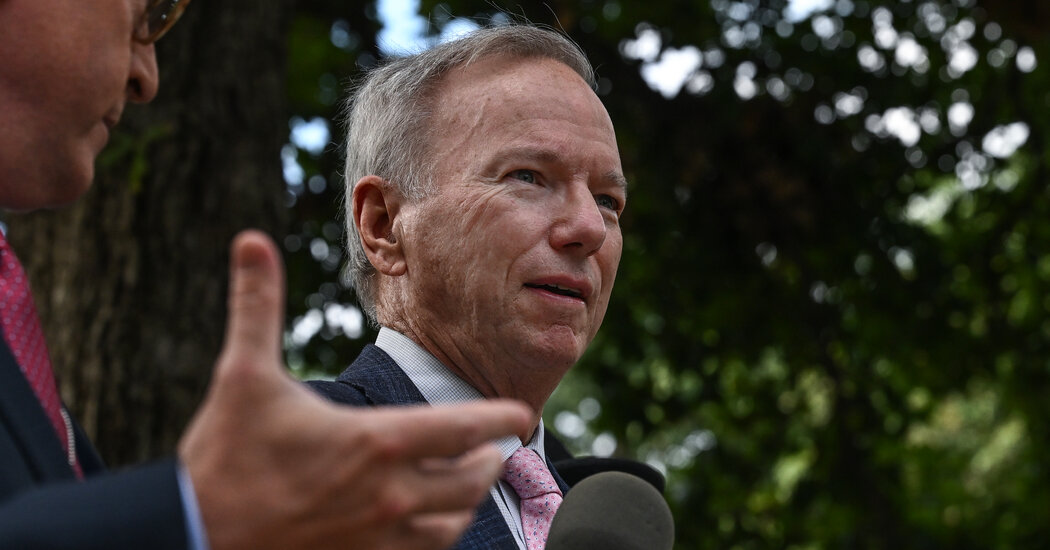
Andrew here. If you want to understand the deep fear that artificial intelligence is creating in much of the nation, look no further than the reaction to Eric Schmidt’s commencement address. The former Google C.E.O. spoke the truth about the technology, but it did not go over well with graduates who are anxious about their future. We’ve got more below.
We also take a look at a major deal that was just announced in the power utility space. And, make sure to read Robert Draper’s story about the dark arts of a reputation management firm that sought to help Goldman Sachs’s outgoing general counsel minimize her ties to the Jeffrey Epstein scandal.
And here is a talker: It appears that President Trump — or at least his investment advisers — made 3,700 individual trades in the last quarter. Let me know what you think the trading policy for White House employees, including the president, should be.
A.I. backlash on graduation day
The subject of artificial intelligence and its transformative impact on the world has come up at college graduations across the country in recent days. The response from newly minted grads? Some full-throated booing.
It’s the latest sign that even as the big hyperscalers commit to hundreds of billions in new A.I. investment, many in the next generation of corporate workers have mixed feelings about what it means for them.
Cue the boo birds: In a commencement address at the University of Central Florida this month, Gloria Caulfield, a real estate executive, called A.I. the “next industrial revolution” and was met with a loud chorus of boos. Stunned, she asked, “What happened?”
On Sunday, Eric Schmidt, the former C.E.O. of Google, was booed repeatedly when he began talking about A.I. during his commencement speech at the University of Arizona. “I know what many of you are feeling about that,” Schmidt said. “I can hear you.”
Schmidt told the grads that he understood there was “a fear” that the machines were coming and jobs were disappearing.
Scary numbers: According to new research from the employment site ZipRecruiter, some 47 percent of recent graduates say that A.I. has already affected hiring in their field, and nearly 51 percent of soon-to-be grads believe that A.I. will reduce the number of entry-level jobs.
Companies like Coinbase and PayPal have said they will reduce their workforces to adapt to A.I.
It isn’t just grads worried about jobs and A.I. At the Stanford Leadership Forum last month, the billionaire financier Ken Griffin described how A.I. agents did work at his Citadel hedge fund in days that teams of Ph.D.s needed months to do.
“These are not mid-tier white collar jobs,” Griffin said. “These are extraordinarily high-skilled jobs” that are being automated by A.I. He added that he went home one Friday “actually fairly depressed by this.”
But grads are grappling with more than employment stress. In a guest essay on Sunday in The Times’s Opinion section, Theo Baker, a senior at Stanford, examines what easy access to A.I. has done to “the first college class of the A.I. era.”
ChatGPT and other generative A.I. tools have made cheating “omnipresent,” Baker writes. And he worries about how quickly students have grown dependent on A.I.:
Emerging research has begun to show what most people feel is obvious: Relying on A.I. for cognitive tasks can reduce one’s own intellectual capacity and resilience. It’s one thing to use it in the workplace, but in the classroom, difficulty is often precisely the point.
HERE’S WHAT’S HAPPENING
SpaceX is reportedly preparing to file its I.P.O. as soon as Wednesday. That could see Elon Musk’s space company begin trading on June 12 as it aims for a valuation of more than $2 trillion, Bloomberg reported, citing unnamed sources. (Musk said on social media that he has no current plans to sell any of his SpaceX shares.)
China will spend billions more on U.S. agricultural goods. Beijing has agreed to buy $17 billion a year in products from U.S. farmers through 2028 — it bought less than half that last year amid a feud over tariffs — not including previous soybean commitments, the White House said on Sunday. Elsewhere, China’s economy continued to slow in April.
An embattled nuclear power company enlists Alex Spiro. Fermi has hired Spiro, the high-profile litigator from Quinn Emanuel Urquhart & Sullivan, as a legal fight with its former C.E.O., Toby Neugebauer, intensifies, Lauren Hirsch is first to report. Neugebauer is contesting his removal, and campaigning for Fermi to overhaul its board and consider a sale. Shares in Fermi, which was co-founded by Rick Perry, the former U.S. energy secretary, have plunged nearly 80 percent since its I.P.O. last year.
The big question about a blockbuster deal
If completed, the proposed union of NextEra Energy and Dominion Energy that was just announced would be one of the biggest of the year and create a colossus in the power industry.
But it will test the appetite of a Trump administration that has largely been willing to approve mega-mergers, and of state authorities worried about rising energy prices.
The details: NextEra, one of the nation’s biggest power companies, is offering about an eighth of a share for each of Dominion’s shares. It also plans to make a onetime cash payout of $360 million to Dominion shareholders.
It would be the biggest takeover struck so far this year, excluding the combination of the Elon Musk-owned SpaceX and xAI.
A combined NextEra-Dominion would have about 10 million customers across the nation, including in major markets like Florida and in Virginia, home to the area known as Data Center Alley for its concentration of cloud computing hubs.
Data centers are driving the deal. They’re expected to help push up peak electricity demand in coming summers and winters more than 20 percent. They’re stressing existing grids — and A.I. giants plan to build many more, requiring more power plants.
Data centers have motivated other major takeovers this year, including a BlackRock-led consortium agreeing to buy AES for $10.7 billion.
But they also represent perhaps the biggest hurdle for the transaction. Data centers have become hugely unpopular, in part because of their enormous need for electricity, water and other resources. That has incentivized politicians to take a harder line on them:
NextEra’s Florida customers recently saw a $7 billion increase in their electricity rates, largely affecting residential and small-business customers.
Will that bear on federal or state regulators as they weigh whether to clear the deal? “If regulators approve this merger, it will lead to higher electric bills for customers in Virginia and South Carolina,” David Pomerantz, the executive director of the nonprofit watchdog Energy and Policy Institute, told The Times.
“K-shaped,” or just OK?
Earnings season has been a blockbuster so far. Corporate profits have driven the S&P 500 to fresh records, muffling some of Wall Street’s worries about the economic fallout of the war in Iran. The artificial-intelligence giants’ $725 billion spending spree has helped.
A.I. will again be a focus this week as Nvidia reports its earnings on Wednesday. But investors will also be watching retailers’ results, and what these bellwethers have to say about the U.S. economy.
What to expect: Home Depot kicks things off on Tuesday. On Wednesday, Lowe’s, TJX and Target report quarterly results, followed by Walmart, Ralph Lauren and BJ’s Wholesale Club on Thursday.
Consumers are feeling gloomy, but they’re continuing to spend. Households expect inflation and the job market to worsen this year, though retail sales remain robust. But as wartime inflation forces families to save less and rack up debt, analysts are wondering about the durability of that spending trend.
President Trump’s tax cuts have helped — but for how long? Generous tax refunds “have offset the impact of gas prices,” Michael Pearce, an economist at Oxford Economics, wrote in a research note last week. But “with refund season behind us and gas prices still creeping higher, that will flip in the months ahead, putting downward pressure on spending growth,” he added.
A reminder: Last quarter, retailers and other consumer-focused companies told analysts that inflation and stagnant wage growth were hitting lower-income consumers especially hard.
Walmart reported a growing “diversion between the spending at the upper income level versus the lower income level” in the second half of last year, John David Rainey, the retail giant’s C.F.O., told analysts in February. He and several other executives described the split-screen view as a sign that a “K-shaped” economy was taking hold.
Expect analysts to zero in on this point again with retail executives. Since the U.S. and Israel attacked Iran on Feb. 28, the average price of gasoline in the U.S. has risen roughly 50 percent, putting the crimp on households’ finances.
More than 3,700
The number of trades President Trump or his investment advisers made during the first quarter. They included companies like Apple, Boeing and Nvidia, whose C.E.O.s accompanied Trump on his China trip last week. The trade volume has astonished many on Wall Street and drawn criticism from some lawmakers, including Senator Elizabeth Warren, Democrat of Massachusetts.
A crash course in Epstein-laundering
The investigation into Jeffrey Epstein has rocked Washington and the business world since the Justice Department released millions of documents related to the sex offender. It has also lifted the curtain on the opaque world of reputation management.
One such firm, Terakeet, spent nearly two years attempting to play down ties between Kathryn Ruemmler, the general counsel at Goldman Sachs, and Epstein, Robert Draper reports for The Times:
Terakeet created and posted positive online content about Ms. Ruemmler that was aimed at appearing above the mostly negative content about her association with Mr. Epstein. The goal was that at least 80 percent of the first 30 Google search results would be favorable.
To pull this off, the firm, based in Syracuse, N.Y., resorted to the furtive, algorithm-placating digital tradecraft that has made it one of the most exclusive and expensive players in the booming world of reputation management firms that combine public relations and technical skills to maintain a preferred narrative online. (Mr. Epstein himself tried to do the same sanitizing of his digital presence, although not with Terakeet, with seemingly similar, unsuccessful results.)
Among Terakeet’s other clients, Draper reports, was Robert F. Smith, the private equity billionaire who acknowledged engaging “in an illegal scheme to conceal income and evade taxes” from 2000 to 2015.
Ruemmler declined to comment for the article. Mac Cummings, Terakeet’s co-founder, did not speak to The Times on the record.
The Ruemmler campaign was largely unsuccessful, with her connections to Epstein remaining prominent in Google search results on Monday. She is set to step down from Goldman next month.
THE SPEED READ
Deals
-
Elliott Investment Management is said to have amassed a large stake in Bio-Rad, a supplier of life-science tools. (WSJ)
-
Everlane, the millennial fashion brand, is reportedly being sold to Shein, the Chinese online clothing retail giant, in a deal that values it at about $100 million. (Puck)
Politics, policy and regulation
Best of the rest
We’d like your feedback! Please email thoughts and suggestions to dealbook@nytimes.com.

