

Want to bookmark your favourite articles and stories to read or reference later? Start your Independent Membership today.
Already a member?
Log in
You want to be thinking about what you’re feeding yourself and what you’re feeding your gut microbes,” Dr Rupy Aujla tells me. “I think it’s a really interesting experiment to have in your mind.”
Creativity rather than restriction is how the NHS GP and nutritional medicine advocate behind recipe site The Doctor’s Kitchen encourages us to view eating for our gut health. And as 96 per cent of us in the UK aren’t eating enough fibre, according to the National Diet and Nutrition Survey, we certainly need innovative ideas.
He explains that at the same time as thinking about building a diet for skin, metabolic and muscle health, we need to be thinking about what our microbes want to eat.
Mostly concentrated in the large intestine, microbes “are like mini pharmaceutical factories”, explains Dr Aujla.
They have local effects in the gut like reducing inflammation, maintaining tight junctions, supporting the immune system, as well as improving sugar balance, our mood, having an impact on our skin, our bones and more.
So what can we eat to support our gut health? “It’s essentially about giving them the variety that they want and the core substrate, which is fibre,” Dr Aujla says. “Most people think of brown flakes. I think of things like legumes, pulses, nuts and seeds.”
He stresses that it’s the variety of fibre that we want to aim to give them, plus as much variety of fruits and vegetables as possible.
“We tend to concentrate our diets around a few ingredients in the supermarket, but there are literally hundreds, if not thousands, of different things that we can consume that our microbes would love the opportunity to eat.
“And so looking at those different categories within legumes and fruits and vegetables is the easiest way to improve your gut health.”
Top points for gut health in Dr Aujla’s books are the foods that add to the population of microbes that you already have like fermented products such as kefir, Greek yoghurt, sauerkraut and kimchi.
If you’re familiar with the doctor’s work, you will have heard his shorthand “BBGS”: beans, berries, greens and seeds, that are foundational to the way he eats everyday.
“White beans, black beans, all of these have varying amounts of different types of fibres as well as phytonutrients.” These give fruit and vegetables their colour, “but they’re also like fibre boosters”.
Just adding a handful or around 100 grams of cooked legumes can bring you close to the target 30 grams of fibre a day mark, says Dr Aujla.
Berries, particularly ones with seeds like raspberries and blackberries, are also on his shopping list. Fresh or frozen, they “add meaningful amounts of fibre, but also phytonutrients that gut microbes love to turn into secondary metabolites that can have beneficial effects locally and generally in your body”.
While he highlights that greens aren’t a great source of fibre, they offer novel plant chemicals, particularly from the brassicaceae family (that’s broccoli, cauliflower, cabbage, kale and Brussels sprouts to you and me). These are “uniquely anti-inflammatory and might have some cancer-protective benefits as well”.
Seeds are a “really big focus” for the doctor, and he wants more people to think about nuts and seeds as sources of vitamin E, zinc, magnesium, manganese copper – things that we tend to lack in our diet.
What does the doctor eat for breakfast?
“I tend to start my day with a high protein yoghurt because it’s super easy to just take out a pack and whack into the middle of a bowl.” Then you can top with some of his BBGS like berries and nuts.
He looks for yoghurt that has live microbes and a good level of protein (he likes the Biotiful kefir yoghurt for example) as this gives you a slow release of amino acids that can “improve your hunger and satiety levels over that morning so you’re less likely to snack mid-morning”.
Walk into any supermarket at the moment and you’ll see a protein label slapped on pretty much everything – think fizzy drinks, cereals, bread, even water. But is this obsession at the expense of our gut health?
We tend to concentrate our diets around a few ingredients in the supermarket, but there are literally hundreds, if not thousands, of different things that we can consume that our microbes would love the opportunity to eat
In modern fitness culture, diet is largely reduced to calorie deficits and macro ratios. “When you try to work those numbers, often nuts and seeds go out the window because they’re too high in calories and not high enough in protein,” Dr Aujla explains. Fruits and vegetables are sidelined, replaced by animal-based protein that doesn’t contain any fibre.
“No wonder people, after a little while, might feel and look phenomenal … but their guts are completely out of order.”
For those accustomed to chicken breasts and whey isolate, suddenly embracing legumes can come as a violent shock to the digestive system. The doctor points out that when people jump straight from zero fibre into a chickpea curry and have a bad reaction, “you are going to assume that you can’t tolerate fibre, where in reality, it’s very similar to me taking six months off the gym and then trying to go back to deadlifting the way that I was doing at the start. I’m going to feel sore, I’m probably going to cause an injury, and I’m going to potentially conclude the gym isn’t for me.
“And so this is, I think, the trap that a lot of people find themselves in in this protein-dominated social media world.”
If we’re starting from scratch with fibre, how should we approach it?
“Really, really slowly,” says Dr Aujla. “It can be as slow as having a tablespoon of cooked legumes every single day.”
Keep your meals the same, adding just a small spoonful of well-rinsed tinned legumes to lunch or dinner to wash away the starches. From there, gradually build up adding more every week: “It’s a very, very slow titrating process.”
To dodge the afternoon slump at work, Dr Aujla uses a simple lunch bowl formula: a core protein (tempeh, fish, or chicken), colourful veg, greens, a fibre booster like black beans or chickpeas, and a garlicky olive oil yoghurt dressing. “When you’ve got that formula down, you know that you’ve got enough protein for your needs. You’ve got enough fibre, you’re getting some fermented foods in there as well if you’re using a pickle or a fermented dairy.”
For an even faster fix, he batches a high-fibre sandwich filler of smashed chickpeas, a fermented yoghurt, curry powder, turmeric, celery and onion which he scoops onto toasted rye bread. “Working in medicine for 15 years as a doctor in hospitals … you need to find those strategies to keep yourself on track.”
On the murky topic of whether food additives are harmful to our gut health, Dr Aujla refuses to trade in panic, though he advises us to proceed with caution.
“The honest answer is the research isn’t firm yet – I don’t think we can say categorically that all emulsifiers and additives are detrimental,” he admits, noting that some, like polysorbate 80, have a clear track record of “localised inflammation” in the gut lining.
Instead, his biggest concern is the unstudied “cocktail effect” of multiple additives consumed together in ultra-processed foods.
Rather than studying one sweetener and concluding it doesn’t appear to be harmful, “I’m more concerned about the combination of that sweetener with other additives in the food supply,” he says.
“I’m quite fastidious myself. It’s a slippery slope and I think we know enough about these products to say, look, it’s best to avoid them.”
Can we cheat-code our fibre with supplements?
“I’m not a fan of probiotic supplements. I prefer for folks to get it from food,” he says.
Aside from targeted clinical cases like managing post-antibiotic recovery or specific types of IBS under a doctor’s care, he advises keeping your card in your wallet: “I would save your money and spend it on really good quality food. Supplements, that’s if you want to go for the 1 or 2 per cent potential benefits. But this whole food mountain is what people have to climb first.”
After Dr Aujla, who lives in west London with his wife Rochelle and toddler Raffael, was diagnosed with a significant heart condition, atrial fibrillation (AF), he decided to improve his diet and lifestyle for six months before having an ablation procedure. After the adjustments, the number of episodes he experienced dropped, prompting him to dive into nutritional medicine and recognise the power of food for our health.
Now an author of five cookbooks including the Sunday Times bestseller Healthy High Protein, he tells me that looking after your gut health can have a preventative effect on our wider health.
Alongside the potential to reduce the risk of cardiovascular disease and dementia, he says it may “even have benefits for people with mental health conditions as well, such as low mood, depression and anxiety” due to the gut-brain axis. It can improve the way you feel day-to-day, “you can get more energy, more vitality, sharp thinking and improvements in lean mass as well”.
Healthy kefir caesar salad
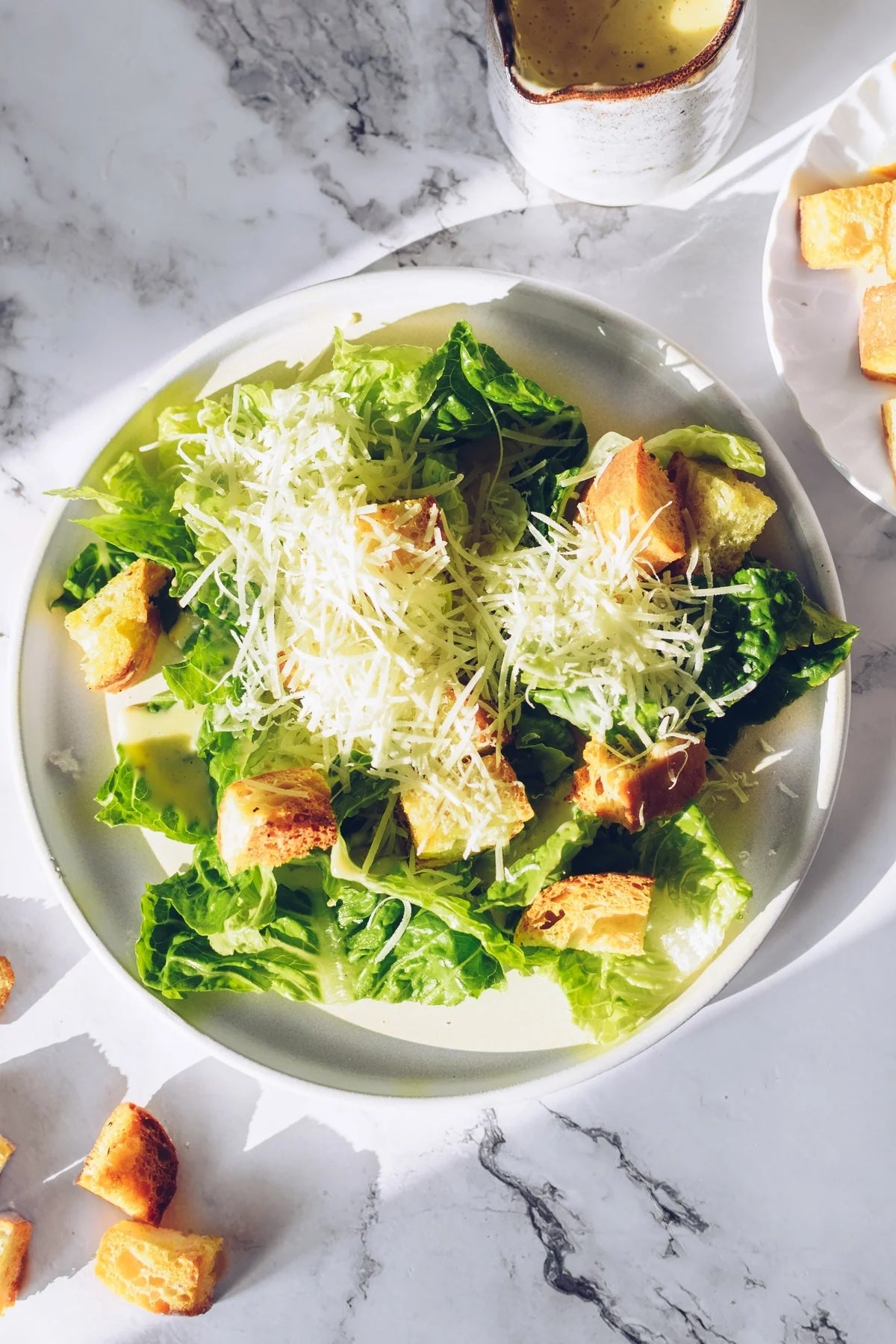
Ingredients:
For the dressing:
100g Biotiful Kefir Yoghurt Original
1 garlic clove, crushed
1 tsp Dijon mustard
1 tsp soy sauce
1 tsp maple syrup
1 tbsp lemon juice
1 tbsp capers roughly chopped
For the salad:
2 heads romaine lettuce, roughly chopped
50g croutons
50g parmesan, shaved
Method:
1. Whisk the yoghurt, garlic, mustard, soy, maple syrup, lemon, capers and some seasoning.
2. To a large bowl, add the lettuce, croutons and parmesan. Pour over the dressing and toss to combine.
3. Serve.
Healthy protein chocolate cherry pancakes
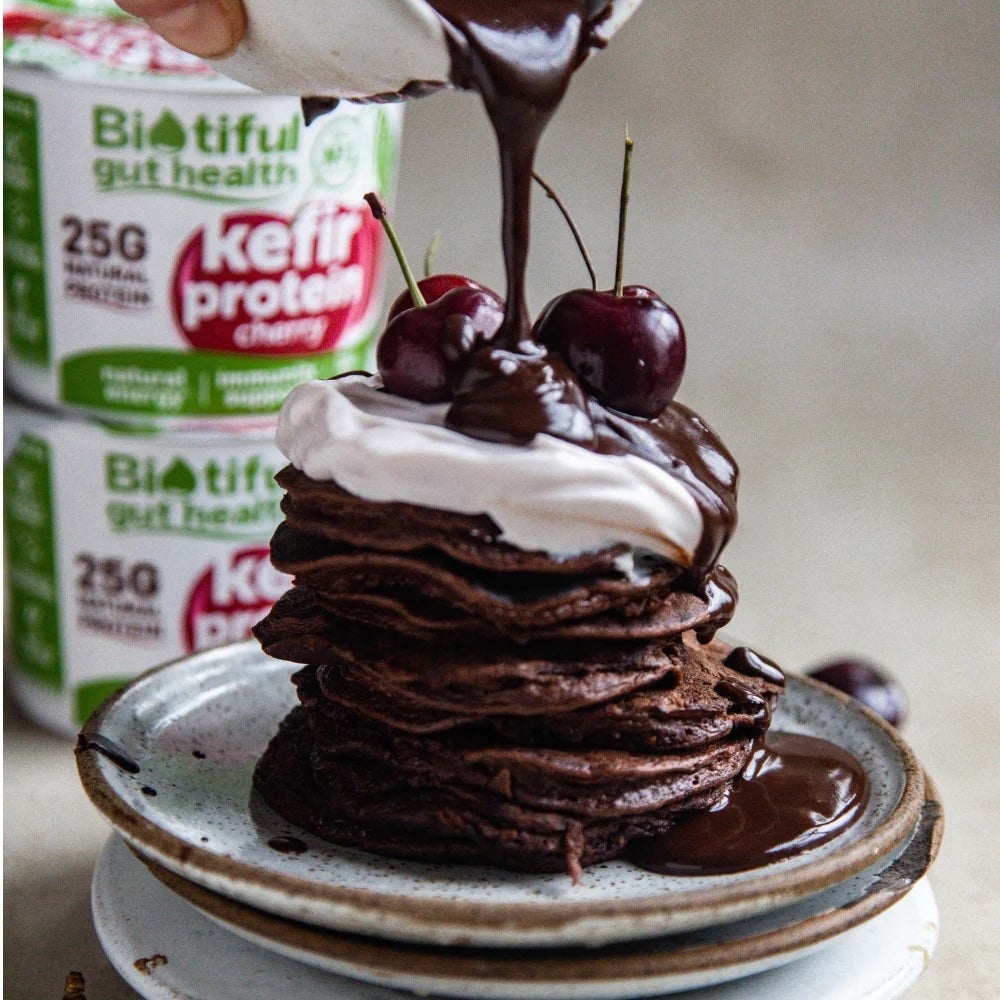
Our protein chocolate cherry pancakes are great for your gut and they taste incredible. High in protein and packed with gut healthy superfoods, this recipe is quick to make, making it perfect for lazy weekend mornings or a strong start before work. Start your day right with this delicious recipe.
Serves: 2
Ingredients:
2 bananas
4 eggs
¾ cup oats
4 tbsp cacao powder
2 tbsp honey
Pinch of salt
1 tsp vanilla
To serve:
1 pot Biotiful Kefir Cherry
50g dark chocolate, melted and at room temp
Method:
1. Blend together banana, eggs, oats, cacao, honey, salt and vanilla until smooth and creamy. Heat some oil or butter in a pan until hot, then spoon the mixture onto the hot pan.
2. Cook until the top is starting to bubble, then flip and cook on the remaining side until lightly golden.
3. Serve pancakes warm in a stack, topped with Biotiful Kefir cherry and melted chocolate.
Healthy vanilla yoghurt apple granola
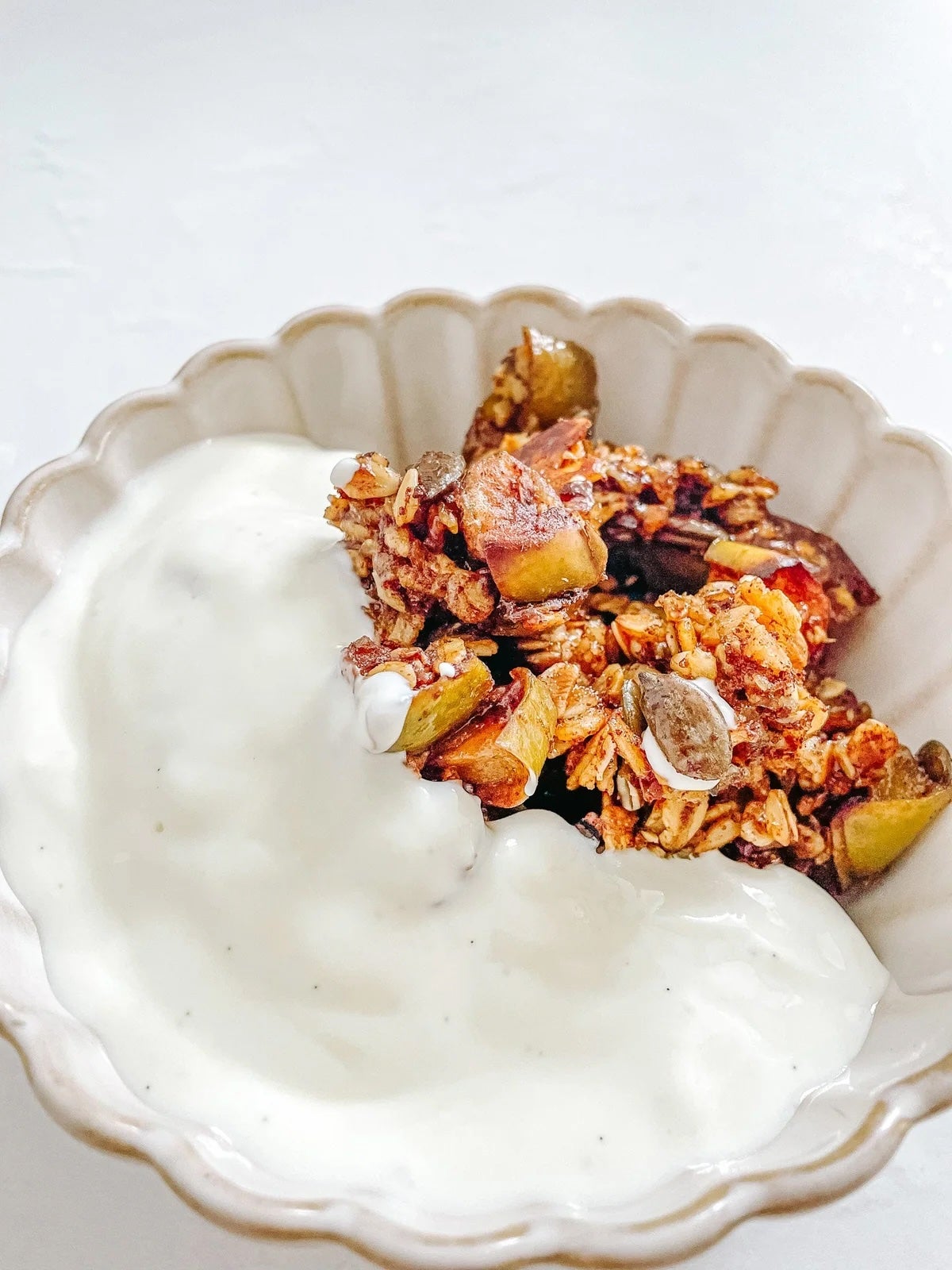
Upgrade your mornings with our vanilla yoghurt and apple granola recipe. This one is so great for prep, as you simply combine the ingredients, bake, let it cool and you can store in a jar, so it’s ready to grab and go!
Serves: 1
Ingredients:
2 tbsp coconut oil, melted
1 tbsp coconut sugar
1 apple, cubed
4 tbsp oats
Pumpkin and sunflower seeds
2 tbsp honey
2 tbsp golden syrup
To serve:
Biotiful Kefir Yogurt Vanilla
Method:
1. Mix together your coconut oil, sugar, and apple in a saucepan and fry until apples begin to caramelise.
2. Pour into your oven dish, and add your oats and seeds.
3. Stir through your honey and golden syrup until fully combined, and press into one flat layer.
4. Bake in the oven at 180C for 20-30 minutes until fully caramelised.
5. Allow granola to cool, and then break into a bowl.
6. Serve with Biotiful Dairy kefir yoghurt vanilla, and enjoy.


