
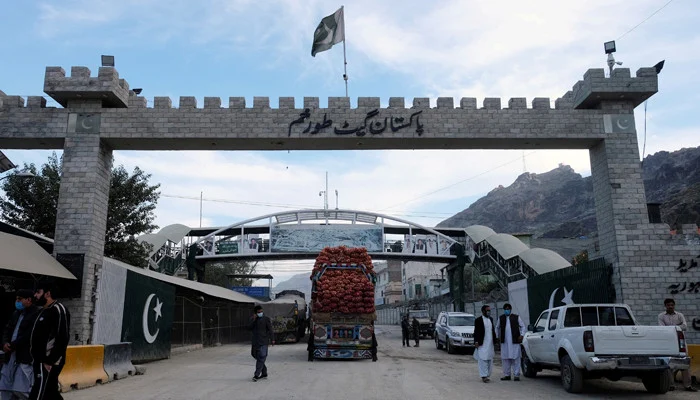
In October 2025, Pakistan closed all major western crossings with Afghanistan. Pakistan stated that the closures were necessary because of escalating tensions and TTP-linked attacks originating from Afghan territory. The current regime does not indicate a return to normal movement in the near future.
The immediate costs of the closure have been borne by traders, transporters, labourers, workers and borderland communities who depend on cross-border movement for both economic and social reasons.
Cross-border trade between Pakistan and Afghanistan is central to the borderland economy. It begins before the customs gate, in social connections, reputation, family ties, language, credit and preexisting business relationships. Much of this trade is mediated by trading networks and brokers, whose credibility depends on trust. For people living in Pakistan and Afghanistan, the border is more than a political line between the two countries; it is a long-standing socioeconomic space.
Anthropologically speaking, areas near borders comprise communities with ties to both countries – the country in which they reside and the country on the other side of the line where they have ethnic, linguistic and kinship ties. The official line between Pakistan and Afghanistan has been shaped by centuries of connection; thus, trade in the region is not simply a matter of goods passing through official channels. Much of it is also conducted on credit, given the region’s lack of formal banking and credit systems.
Policies regarding the borderlands of Pakistan and Afghanistan extensively employ concepts such as regulation, security, closure and control. For border populations, however, the frontier is not only about security but also a locally embedded economy of subsistence and mobility. It provides jobs for truck drivers, workers, warehouse staff, loaders, retailers and customs officers. The closure of the border not only affects trade figures but also disrupts the incomes, debts, mobility, and everyday planning of traders, transport workers and borderland households.
Representatives of the business community have often cited an earlier high point of around $2.7 billion in Pakistan-Afghanistan trade, though this should be treated as a business-community estimate, as published figures vary widely. A 2018 report in ‘Profit’ stated that bilateral trade had fallen from $2.7 billion to $1.2 billion in around 18 months, while other reports placed the earlier peak closer to $2.5 billion. Since then, trade has declined significantly. According to Afghanistan’s Ministry of Commerce, reported by Pajhwok, trade between Afghanistan and Pakistan in 2024 stood at $2.461 billion and in 2025 at $1.766 billion.
The Pakistan Trade Development Authority’s December 2025 report shows that Pakistan’s exports to Afghanistan fell from $754 million in July–December 2024–25 to $336 million in July–December 2025–26. Imports from Afghanistan also declined from $419 million to $239 million during the same period. This means that Pakistan’s recorded goods trade with Afghanistan fell from approximately $1.173 billion to $575 million in the first half of 2025–26.
My fieldwork with traders and transporters shows that many traders involved in the Pak-Afghan trade had homes and strong networks in Kabul. These networks gave traders from Khyber and Peshawar an advantage because they could supply goods to Afghan traders on credit due to the trust between them. My fieldwork with transporters in Karachi reinforces the same point about the importance of these networks.
After the border closure, profit margins fell sharply, in some cases by more than 50 per cent. The livelihood chain attached to even one truck is far wider than that of the driver alone, as thousands of households depend on the trucking economy indirectly through people like drivers, assistants, loading bay staff, mechanics, tyre dealers, service stations, roadhouses, warehouses, customs clearance agents, brokers and small traders. The effect of a complete stop of truck traffic for a certain period of time does not end with the transport companies. This will have a flow-on effect on the entire employment structure of the industry.
Today, many traders in Peshawar and Karachi remember a time when journeys to and from the frontier were easier and more familiar. They had homes, relatives, land – and contact networks in Kabul, Jalalabad and Kandahar. For the people of this region, the border has always been a shared space for passage, trade, kinship, and interdependence between the tribal areas and the border districts of Balochistan and neighbouring Afghanistan.
This is precisely what the current policy fails to recognise. The government cannot expect to keep borders safe by creating uncertainty in legitimate trade. While frequent closures may be justified on security grounds, in practice, they punish those who have invested time and money in legal trade to earn a living: drivers, workers, petty traders, brokers and families living near the border. In addition, closing legitimate lines of communication creates an environment that leads to the development of informal channels and increases capital outflow.
Trade and security must be addressed separately. This does not mean weakening regulations; it means recognising that lawful trade cannot survive repeated closures and uncertainty. Pakistan’s approach to Afghanistan should be more economy-centred, but it remains heavily security-centred. A viable frontier economy will require clear guidelines for opening borders, improved customs rules, payment systems and consultations with chambers, transport trade unions, customs brokers and traders from border areas.
Pakistan can manage the Pak-Afghan border more effectively if it does not see it only as a site of state control but also as a conduit for exchange, movement and community linkages.
Border communities should not be treated merely as objects of security policy and left to bear the costs of border closure. They should be recognised as economic actors whose participation is critical for durable border management and security. Policies should keep formal trade viable rather than forcing it outside of regulated systems.
The writer is a policy analyst and researcher. He is the author of ‘Pakistan’s Tribal Borderlands’ and can be reached at: [email protected]
Disclaimer: The viewpoints expressed in this piece are the writer’s own and don’t necessarily reflect Geo.tv’s editorial policy.
Originally published in The News

