
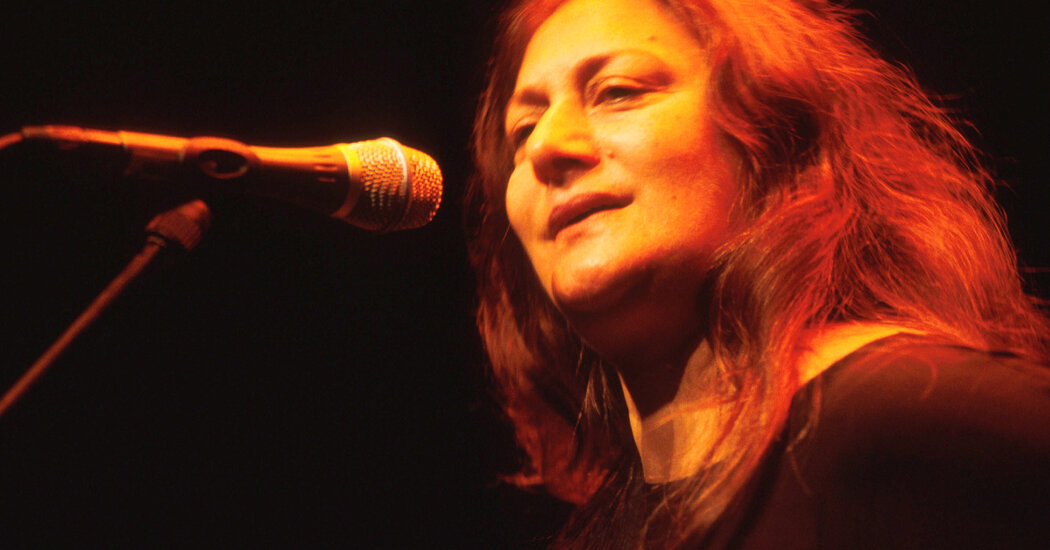
Beverley Martyn, a British singer poised for fame in the 1960s until a whirlwind romance with a guitarist turned into a nightmarish marriage, nearly killing her dream to make music of her own, died on April 27. She was 79.
Her death was announced by the official website of the estate of her ex-husband, John Martyn.
By the time she was 18, Ms. Martyn — then known as Beverley Kutner — was already the lead singer of a band, the Levee Breakers, which had come out with a promising single, “Babe I’m Leaving You.”
When she sang at a London party in the mid-1960s attended by Barbra Streisand, Ms. Streisand came over and said with a warm smile, “I see I have competition,” Ms. Martyn wrote in her memoir. Around the same time, she also met Paul Simon, and the two became an item. He invited her to meet up with him and Art Garfunkel in the United States.
She contributed vocals to the duo’s track “Fakin’ It,” released in 1968, and she performed at the Monterey Pop Festival in 1967, listed on the same bill as Otis Redding, the Who and Jimi Hendrix. She went on a drive with Peter Fonda, chatted with Janis Joplin and was followed around “constantly,” she wrote, by Phil Ochs.
Ms. Kutner and Mr. Simon broke up, but she returned to Britain in a mood of idealism. In an interview with The Coventry Standard, her hometown paper in England, she praised “the hippies’ beliefs in love and beauty” and L.S.D., which, she said, had taught her “to be my own psychiatrist.”
After returning home, her friend Jackson C. Frank took her to a gig by a young guitarist with, she wrote in her memoir, “the eyes of a Botticelli angel”: Mr. Martyn.
Soon they were inseparable. The couple decided to travel together to the United States, where Warner Bros. wanted Ms. Kutner to record a solo album. They married before the trip.
They holed up in an idyllic rural home in Woodstock, N.Y. There, at a local concert, Ms. Martyn met Bob Dylan, whom she later described to The Guardian as “my hero, my Jewish cowboy!”In her youth, Ms. Martyn’s family had been the only Jews on her block.
They began talking, and Ms. Martyn was obviously enchanted. Then her new husband pushed them apart. “Don’t hurt her, man,” she heard Mr. Dylan say.
Back home, Ms. Martyn saw a new side of her husband, she wrote in her memoir. He shouted and threw things, including a fork, which hit her below one of her eyes. Then he fell to his knees and apologized profusely.
Mr. Martyn was supposed to be her backup guitarist. But when they recorded, he finagled his way into becoming half of a musical duo — with his name listed first. Their album “Stormbringer!” (1970) would later be seen as heralding Mr. Martyn’s influential, jazzy style of folk.
Warner Bros. continued showing interest in Ms. Martyn, asking to release one of the tracks she had written, “Can’t Get the One I Want,” as a single. Mr. Martyn said no. He also rejected Mr. Garfunkel’s request to record a cover of the song.
“I wanted my marriage to work and so I let John dictate the terms,” Ms. Martyn wrote. “Looking back, it was the end of my career.”
The Martyns recorded another joint album in 1970, “The Road to Ruin,” but Mr. Martyn went solo after that.
While he pursued his career, Ms. Martyn raised her three children, including a son from a prior relationship, in their new home in Hastings, a town on England’s southern coast.
Mr. Martyn’s visits became increasingly violent. In her memoir, Ms. Martyn described suffering a broken nose, a fractured inner ear and hairline fractures of the skull.
In the biography “Small Hours: The Long Night of John Martyn” (2020), the author, Graeme Thomson, portrays Mr. Martyn as habitually violent, and he quotes a friend describing Mr. Martyn’s abuse of women as an open secret.
Scared of bringing new people into their lives, Ms. Martyn spent much of her time with one of the few people who had attended her wedding: the folk singer Nick Drake. On his visits to Hastings, he and Ms. Martyn would spend hours drinking tea and looking out at the ocean.
“He was the most introverted character I’ve ever met,” Ms. Martyn later told The Guardian. “I think he felt safe with me, and I tried to take care of him.”
One night in 1979, Mr. Martyn returned from a pub with a friend and asked Ms. Martyn to make them some food, she wrote in her memoir. She replied that she was too tired. He banged her head into meat hooks hanging in their kitchen, then ordered her to go to bed.
Still barefoot, she slipped her feet into her elder son’s boots and crept out the front door.
The couple never spent another night together. But Ms. Martyn’s musical breakthrough still lay decades ahead.
She was born on March 24, 1947, in Coventry. Her parents were both refugees from Poland. Her father, Louis, a watchmaker, was violent and wrathful, much like her future husband, she wrote in her memoir. Her mother was a bookish former actress.
Beverley attended drama school in London, where she started hanging out at the clubs associated with the nascent folk revival. An impromptu jam session led to the formation of her first band.
After her divorce, she spent years in poverty and played few gigs. Musicians like Mr. Garfunkel and Loudon Wainwright III offered occasional artistic and financial support.
Before Mr. Drake’s death in 1974 from a drug overdose, he said that he wanted Ms. Martyn to have a reel-to-reel of his first proper recording session. Many years later, after frequently listening to the tape, she decided to sell it. An album partly composed of that recording, “The Making of Five Leaves Left,” came out last year.
Ms. Martyn’s survivors include her children Wesley and Mhairi.
Mr. Martyn’s death, in 2009, prompted a burst of productivity.
Ms. Martyn’s memoir was published in 2012. Two years later, “The Phoenix and the Turtle” was released — her second-ever solo album, and the first to receive major public attention. “A successful comeback, at last, for one of the celebrities of the 1960s folk scene,” The Guardian wrote.
At the end of her book, Ms. Martyn said that her voice was still as good as it had ever been. “Don’t be surprised,” she wrote, “if you wake up one morning and hear this phoenix singing its heart out. She’s been silent for too long.”

