
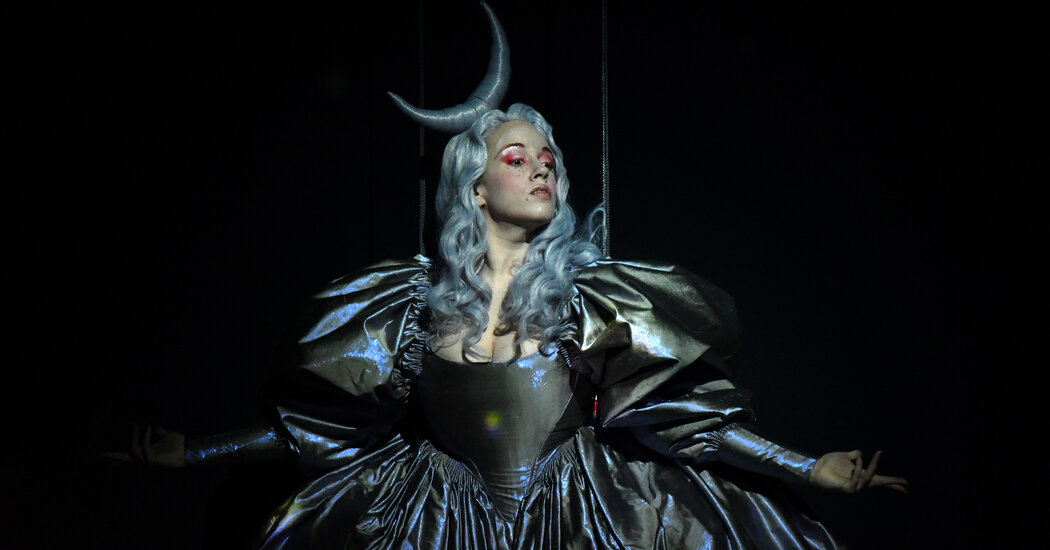
Even by operatic standards, the role of the Queen of the Night in Mozart’s “The Magic Flute” is a whopper. With high F notes that seem almost humanly impossible to hit — and keep hitting — the role tests the limits of a coloratura soprano. Only a select group of singers can scale this operatic summit.
The death in March of Rainelle Krause, who had emerged as one of the most sought-after sopranos tackling this role, has highlighted the challenge for opera houses to recast it on short notice, not only because the part is so difficult but because “The Magic Flute” is so often staged around the world. Krause had performed at the Metropolitan Opera just a few months before she died, and it was a career milestone at such a major opera house. She died at 38 on March 16 after complications following surgery (the family has declined to provide further details).
“Her Met debut transitioned her into being a world-renowned star, and she was contracted to come back to the Met for at least the next two seasons,” Ryan Krause, her husband, said in a recent video interview. “It’s the kind of role that some people get tired of singing, but Rainelle absolutely loved singing it.”
Krause had sung it around the world, including at the Dutch National Opera in Amsterdam and the Berlin State Opera. She had contracts to perform in “Ariadne auf Naxos” at the Lyric Opera of Chicago and in “The Marriage of Figaro” at the Nashville Opera next season. She had also been offered the role of the Queen of the Night at the Seattle Opera, the Grand Theater of Geneva and the Garsington Opera in England, according to her agent in New York, in addition to two seasons at the Metropolitan Opera, which, through a spokeswoman, declined to comment for this article.
The nuance of the Queen of the Night role is what many sopranos aspire to, but they often sing it only for a few years, given the vocal demands of the high notes. The soprano Kathryn Lewek, a major interpreter of the role, once described singing it as “playing darts with your eyes closed.” The complexity of the character is also what draws many singers: She is often seen as the opera’s villain, but she grieves for her daughter, Pamina, who is held in a mythical world by the godlike Sarastro as Prince Tamino attempts to rescue her. The Queen’s arias are passionate and desperate.
“I’ve been singing this role for 15 years, but most queens usually do about five because it’s hard on the voice,” Lewek said in a recent phone interview. “Rainelle was a rising Queen, and she had been singing it for years, but only recently at such high-profile places.”
Lewek and Krause had become friends in the past few years, and Krause had replaced Lewek more than once onstage since they shared the same agent.
“I hold the record for singing it 83 times, and I can’t imagine a world in which there isn’t a great Queen of the Night exciting audiences,” Lewek said. “It’s important that we have a solid Queen of the Night, and Rainelle was a great interpreter of the role.”
Krause’s next opportunity in the role was to be this summer at the Santa Fe Opera, which would have marked her debut at the summer festival, for eight performances.
“Rainelle was on our list as early as two years ago when we first had her under consideration,” Robert K. Meya, general director of the opera, said in a recent phone interview. “She really had her breakout moment at the English National Opera in London in early 2024, which is when she came to international prominence.”
The role will now be sung in Santa Fe by Jeni Houser, who also shared singing duties in “The Magic Flute” with Krause at the Metropolitan Opera.
The production, like many of the past in the open air of the high New Mexico desert, is part of what lures many singers to tackle this role there, he said.
“The image of the Queen of the Night is forever associated with the clouds and stars,” Meya added. “Here at the Santa Fe Opera, we actually offer her a starlit night. The Queen of the Night is in her element here.”
Krause was looking forward to her summer in Santa Fe, her husband said, and the other engagements that she had booked, which included roles that were equally demanding.
“She debuted in ‘Lucia di Lammermoor’ at Nashville Opera last year, and she blew the roof off the place and showed just how versatile of an artist she was,” he said. “Lucia is a marathon, whereas Queen of the Night is a sprint.”
That sprint of a succession of high notes in such a short time is legendary, which adds a layer of difficulty not only to singing the role but finding a reliable queen.
“‘Der Hölle Rache’ is one of the most famous arias in human history — it transcends generations,” Meya said. “It is as demanding as it is iconic, and the Queen of the Night remains one of the most difficult roles to cast.”
Much of Krause’s success, said Ryan, who attended her Met debut performance in December with her parents and a few friends, can be credited to a video that was made of Krause performing the role while doing a trapezelike act for Opus Opera in New Orleans, swinging from silk cloth from a ceiling in a rehearsal room. That video was sent to several opera houses that quickly took note, he said.
“She developed that act herself and we filmed it and it went viral,” he recalled. “It got her a lot of notoriety, and not just because she could sing that role upside down and spinning around, but because she demonstrated her artistry.”
But it wasn’t all just flashy notes and acrobatics, he added.
“She brought more pathos to the Queen than is typical, and she really tried to connect with that character’s motivation in a way that often gets overlooked,” said Ryan, who helped create a scholarship this month in her memory at Indiana University, where they met. “The character resorts to means that are less than savory. She’s driven by having been robbed of her power, and Rainelle found that a great source of motivation for the character.”
Her arrival at the Metropolitan Opera in the months before her death was a touchstone, many agree.
“Her performance at the Met was striking not only for its technical brilliance, but for its composure under immense pressure,” Vanessa Uzan, Krause’s agent and founder and president of UIA Talent Agency in New York, wrote in an email. “She brought a level of precision, consistency and dramatic conviction that is exceedingly rare in a debut of that scale. It was immediately clear that she was not simply arriving. She belonged there.”
For Lewek, moving into different roles after 15 years of performing as the Queen is part of the evolution of a coloratura soprano, and she saw Krause as a major player in the future of the character.
“There’s not a whole lot that impresses me anymore when it comes to this role, and people have even sent me videos of their parrot singing the Queen,” she said. “But somebody sent me a video of Rainelle, and she was amazing. It’s very high pressure, and you need nerves of steel. And Rainelle had nerves of steel.”

