
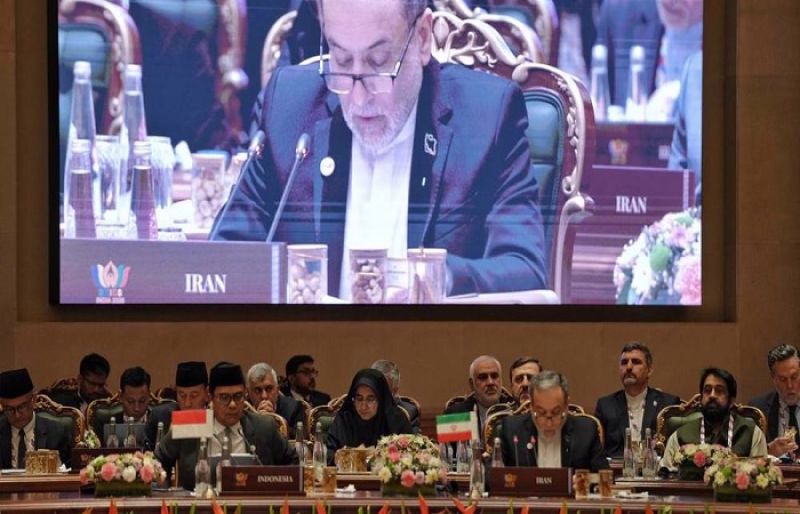
Speaking Friday at the BRICS foreign ministers’ meeting in New Delhi, Araghchi said that the world is experiencing “a period of structural instability and a deep crisis of trust.”
“The structures governing the international order, designed in the post-World War II era, no longer have the capacity to respond to the realities of the 21st century,” he told fellow foreign ministers.
“The gap between emerging powers and traditional decision-making structures not only threatens global stability but has fueled widespread injustice in the distribution of power, wealth, and development opportunities.”
The Iranian foreign minister criticized what he described as multilateralism in name only.
“What we witness today in some international institutions is not ‘multilateralism,’ but rather an attempt to preserve ‘unilateralism’ under the guise of international law,” Araghchi said.
“The instrumental use of laws, the imposition of unilateral sanctions, and the disregard for the rights and national sovereignty of countries are signs of a deep crisis in global governance.”
He said that a system which delegates vital decisions for humanity to a limited group of countries while ignoring the interests of developing nations “has lost its legitimacy.”
Araghchi devoted particular attention to unilateral sanctions, describing them as tools of “economic terrorism” that have evolved from diplomatic instruments into weapons of economic warfare.
“These measures, carried out in flagrant violation of international law, target not only governments but the fundamental rights of human beings—including the right to life, access to health, food, and development,” he said.
The foreign minister emphasized that confronting this economic terrorism and establishing independent financial mechanisms within BRICS is “an undeniable necessity for preserving the independence and national sovereignty of countries.”
Security Council reform ‘not a choice but a necessity’
Araghchi called for fundamental reforms to international organizations, particularly the UN Security Council, describing the current body as “a clear symbol of inefficiency and imbalance.”
He cited the Security Council’s silence regarding the US-Israeli aggression against Iran as a stark example of its failure.
Araghchi also highlighted attacks on Iran’s critical infrastructure, including refineries, petrochemical complexes, bridges, railways, stadiums, cultural and historical centers, energy transmission lines, and major industrial facilities.
“These infrastructures are not just technical or economic facilities; they are the backbone of people’s daily lives,” he said.
The foreign minister warned that silence in the face of such aggression sets a dangerous precedent.
“If today we remain silent in the face of the suffering of the Iranian people… or if we pass by it based on political considerations, tomorrow this cycle of violence and instability can be transferred to any other part of the world,” Araghchi said.
Araghchi stressed that Security Council reform is “not a choice, but a necessity for the survival of the United Nations.”
“We seek a council that has real representation from all continents and regions of the world, a council in which power is distributed with accountability and justice, not one that serves only the interests of some abusive and aggressive powers,” he said.
The foreign minister outlined Iran’s vision for reformed international governance based on four principles: justice replacing power, national sovereignty as the first principle, respect for the rights of all human beings, and acceptance of cultural and political diversity.
He positioned BRICS as a potential cornerstone of genuine multilateralism, representing a large portion of the world’s population and economy.
“We in BRICS must work not to create a confrontational bloc, but to create a strategic balance,” Araghchi said. “Our cooperation in economic, financial, and technological fields can reduce dependence on monopolistic structures and provide new space for independence and sustainable development.”
He called for a shift from “crisis management” to “structural management,” urging participants to use BRICS capacities to reconstruct global governance and restore credibility to multilateralism.
Iran emerges stronger from US-Israeli aggression
Speaking to national broadcaster IRIB on the sidelines of the BRICS meeting on Friday, Araghchi said the recent aggression against Iran dominated all his bilateral discussions.
“All countries were eager to know how Iran was able to resist in this way and emerge victorious from this war, and also what the conditions will be from now on and in which direction the region will move,” he said.
The foreign minister noted a significant shift in international perceptions of Iran following the 40-day US-Israeli aggression that began February 28 and ended through a Pakistan-brokered ceasefire after intensive Iranian counterstrikes against US and Israeli bases and assets across the region.
“What I find very noteworthy is that now all countries acknowledge that the Islamic Republic of Iran won this war and was able to thwart the enemies in achieving their goals, impose its will, and gain a new position,” Araghchi stated.
He said Iran must now be viewed through a different lens—”as a power and player in the region that has been able to establish itself; a player that has the ability to confront the greatest powers.”
“This can be clearly seen in the words of all delegations,” he added.
Araghchi said that all participants in his bilateral meetings and BRICS speeches conveyed that the region’s future and its mechanisms require a fresh perspective that takes into account the realities revealed after the war.
“In fact, this war has become a turning point in the region and has significantly elevated the position of the Islamic Republic of Iran,” he said. “Now is the time for the Islamic Republic of Iran to consolidate its position and demonstrate its regional role more than ever before.”
The US-Israeli aggression against Iran began on February 28 with airstrikes that assassinated senior Iranian officials and commanders, including Leader of the Islamic Revolution Ayatollah Seyyed Ali Khamenei, and caused damage to civilian infrastructure including hospitals and schools.
Iranian armed forces responded with daily missile and drone operations targeting locations in Israeli-occupied territories and US military bases across the region. Iran also closed the Strait of Hormuz to enemies and their allies, resulting in a significant increase in oil prices.
The Islamic Republic began exercising stricter controls last month after President Donald Trump announced an illegal blockade of Iranian vessels and ports in violation of the Pakistan-brokered ceasefire that took effect on April 8. A recent US military campaign aimed at forcibly reopening the strait was forced to halt amid Iran’s steadfast resilience.

