
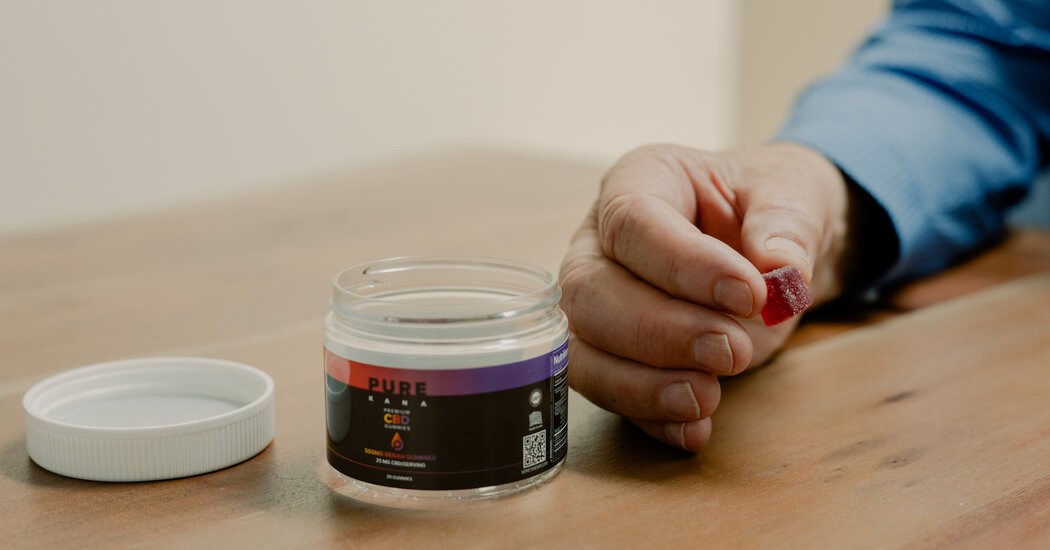
The Trump administration has been making headlines for taking steps to loosen restrictions around cannabis, including legalizing it for medical use. Now it is beginning an experiment that places cannabis even more squarely into mainstream health care: thousands of Medicare patients soon will be able to get CBD, a nonintoxicating component, for free.
“ONE in FIVE adults used it in the past year, and many say it improved their chronic pain enormously,” President Trump wrote on social media last month in a post cheering the program.
The aim is to gather real-life evidence showing whether CBD can improve patients’ quality of life and, by extension, reduce health care costs, administration officials say.
CBD products are already popular with some Medicare-age patients. A 2024 study in Clinical Gerontologist found that 14.3 percent of patients 65 and older had used them in the past year. Patients usually purchase over-the-counter gummies and tinctures to ease anxiety, insomnia and chemo-related nausea.
“Millions of older adults are already integrating cannabinoid products into their health care routines, yet the health care system has almost no infrastructure to understand what they are spending, why they are using these products, or whether these expenditures reduce other health care costs,” said Sasha Kalcheff-Korn, the executive director of Realm of Caring, a nonprofit group that conducts research and promotes cannabinoid therapies.
Despite Mr. Trump’s ebullient endorsement, many doctors worry about encouraging the use of unapproved supplements to geriatric patients, who typically have multiple medical conditions and already take many medications, some of which could interact with CBD products to detrimental effect. Still, their concerns would be eased somewhat, they say, if patients collaborated with doctors on appropriate dosing, which is another goal of the government initiative.
”I believe that CBD should be available to all seniors as part of their health care, recommended by a provider with knowledge of cannabinoid medicine,” said Dr. Melanie Bone, the director of medical cannabinoid therapies at MorseLife, a senior residence in West Palm Beach, Fla. “It may help with a number of ailments of aging, and has almost no downside. But CBD is not a panacea. The only way to know if it works is to try.”
What does research show about CBD for older patients?
CBD, or cannabidiol, one of the most prominent compounds in the cannabis sativa plant, is nonintoxicating and known for its soothing effects on the central nervous system. Many CBD products are made from hemp, a legal strain of cannabis that is rich in CBD and has only small amounts of the intoxicating compound, THC. The Medicare program restricts the amount of THC that can be in hemp-derived CBD to 3 milligrams per serving.
In recent years, CBD has become increasingly attractive to older patients. Results from studies are mixed to positive. But many of the doses evaluated contained more THC than those allowed by the Medicare guidelines. Most researchers have noted the need for more rigorous gold-standard trials.
Mr. Trump’s assertion that one in five adults use CBD products, many for chronic pain, which was also included in supporting documents for an executive order announcing the program, appears to conflate self-reported surveys and polls that broadly address adult use of medical cannabis or CBD.
But a chief benefit of CBD that some studies do underscore is that many seniors use the products to replace opioids for pain and benzodiazepines for anxiety and insomnia, which can have troubling side effects.
The new Medicare program mandates that the CBD be given to patients only by doctors, who regularly review their medical history and reactions to the products.
How does the program work?
One of the main goals is to learn whether CBD can help older people feel better enough to get off, or avoid starting, prescriptions for pain, nausea, sleep and anxiety. The hope is that CBD could help prevent more expensive medical interventions that those drugs can lead to. Opioids, for example, can prompt dizziness, constipation, overdoses and trips to the emergency department.
Only a small subset of Medicare recipients — those who participate in a type of health care network called an Accountable Care Organization — will initially be eligible for the benefit. So far, just five large groups have been approved to offer CBD. By January, 2027, CBD will be offered to patients in all 74 ACO groups.
The participating organizations have providers across an array of states, including Oklahoma, Texas, Wisconsin, West Virginia and Arizona. Currently, only patients affiliated with programs in New York and Florida patients have begun receiving CBD products, according to a spokesperson for the Centers for Medicare and Medicaid Services.
Those doctors must buy the CBD products up front, spending up to $500 per patient a year. They must agree to screen patients and products carefully, and collect real-time data on how the CBD affects patients.
They will not be directly reimbursed for the CBD. In the incentive-based structure, these groups receive a budget from Medicare. Those that come in under budget by improving patient quality of life and reducing costs, now additionally equipped with CBD as a tool, will receive a percentage of those savings.
Are there any obstacles?
Yes.
Late last year, Congress passed a measure that could remove from the U.S. market most CBD products, including those that doctors suggest for patients.
That is because many CBD products contain far more THC and other synthetic, intoxicating compounds than Congress intended in 2018, when it created the legal definition of hemp, to distinguish it from marijuana. Many of those amped-up CBD items, packaged to look like candy, have led to calls to poison centers.
In reaction, Congress placed severe limits on hemp last year that are set to take place in November. Under those restrictions, Cornbread Hemp, a Kentucky-based company with a contract to supply CBD for the new program, will not be able to do so, because its products’ THC content is above the new limits. A patchwork of bills introduced in the Senate and the House are trying to slow or rewrite what amounts to a looming hemp ban.
In his social media post last month, Mr. Trump urged Congress to act.
“Please get it done, and SOON,” he wrote.

