
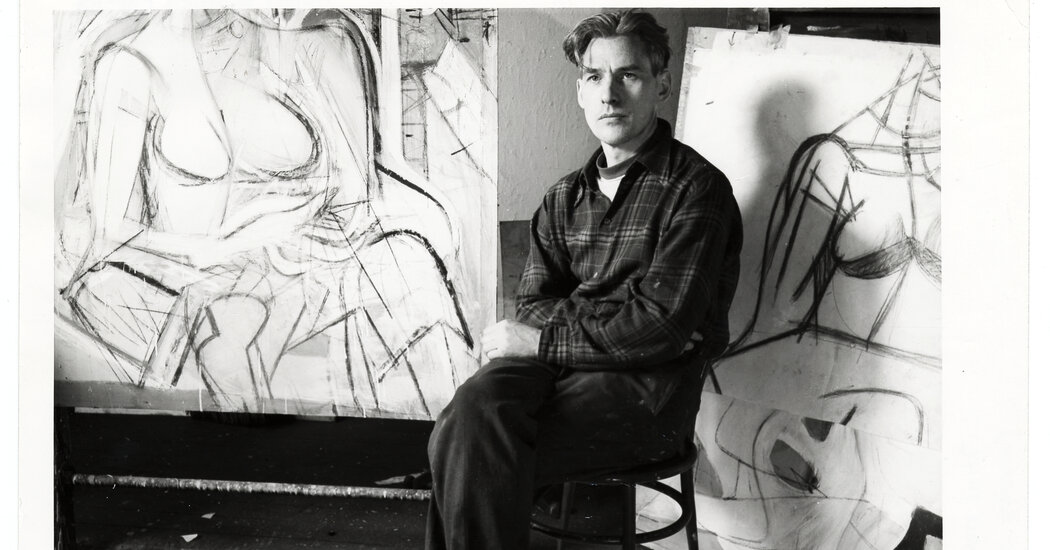
Summer is the time for blockbuster museum exhibitions, and frequently those popular, big ticket shows focus on painting.
Next month, the Art Institute of Chicago offers a notable exception: “Willem de Kooning Drawing,” on view June 14 to Sept. 20. In the fall, a version of the exhibition goes to the Rijksmuseum in Amsterdam.
The Chicago show will feature 210 works, largely drawings by the 20th-century master de Kooning (1904-97), with some paintings, sculptures and hybrid works on hand for good measure.
De Kooning was born in Rotterdam, the Netherlands. He traveled to the United States in 1926 — arriving as a stowaway on a ship — and stayed, eventually making his way to homes in New York City and the Hamptons.
After starting out as a house painter, he later achieved the heights of artistic fame and influence for his Abstract Expressionist work, painting memorable compositions like “Woman I” (1950-52), a seminal work that is on loan from the Museum of Modern Art for the Art Institute show.
De Kooning drew constantly. The critic Peter Schjeldahl once called the artist “a hand with a man attached.”
As Kevin Salatino, the lead curator of “Willem de Kooning Drawing,” put it: “Drawing is fundamental to everything he did.” He estimated that there are 2,000 to 3,000 extant drawings by de Kooning, and that many more were lost along the way.
Salatino, the chair of the prints and drawings department at the Art Institute, talked in a phone interview about the highlights of the show and de Kooning’s devotion to draftsmanship, in a conversation that has been edited and condensed.
Why does it seem like drawings can get less attention from museum audiences?
They’re sometimes thought of as preparatory to painting, rather than works in themselves. People don’t necessarily recognize that drawings can be finished works of art. If you’re doing a full retrospective and it’s paintings dominant, then the drawings are going to get short shrift. This is a show where the drawings are dominant and the paintings are subservient. We only have 11 paintings.
Some of the drawings in this show look like paintings, and there are hybrids that blur the traditional medium categories.
I would be lying if I didn’t say we also struggled with that. You’ll notice that the title of the show is “Willem de Kooning Drawing” — singular drawing, not plural. It’s meant to indicate that we’re talking about drawing as both fact and act, as both noun and verb.
De Kooning was famously on record as saying he didn’t really understand the difference between drawing and painting. There is a kind of graphic sensibility that runs through much of the work, and we tried to trace that.
So he didn’t do preparatory drawing with a specific painting composition in mind, as many artists do?
No, he made drawings that would lead to paintings, I would say. He often incorporated one into the other. In some of the hybrids, he was drawing in the painting. Some have a tremendous amount of actual graphite and charcoal — he was working into the paint with the charcoal, and he just left it there.
Why is this a show for the Art Institute in particular?
We have a long history of collecting great drawings. In fact, our first de Kooning drawing is a masterpiece, “Two Women’s Torsos” (1952), which was bought in 1955.
What’s special about that one?
It’s from the time around the painting “Woman I,” and it was done in the summer of 1952 when he was in the Hamptons, staying with Leo Castelli and Ileana Sonnabend. He created a makeshift studio on the back porch, and he made a whole bunch of pastels that summer. You see two bathers standing in a kind of landscape. You can puzzle out certain things happening, but it’s the way he utilizes space that’s so fascinating.
And pastels can be tricky.
You can’t blend pastels because they turn muddy and gray. You have to be very careful with how you apply them. And he used very cheap pastels. He didn’t go for the fancy French ones, and yet he created the most extraordinary color juxtapositions. You never question the actual fleshiness of those flesh tones, even when they’re lilac or yellow.
How did he get to this level of draftsmanship?
I have always said that de Kooning was the last old master. He was trained in that tradition. He went to the Rotterdam Academy at the beginning of the 20th century, which was still using the techniques and practices of earlier centuries. And what do you start with? You start with drawing.
If you look at his first extant drawing, which he gave to the Met, “Dish with Jugs” (ca. 1919-21), it is a masterpiece in our show. When you see it reproduced, it looks like a black-and-white photograph.
It’s been calculated that it took him something like 600 hours of work, making that drawing over a very long period of time in short spurts, because he went to school only at night. He had to work during the day.
What was he doing?
He was working for a design company from the age of 13 or 14, which is part of what distinguishes him from almost every other major artist of the 20th century. He knew all the tricks of sign painting and faux painting. He could build furniture. He knew how to wallpaper. He learned all of those tricks.
What’s something that will surprise even frequent museum goers?
In the 1960s, he started to draw with his eyes closed. There was a tradition for that — Surrealism had a lot of that. There’s just something about the embodiment of his line, because he was not looking, he was just moving his hand with a tool in it. There’s a group of them from 1966 that he published in book form. We have all 24 of them.
That seems extraordinary — how did it work?
He literally closed his eyes, but he put his finger in the middle of the page so he could at least control where he was on the sheet. He drew from the middle out. He was willing to take a chance with that, because people already recognized him as a truly great draftsman. He was always pushing himself to do something that would force him into a new state of creativity.

