
At 11, Tim Bovard undertook his first taxidermy experiment on a piece of roadkill. He had found an unlucky skunk and improvised its reanimation using an instruction book, much to the alarm of his friends’ parents.
His own parents were unfazed — his father and grandfather were both scientists and outdoorsmen — and soon it was known in their suburban community of Claremont, Calif., that, as Bovard recently recounted: “Dr. Bovard’s son was an animal nut. So when they found the abandoned birds, owls, hawks, kestrels, crows, blue jays, scrub jays, they brought them to me, and I raised them.”
By the time he was a teenager, he was sewing his own clothes, learning to tan leather and taking backpacking trips in the Sierras with his dogs while wearing a full buckskin suit of his own creation. He began apprenticing with a local taxidermist in high school, and then chose to work for him full time through college.
Bovard was always set on his life path, though when he visited friends at college parties, he asked them to stop mentioning what he did instead of going to class, noticing that it gave some people the creeps.
Bovard, still exuberant and energetic at 72, is the last full-time taxidermist at any museum in the United States. He still lives in Claremont, now with his wife, two dogs and “10 and a half cats” (the “half” cat lives mostly outdoors) and wakes most days at 4:30 a.m. to commute to the Natural History Museum of Los Angeles County, where he has worked since 1984. He is responsible for maintaining animal mounts the museum has kept in its collection for more than a century, reworking dioramas that could look more true to life and designing new exhibits.
In past generations, museums dispatched hunting expeditions to acquire their animal collections, but Bovard works only with donations from zoos or offerings from private collections. As when he was a child, roadkill is another option.
Once the skin is on and the glue is dry, he sews the pelt together, hiding his seams.
“Mammal stitching has to be pretty tight,” he said, especially for lions or zebras. “Now, a bear with long hair? It doesn’t matter so much. For birds, feathers cover it all.”
The care and keeping of these forms is a responsibility he takes both seriously and joyfully. Frequently, he skips his commute entirely and sleeps in his office, rolling out a blanket between filing cabinets that carry the records of every animal in the museum’s 111-year-old collection and the “fleshing wheel” he uses to gently remove tissue from hides.
“It wouldn’t be for everybody,” he said with a smile. “But I am known to be slightly different. That’s putting it sort of mildly.”
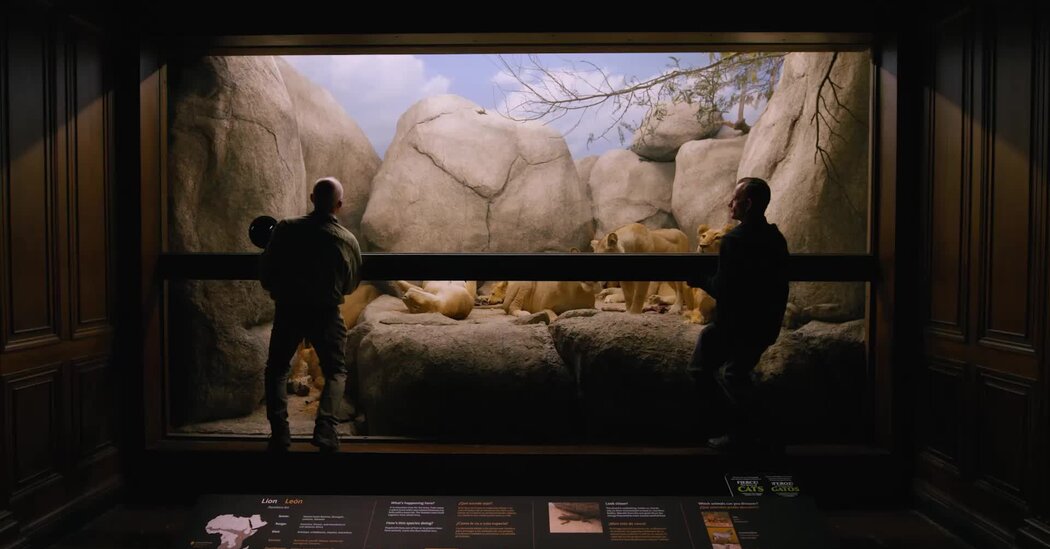
In fact, he has slept at work for weeks at a time, like when he was revamping the museum’s lion diorama and wanted to adjust furry skin folds and feline facial expressions every few hours during the night as the glue set.
Unlike many taxidermists, Bovard is responsible not only for the animals on display in the museum but also for very element of the dioramas, including every tree, leaf, twig, flower, dusting of snow and body of water. He’s made hundreds of thousands of leaves through a method called vacuum forming — a manufacturing technique where plastic is heated and then shaped around a mold using suction — using leaf molds he created himself from plant matter he harvested on research trips.
To do this exacting work, he has amassed an encyclopedic knowledge of the natural world. He knows, for example, that one key to designing a lifelike raptor is the hooding over the eyes. But he also knows the posture that raptor would take sitting on a tree branch, what kind of tree it would be sitting in, the patterns in which it would have preened its feathers, what kind of prey it might be looking for and how its presence would most likely affect the behavior of every other animal in its radius.
For a restaging of a lion family, he wanted two lionesses to be nuzzling foreheads, the standard greeting in big cats, to capture their sociality. He wanted to create more of a sense of dynamic movement in the scene of jaguars perched atop a box canyon in Sonora, Mexico, for example, by adding some small mammal prey, like javelinas, leaping away from the cats.
“It’s all about directing the eye,” he said, pointing toward the far corner of the painted background.
And then there are all the routine tasks, the things he’ll never stop doing, at least not until he retires, like dusting the museum’s pride of lions, vacuuming elephant ears and polishing all the glass eyes.
When asked about whether retirement is on the horizon, he laughed. He was still sleeping on his office floor as recently as New Years. There’s an orangutan he wants to mount this year, and tens of thousands more leaves to make. “No plans to retire.”

