
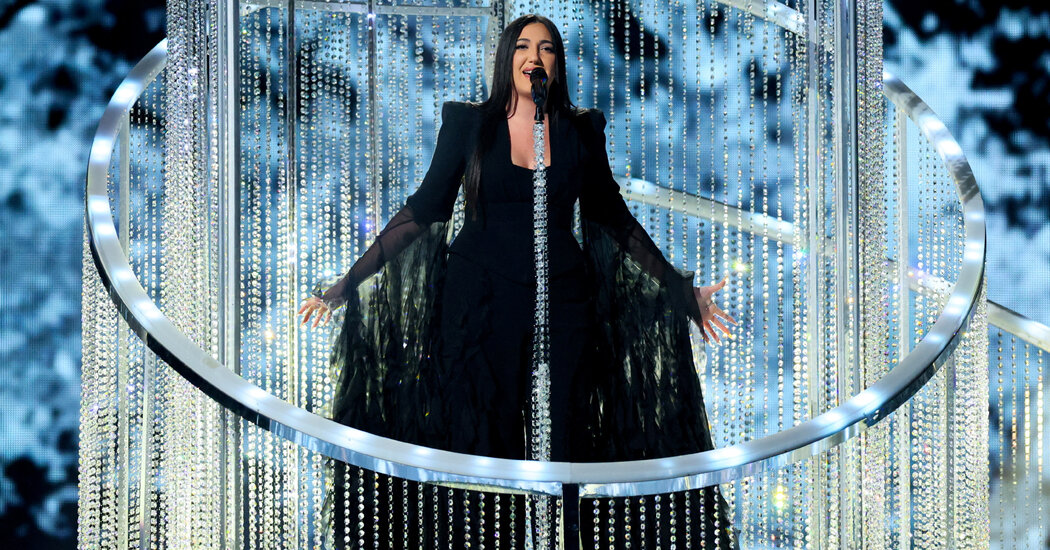
Last fall and winter, senior Israeli diplomats urgently contacted officials and television broadcasters across Europe to address a delicate, if unexpected topic: the high camp Eurovision Song Contest.
Broadcasters wanted to ban Israel from Eurovision and threatened to boycott the contest over the war in Gaza. Some even accused the Israeli government of unfairly influencing the results through a mass voting campaign.
Israel arguably had bigger diplomatic concerns than a pop music competition, even one that reaches 166 million viewers around the world. A United Nations commission had recently accused Israel of committing genocide, which it vigorously denied. And world leaders were recognizing Palestinian statehood, which it had long opposed.
“I am a little bit surprised why this is a matter that the embassy is looking into,” Stefan Eiriksson, the head of Iceland’s national broadcaster, wrote to an Israeli diplomat who wanted to discuss Eurovision last December.
This previously undisclosed diplomatic push to keep Israel in Eurovision was just one aspect of a drama that unfolded over the past year around the world’s most watched cultural event. To the Israeli government, Eurovision became more than just a celebration of glittery outfits, gay pride and pyrotechnic staging. It became a chance, through strong showings by its singers, to burnish the country’s flagging reputation and rally international support.
This year’s competition starts on Tuesday, following the biggest crisis in Eurovision’s 70-year history. Iceland and four other countries are boycotting to protest Israel’s participation. The nonprofit European Broadcasting Union, which runs the contest, faces financial challenges.
A New York Times investigation found a well-organized campaign by Prime Minister Benjamin Netanyahu’s government that embraced Eurovision as a soft power tool, and a secretive contest organizer that was ill-equipped to respond.
As the normally lighthearted contest became a proxy fight over Middle Eastern affairs and human rights, Eurovision struggled to defend a core tenet: Politics play no role in the event.
Israel’s efforts to influence Eurovision’s vote were broader and started years earlier than previously known. Even before the voting controversy burst into view, financial records show, Israel spent at least $1 million on Eurovision marketing. Some of that money came from Mr. Netanyahu’s “hasbara” office, a euphemism for overseas propaganda, to promote Israel’s singer.
Governments are not supposed to intervene in the voting. Eurovision is a contest for public broadcasters and singers, not governments.
The Israeli foreign ministry did not respond to detailed requests to comment. A spokesman for Mr. Netanyahu’s office said he would review the questions and consider responding. He did not respond.
Eurovision’s director, Martin Green, said in an interview that Israel’s actions last year were excessive but did not contribute to Israel’s unexpected second-place finish.
A Times investigation based on previously undisclosed voting data, Eurovision documents and interviews with more than 50 people, however, found that the campaign could have easily changed the contest outcome.
Israel’s singer won the popular votes in countries where polls show that Israel is deeply unpopular. A vote analysis shows that, in some countries, it would have only taken a few hundred people to tip the popular vote, which in turn can shape the final outcome because of the contest’s voting system.
There is no evidence that Israel, as some Eurovision fans speculated, used bots or other covert tactics to manipulate the vote.
Organizers have kept full vote data a closely guarded secret, even from their own broadcasters. Faced with an internal revolt and threats from Israeli allies to leave the contest, they publicly downplayed Israel’s vote campaign and never thoroughly investigated it.
Contest organizers commissioned a review of broadcasters’ feelings on Israel but kept the full report secret. They called a vote on keeping Israel in the contest, then abruptly canceled it. They discouraged broadcasters from talking to journalists.
“The Israeli government has co-opted Eurovision,” said Stefan Jon Hafstein, the chairman of the board for Iceland’s public broadcaster.
Buying advertisements and coordinating social media messaging is not illegal. Eurovision is, after all, just a singing contest — albeit the world’s largest. But while governments often try to capitalize on the publicity their singers provide, no government-led promotional effort has been as extensive and controversial as Israel’s.
“Israel’s voice should be heard everywhere,” said Israel’s largely ceremonial president, Isaac Herzog, who raised the boycott issue in meetings with world leaders last year. “We should participate, we should raise our flag high, and we should bring the best performers to Eurovision.”
Eurovision, which once launched the international careers of ABBA and Celine Dion, faces an uncertain future. Financial projections reviewed by The Times estimated last year that the boycotts would cost the nonprofit broadcasting group hundreds of thousands of dollars in participation fees. Mr. Green said Eurovision’s finances were robust, but acknowledged struggling to find sponsors.
“It’s certainly one of the biggest challenges we’ve faced,” Mr. Green said of the Israel controversy. But Eurovision, he added, exists to demonstrate global harmony — “to show the world as it could be.”
This is the inside story of the controversy that almost broke Eurovision.
Eurovision as Soft Power
In May 2024, fans gathered in the coastal Swedish city of Malmo for the first Eurovision contest of the Gaza war.
Despite the name, Eurovision brings together singers and broadcasters from around the world. Israel debuted in 1973. Musicians compete under national flags, but the acts are funded by broadcasters.
At the time, no bright-line rule prohibited government promotion, but independence is a core Eurovision tenet.
The Israeli government, though, had quietly been promoting its broadcaster’s acts since at least 2018, according to Doron Medalie, a former Eurovision songwriter for Israel. The government spent more than $100,000 on social media promotion that year, he said. Israel won.
Mr. Medalie said the victory convinced Israeli leaders that Eurovision, which is hugely popular in Israel, was a good investment.
The Netanyahu government increased spending ahead of the Malmo contest, records show.
European public opinion opposed the war, and some music industry groups were already calling for Israel to be kicked out of Eurovision. A strong Israeli performance would show that Israel was loved by the European public, according to Israeli officials. They, along with some people close to Eurovision, spoke on condition of anonymity, either because they were not authorized to speak publicly or because they feared retribution from contest organizers.
In Malmo, the Israeli government spent more than $800,000 in Eurovision-related advertising, according to data from the Israeli Government Advertising Agency. The data, which was obtained by the Israeli media watchdog The Seventh Eye and provided to The Times, reveals that the bulk of the money came from the foreign ministry. A line item from the prime minister’s hasbara office showed that it had also allocated money for “vote promotion.”
Israel’s public broadcaster, Kan, told The Times that it had no prior knowledge of government ad campaigns and that, to its knowledge, “the competition rules weren’t violated.”
In 2024, Israel’s singer, Eden Golan, came second in the popular vote and topped the voting in many nations where pro-Palestinian sentiment is strong. “The world, it seems, is not against us,” the Israeli news site Ynet wrote.
Ynet noted that the foreign office had advertised on YouTube during Eurovision. But the story, and the unusual voting patterns, otherwise received little attention.
Eurovision broadcasters were preoccupied. The activist Greta Thunberg and thousands of others crowded Malmo, protesting Israel’s involvement. Onstage, several singers wore Palestinian symbols. The Dutch rapper Joost Klein was expelled for an unrelated altercation with a camerawoman.
But one broadcaster, from Slovenia, noted the peculiar vote outcome and asked Eurovision to release more data. Organizers never responded, the broadcaster said.
Eurovision said last week that it had not deemed any Israeli promotions from 2024 to be excessive.
Eurovision had put Malmo behind it, but its problems were only beginning.
‘Vote 20 Times!’
At the 2025 Eurovision contest, in Basel, Switzerland, Israel finished second overall and won the popular vote — once again carrying countries where people have been outspoken against Israel’s policies.
This time, the unexpected results were noticed.
Using Google’s ad library, journalists at the Finnish broadcaster Yle revealed that the Israeli government had bought online advertisements in multiple languages, calling on people to vote for the Israeli contestant, Yuval Raphael, up to the maximum 20 times.
Spending figures for that contest are not available, but Israel’s campaign was broader and more coordinated than in Malmo.
Mr. Netanyahu himself posted a graphic to social media encouraging people to vote 20 times for Ms. Raphael. Pro-Israel groups across Europe posted the same and related graphics. Israel’s deputy ambassador to Austria, Ilay Levi Judkovsky, told The Times that he had contacted a diaspora group to rally support for Ms. Raphael.
Mr. Medalie, the Israeli songwriter, defended the strategy. Israel spends so much on security, he said, that it was only fair that the government fund promotion.
“Everybody is jealous and triggered because Israel is achieving great results,” he said.
Israel’s promotion efforts could have easily affected the popular vote, an analysis of vote data found. That’s because, in some countries, records show, so few people vote that only several hundred voting repeatedly could change the outcome.
After the contest, Slovenia’s broadcaster again demanded voting data and threatened to withdraw. Others privately called for an outside investigation.
Mr. Green, the director, promised that Eurovision’s governing body would review the vote. But that group never received a full vote analysis, just “top-line” data, Mr. Green acknowledged.
Neither he nor the broadcasting union commissioned an external investigation.
“We are very, very happy that the result is true and fair and analyzed,” Mr. Green said.
In July, at a broadcaster meeting in London, dissent mounted. Spain called for a debate over Israel’s participation, and for changing a voting system that it saw as susceptible to manipulation.
Rather than investigate, Eurovision hired a consultant, the Czech broadcasting veteran Petr Dvorak, to interview members about Israel’s participation.
Opinions varied widely. “Sometimes, they just felt that Israel as a state is sometimes using this event as some sort of promotional tool,” Mr. Dvorak recalled in an interview. Others wanted Eurovision to skip or postpone the 2026 contest. Some felt that Kan, the Israeli broadcaster, should not be held accountable for the actions of its government.
Broadcasters would later receive only a summary of Mr. Dvorak’s findings, not his report, reinforcing some views that the effort was a waste of time.
By the end of September, five broadcasters — Iceland, Ireland, the Netherlands, Spain and Slovenia — were openly discussing a boycott.
A Simmering Controversy Boils Over
A Eurovision meeting in Croatia that month did not allay concerns. Instead, Mr. Green’s team gave two seemingly contradictory presentations, according to two attendees.
The first presentation claimed that Israel had not affected the 2025 outcome. No detailed data was offered. The second presentation coached broadcasters on using social media to secure more votes.
To some in the room, organizers seemed to be saying that online campaigns could influence the vote, but that Israel’s had not.
Organizers were stuck between competing factions. Rumors swirled that Norway and Portugal might join the dissenting five countries if Israel remained onstage. Documents show that Israeli allies like Germany and Estonia opposed a ban.
Organizers calculated the financial effects of both scenarios: losing Israel’s critics, or losing Israel and its defenders. Neither outcome was good, records show. By some estimates, Eurovision stood to lose more than $600,000 in fees.
Things had gotten so bad that even Austria’s national broadcasting chief floated in one internal conversation the possibility of his country withdrawing in support of Israel, according to someone directly familiar with the discussion. That would have left the 2026 contest, set to take place in Vienna, without a host.
(A spokesman for the Austrian broadcaster said “it has always been clear” that Vienna would host. The broadcasting chief has since resigned.)
In a late September letter to members, Eurovision acknowledged that it had “never faced a divisive situation like this before” and announced an emergency vote on Israel’s participation.
Privately, Eurovision’s lawyers delivered an extraordinary piece of advice: Organizers could legally exclude Israel if they wanted to.
Eurovision, Torn Apart
A few weeks later, Eurovision canceled the emergency vote, citing the new cease-fire in Gaza. It pushed the issue into December.
Broadcasters still had questions about human rights and Israel’s marketing campaign. But Eurovision seemingly wanted the controversy to go away. Its communications team had circulated an email discouraging broadcasters from speaking with journalists.
The delay gave Israel’s government time to make a diplomatic push.
Israeli embassies contacted broadcasters in at least three countries, according to documents and interviews with people involved. In a fourth country, the Israeli government contacted the foreign ministry to discuss Eurovision.
Finally, in December, after months of debate and delay, broadcasters gathered in Geneva to address Israel’s participation.
Once again, Eurovision sidestepped the question.
The broadcasting union arranged a vote on whether to limit each viewer to 10 votes and “discourage disproportionate promotion campaigns.”
There was a twist: If members approved the changes, they would be agreeing to keep Israel in Eurovision — without ever explicitly voting on the question. (Some members had told Mr. Dvorak that they did not want to be held accountable in their home countries for such a vote.)
The broadcasting union’s president, Delphine Ernotte Cunci, acknowledged that the arrangement “might appear to be rather bizarre.” But, she explained, not voting was “the most democratic solution possible,” according to meeting minutes.
Frederik Delaplace, of the Belgian broadcaster VRT, was unconvinced. Eurovision, he said in the meeting, was “hiding behind guidelines” rather than discussing human rights.
By secret ballot, broadcasters approved the rule changes. Israel would remain in Eurovision, without anyone having to vote on the matter.
The dissenting five broadcasters quickly boycotted.
And an Israeli advertisement is once again generating controversy. A team behind Israel’s entrant, Noam Bettan, circulated social media promotions calling for people to vote for him 10 times.
Eurovision organizers, racing to avoid a repeat of last year, formally warned the broadcaster and asked that the posts be removed. “Employing a direct call to action to vote 10 times for one artist or song is also not in line with our rules, nor the spirit of the competition,” Mr. Green said.
He again reassured the public that such campaigns cannot affect the outcome.
Kirsten Noyes contributed research. Elisabetta Provoledo, Natan Odenheimer and Gabby Sobelman contributed reporting.

