
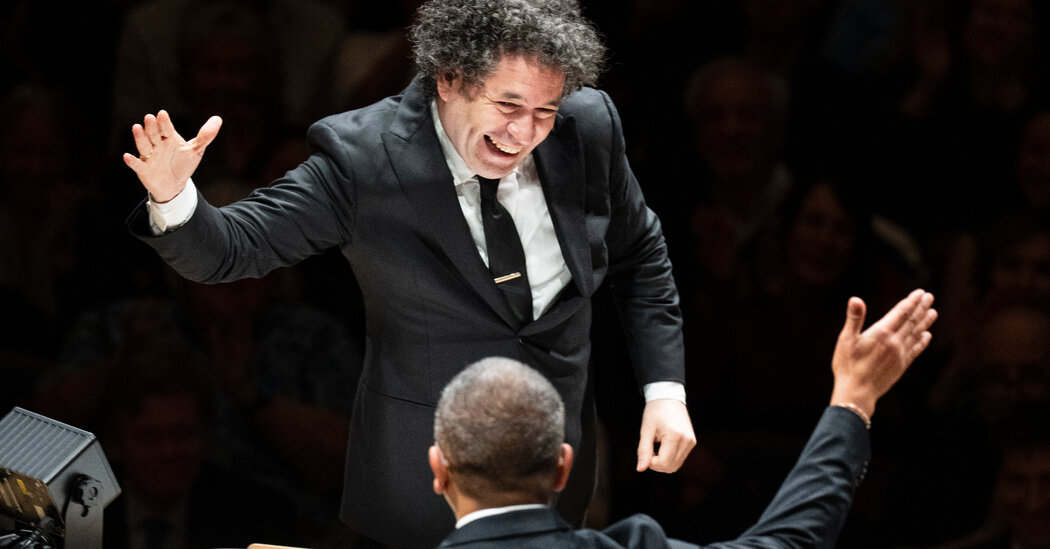
Gustavo Dudamel stepped to the podium at David Geffen Hall one afternoon last week and gazed across a stage crammed with players from the New York Philharmonic and the Spanish Harlem Orchestra. It was their first rehearsal together, and Dudamel was trying to decide how he would count this unwieldy assembly of classical and salsa dura musicians into the opening bars of Carlos Cascante’s “La Música Latina.”
“One, two, one?” asked Dudamel, the Venezuelan-born conductor who will become the Philharmonic’s music and artistic director this fall. “Or uno, dos, uno?”
Dudamel looked over to Oscar Hernandez, the leader of the Spanish Harlem Orchestra, who was seated at a piano, then back to the players.
“Uno, dos, uno!” Dudamel said.
And so began a collaboration that opened with three performances at Lincoln Center and ended Saturday night with an explosive finale at United Palace Theater in Washington Heights. The 184-year-old Philharmonic and the 25-year-old Spanish Harlem Orchestra represent vastly different New York worlds — reflected in the music they play, the makeup of their orchestras and the crowds they draw.
Dudamel’s decision to put them on one stage — with a program including salsa compositions — and with a performance in Washington Heights, signaled how much he intends to change the orchestra when he officially takes the helm in September.
“Cumbanchero!” the musicians shouted at the end of “El Cumbanchero,” a 1949 composition by Rafael Hernández Marín. It was a moment that received cries of approval from the younger crowd in Washington Heights and cheers from the more dressed-up Lincoln Center audience — which clapped to salsa rhythms as Dudamel invited them to do something out of the ordinary during a performance at Geffen Hall: make some noise.
“After the concert, we were shocked at how the subscribers, the audience responded,” said Doug Beavers, a trombone player with the Spanish Harlem Orchestra, said of the Lincoln Center shows. “It was a standing O. They really appreciated this program — and it was totally different from what the New York Phil typically does.”
Barret Ham, a bass clarinet player for the Philharmonic, said the concerts were “definitely taking us out of our comfort zone a little bit.” This is the first time the Phil has played many of these compositions.
“It’s really, really really fast,” Ham added of the salsa. “There’s so much syncopation. Very dance-inspired rhythms. There’s honestly not time to count it the same way when you are playing classical music. You have to ingrain and feel the rhythms more than just count and watch the conductor. It’s been a wonderful learning experience.”
The week was not just noteworthy because of the two concert programs, which blended Latin-American composers in the classical tradition, like Heitor Villa-Lobos and Alberto Ginastera, and those influenced by salsa, like Johnny Pacheco, Francisco López Vida and Hernandez, the leader of the Spanish Harlem Orchestra. This was also the Philharmonic’s first time performing at United Palace Theater, a New York City landmark 110 blocks north of Lincoln Center. At both halls, the bongo, congas and timbales were positioned onstage in front of Dudamel, where violins, violas and cellos would normally be, an image that captured the significance of this alliance.
“Gustavo, it has been the greatest pleasure to be able to share this with you,” Hernandez said in Spanish at the Saturday show. “Your talent is out of this world. It is a source of pride for us as Latinos to have you here with all of us, pushing our culture forward with what you do.”
In an interview, Hernandez said he had seen Dudamel conduct in Los Angeles, but they had never met. “I was pinching myself,” he said of their recent concerts together. “To hear those orchestrations, to see how it combines with our music — one word: phenomenal.”
For their part, members of the Philharmonic seemed delighted to play second fiddle, so to speak, to another orchestra. The strings were used more as a silky backdrop to the brasses, percussion and vocals of the Spanish Harlem Orchestra.
“You couldn’t imagine anything more different unless we played with a rock group,” said Carter Brey, the Philharmonic’s longtime principal cellist. “We definitely are of secondary importance. And that is fine with me. I could sit and listen to them all day.”
At Geffen Hall, 84 members of the Philharmonic performed with 13 members of the Spanish Harlem Orchestra. The United Palace stage is smaller, and for the final concert, there were just 53 Philharmonic players. Rubén Blades joined for one number, to sing his “Las Calles.” Another guest: Dudamel’s father, Oscar, a salsa trombone player.
The alliance between the two orchestras, and the Philharmonic’s decision to venture beyond Lincoln Center, suggests an effort by the Philharmonic to “expand our footprint throughout New York City, to really invite a larger community into what we’re doing,” said Patrick Castillo, the vice president for artistic planning.
The nearly 3,400-seat United Palace Theater, about 1,200 seats more than Geffen Hall, was sold out, and two-thirds of the audience had never attended a Philharmonic concert before, the orchestra said. About 43 percent of the audience came from Washington Heights, Harlem and Inwood.
People were still piling into the United when the hall went dark and Dudamel took the stage to raucous applause.
“I’ve really wanted to come and watch the New York Philharmonic,” said Gio Maragos, 24, as he waited to enter the hall. “And I live in Harlem, so I’m really excited to see this happening uptown.”
Gina Pinos, 60, said she came from TriBeCa because she wanted to see Dudamel at a price she could afford. “I’ve been dying to see him,” she said. “If you go to the Philharmonic, it is like $200 or $300.”
Dudamel and Hernandez said merging these two bands proved easier than expected. “Not difficult,” Dudamel said during a break backstage. “You can feel the orchestra getting the style very naturally. You can see it in their faces.”
Hernandez said he never had any doubts about his band. “They can hang with anybody,” he said after a rehearsal. “The question for the Phil is can they hang out with the Latino music. On a scale of one to 10, they were an eight.”
But there were shaky moments. During one rehearsal, Hernandez gestured to Dudamel to stop the music. He suggested, deferentially — “I didn’t want to step on his toes,” he later said — that the tempo was off. “Dudamel’s not as familiar with those songs like I am,” Hernandez said, “He counted it a little too fast. I said bring it back a little bit.”
At another point, Dudamel told his musicians not to rely so heavily on the score, as they are trained to do, in trying to incorporate the percussive salsa rhythms.
“Groove,” said Dudamel, who grew up aspiring to play in a salsa band. “Just let things happen.”
Ham, the bass clarinet player, said the past week’s shows were important to the Philharmonic players as they look forward to Dudamel’s tenure. “It gives us a lot of insight the musician that he is,” Ham said, “and the kind of things that are important to him.”
The concerts were a reminder of the legacy Dudamel is leaving after 17 years as the artistic director of the Los Angeles Philharmonic, and a preview, he said, of what he intends to bring to New York.
“This is not just a moment,” said Matías Tarnopolsky, the New York Philharmonic’s president and chief executive officer. “This is going to be the new normal for us.”

