
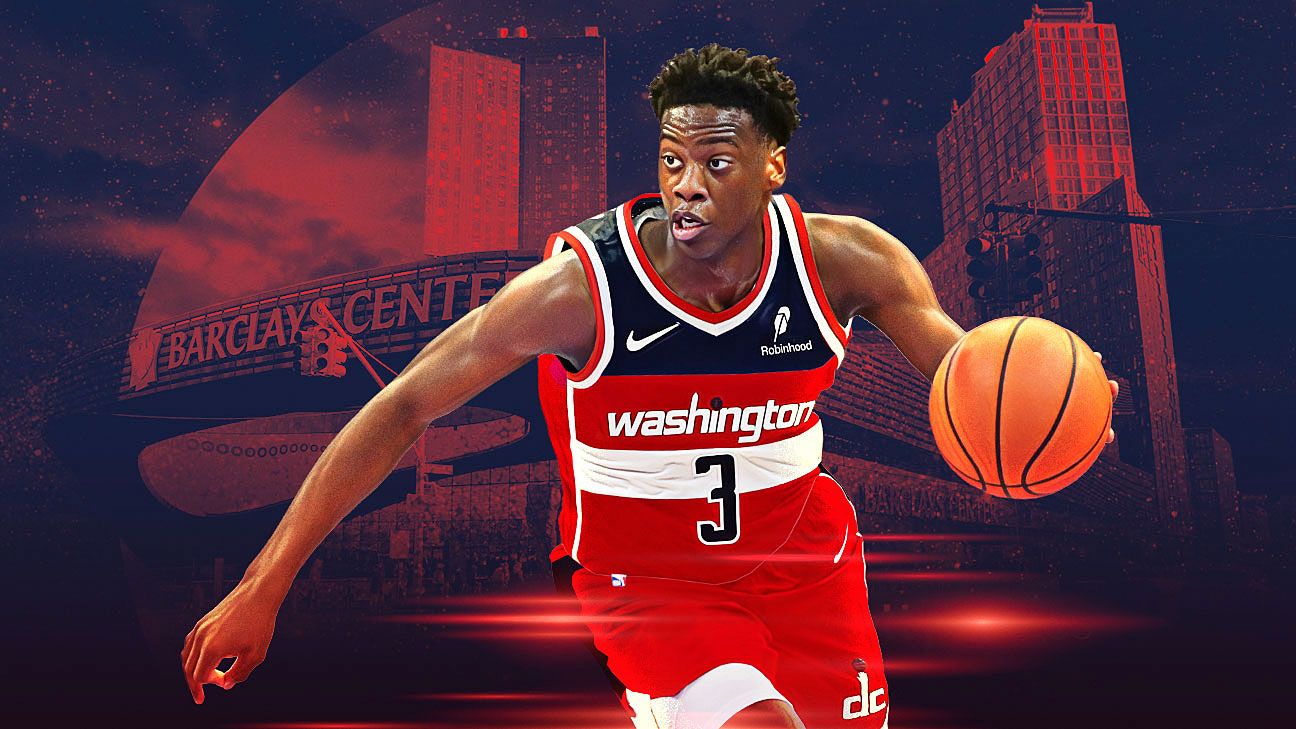
The Washington Wizards officially have the No. 1 pick in the 2026 NBA draft.
The Memphis Grizzlies and Utah Jazz jumped into the top 4, after the Indiana Pacers‘ pick dropped and was obtained by the LA Clippers at No. 5.
AJ Dybantsa sits atop the mock as our projected No. 1 pick, with more left to play out on that front as the predraft process gets fully underway.
All 30 NBA teams convene in Chicago this week for the lottery and draft combine, which begins tomorrow and runs through the end of the week.
The NCAA withdrawal deadline is 11:59 p.m. ET on May 27, giving college players 10 days to make final decisions on turning pro.
With the first-round order now fully set, here’s my updated mock draft going into the combine proper, which begins Monday.
More NBA draft coverage:
Biggest questions for every lottery team
Full draft order | Top 100 rankings | 2026 mock drafts
Combine preview | More
First round

AJ Dybantsa, SF, BYU
Freshman
The Wizards walked away as major winners on Sunday, winning the No. 1 pick for the first time since 2010. This is a shot in the arm for Washington, with the opportunity to add a franchise-level prospect after acquiring veteran stars Trae Young and Anthony Davis at the trade deadline. The Wizards lost 26 of their final 27 games to maximize their lottery positioning, which ultimately paid off. Mired in a protracted rebuild that has spanned multiple front offices and head coaches, Washington hasn’t finished above .500 since 2017-18 — something that may now change quickly.
Dybantsa is a strong fit for Washington on paper, even with the Wizards’ collection of younger wings, with his physicality and athletic tools giving him major two-way upside. He built a strong case at No. 1 over the course of an impressive freshman season, leading D-I in scoring and displaying growth as he learned to shoulder major offensive responsibility. NBA teams view his excellent size and powerful, physical style as hallmarks of a potential franchise-level talent. He has room for realistic growth as a perimeter shooter and defender, and checks all the boxes NBA teams look for in a future star at a coveted position.
While NBA teams have come to view Dybantsa as the favorite at No. 1, expect the Wizards to conduct a thorough process involving other candidates, including Peterson, Boozer and Wilson.

Darryn Peterson, PG/SG, Kansas
Freshman
Peterson opened the season projected at No. 1 and will likely be considered there, barring any further concerns in the predraft process. He told ESPN’s Ramona Shelburne this week that his doctors determined creatine usage played a role in the cramping issues that limited him at Kansas. NBA teams are hoping for further clarity from his medical evaluation and interviews at this week’s combine. A clean bill of health would help assuage lingering concerns and allow teams atop the draft to make a pure basketball decision.

Cameron Boozer, PF/C, Duke
Freshman
Boozer lived up to lofty expectations this season, cleaning up player of the year awards and nearly leading Duke to the Final Four, largely carrying the team all season. He has the makings of a foundational, tone-setting player, and while his limited vertical lift might cap some of his upside at some point, it’s hard to argue with the results he has gotten. Boozer has always been in the mix at No. 1, but has been considered by most NBA teams as a longer shot this season due to the strength of the other candidates.

Caleb Wilson, PF/C, North Carolina
Freshman
Wilson’s season ended early due to a pair of hand injuries, but that didn’t impact his momentum as a top-four selection, as teams fell in love with his motor, explosiveness, and potential as a two-way impact player. He will receive looks higher than this. He will have an opportunity to make his case in predraft workouts, where his athletic gifts should stand out, and teams will want to better assess his skill level and perimeter shooting. Whether he can ultimately leap ahead of the more proven Boozer will be an interesting draft subplot.

5. LA Clippers
Darius Acuff Jr., PG, Arkansas
Freshman
Acuff put together an individually dominant one-and-done season and put himself in position to be the next guard off the board behind Darryn Peterson. Opinions around the NBA vary on where he stacks up amid a very talented guard class — there is curiosity around how he’ll measure physically at the combine, but little doubt he has the chops to help run a team next season. There is an expectation that Acuff will need to be insulated defensively on a winning team, but he is highly skilled and the most polished point guard in this group.

Keaton Wagler, PG/SG, Illinois
Freshman
Wagler led Illinois all the way to the Final Four to cap one of the more remarkable prospect rises ever, entering the season as a curiosity for scouts and finishing as a bona fide top talent in an exceptional lottery class. While scouts expect it will take time for him to add strength and adjust physically to the NBA, the fact that Wagler is 6-foot-6, plays with change of pace, and adds value at both guard positions points to major long-term upside as his body matures and he gains experience. His unusual trajectory and rapid improvement bode well.

Kingston Flemings, PG, Houston
Freshman
Flemings’ explosive speed and winning intangibles swayed NBA executives this season, and he projects as a lead playmaker who puts downhill pressure on defenses and should also add value as a defender. The continued progression of his jump shot is key for him and something he’ll need to demonstrate effectively in team workouts, but he got positive results at Houston (38.7% from 3, 84.5% from the line) and has shown growth already in that area.

Mikel Brown Jr., PG, Louisville
Freshman
Brown’s back injury made it difficult for him to boost his stock in-season, making the predraft process critical to show teams he is healthy and remind them of his significant offensive talent. His positional size, shooting ability and playmaking skill should stand out in workout settings, but he needs a positive spring to work his way further up the board in a guard-heavy lottery, with Acuff, Wagler and Flemings all having outstanding seasons. There are still scouts who view Brown’s upside as the highest of the group, but it might take some work for him to leap ahead of the other top guards.

Brayden Burries, SG, Arizona
Freshman
Burries endeared himself to teams over the course of the season as a steady two-way contributor with room to grow as a scorer. Scouts see an intriguing upside as he continues to improve as an on-ball playmaker, but he is a solid-enough shooter to play the two, giving him appealing versatility. He is older than other freshman guards in the lottery and not as toolsy or flashy, but might be closer to directly impacting winning.

Nate Ament, SF/PF, Tennessee
Freshman
Milwaukee had just a 3.1% chance of moving into the top four, requiring a scenario where both New Orleans’ pick and its own jumped in the lottery, which would have conveyed the worse of the two. The Bucks desperately need backcourt help, but should be thinking best available, considering the uncertainty around the team’s trajectory and with ownership wanting clarity on Giannis Antetokounmpo‘s future by the draft.
While Ament’s stock has slipped from an early top-five projection, he had productive stretches this season within a tricky team context and has room to help himself in workouts. Although scouts are split on whether he has star potential or projects better as a long-term supporting player, there is still plenty of intrigue around the opportunity to select a prospect of his caliber later in the lottery. As a tall skill player with real shotmaking upside, Ament fits a player archetype that teams often love to swing on. As Milwaukee considers a post-Giannis future, a malleable upside swing like Ament could be a fit.

Karim Lopez, SF/PF, New Zealand Breakers
Mexico
The Warriors had long odds and no luck in their first draft lottery since 2021. Steve Kerr agreed to an extension on Saturday, answering one major question, but they have an important decision to make with this pick, as they weigh the long-term health of the roster versus maximizing the team’s competitive chances with Stephen Curry still playing at a high level. Selecting a younger player such as Lopez, who has the experience to potentially slot in early on his rookie deal, might help mesh the short and long-term goals.
The top overseas-based player in a thin international prospect class, Lopez has a chance to help himself in predraft workouts, where teams will gain a better sense of his physical traits and skill level coming off a positive year in the NBL. Showing progress as a perimeter shooter in those settings would help his case to sneak into the top 10, as he jockeys for position with Ament and Yaxel Lendeborg, two other versatile forwards.

Yaxel Lendeborg, PF/SF, Michigan
Senior
The rest of the NBA exhaled as this pick stood pat on lottery night, keeping the 64-win Thunder from adding a top-four prospect. The Thunder have a roster crunch they’ll have to solve for in some way this off-season, holding player options on all three of Luguentz Dort, Isaiah Hartenstein and Kenrich Williams, as well as two first-round picks (they also have No. 17). Picking up all three options would put them at 15 players, barring another consolidation trade of some type.
Lendeborg is set to benefit from his instrumental role in Michigan’s title run, where his versatility shone through on both sides of the ball, and he shot 52.9% from 3 in his final 11 games. He’ll be a 24-year-old rookie, a polarizing aspect of his projection, but he’s ready for the NBA and should be a plug-and-play rotation piece. At a certain point in the draft, the value of his unique skillset outweighs the age factor.
Labaron Philon Jr., PG/SG, Alabama
Sophomore
The Heat will pick in the lottery for the first time since 2019, but had an unlikely 4.8% chance of moving up. Miami has built much of its roster through the draft, but is also historically a free agent destination, and Pat Riley recently went on record with reporters about the possibility of angling for cap space in 2027. The need for added shot-creation on the roster, both short and long term, makes this an interesting landing spot for Philon.
Philon had an outstanding year at Alabama and proved himself as a potent scorer who can generate offense in spurts, helping him earn looks in the back half of the lottery. He can be polarizing for scouts, with persistent questions around his ability to run a team in the half court, but he’s a proven scorer with positional size who could provide a real spark coming off the bench in the right context.

Charlotte took an organizational step forward this season, making the play-in and developing chemistry, with the addition of Kon Knueppel providing a shot in the arm and head coach Charles Lee earning an extension this week. They also hold the 18th pick, giving them some optionality to move around the board.
Mara has given himself a runway to be the first center off the board, possessing an unusual skill level for 7-3 and building momentum during Michigan’s title run. He is an excellent passer and quick processor who can be an offensive conduit, in addition to finishing simple plays. Developing a reliable jumper will be an important step for him. The Hornets could use an infusion of size and offensive skill up front, making this an intriguing potential landing spot for Mara.
Jayden Quaintance, C, Kentucky
Sophomore
Quaintance is viewed by teams as a wild-card prospect with a wide range. He was a lottery candidate entering the year, but has health questions to answer in the pre-draft process. Now a year removed from ACL surgery, he played just four games this season, with knee issues flaring up after he attempted to return. His physicality and defensive upside carry long-term intrigue, considering he has yet to turn 19. How his medicals check out and how much he can participate in on-court workouts will determine his next month.
The Bulls are one of four teams (Memphis, Oklahoma City, Charlotte) that hold multiple picks inside the top 20, setting up interesting potential trade dynamics. Quaintance’s physicality as a play-finisher and shot blocker should make him an appealing consideration for Chicago at this spot.
Hannes Steinbach, PF/C, Washington
Freshman
Memphis holds two picks inside the top 20 and has a need for frontcourt depth, something the Grizzlies could look to address with this second selection. Steinbach’s dependable production and excellent rebounding stand out in a draft that’s lighter on bigs, making him one of the safer options starting in the late lottery.
While not a flashy player, Steinbach is advanced enough offensively to plug into a team’s rotation next season. There are varying opinions on how his defense and shooting (34% from 3) project long term, and scouts view him as somewhat caught between the 4 and 5 positionally because of his size.
Chris Cenac Jr., PF/C, Houston
Freshman
Cenac was polarizing for scouts all season but carries a strong high school résumé and intriguing developmental tools for a patient team to work with. His fluidity at his size and flashes of shooting touch set him apart from most of the other bigs in this class as a long-term bet. He made strides with his toughness and rebounding at Houston but remains a ways from contributing to a winning NBA team. Cenac requires some added projection, but he profiles as a viable developmental bet in this part of the draft.
The Thunder also had two first-rounders last year, choosing to roster Thomas Sorber at No. 15, then traded the 24th pick for a future protected first. Considering their roster situation, they could take a similar approach and look to flip this pick for a future asset, a move that might be simpler than consolidating picks to move up in the lottery.
Cameron Carr, SG/SF, Baylor
Sophomore
Carr is a candidate to potentially rise on the predraft circuit — his level of athleticism and shot-making ability typically plays up well in workout settings. Coming off a breakout season, his mix of perimeter shooting, elite explosiveness and defensive flashes points to long-term upside, particularly if he can add physical strength to his frame (he’s listed at just 175 pounds). His ability to score off cuts and space the floor should translate effectively, allowing him to play an off-ball role that helps mitigate his lack of playmaking.
The Hornets have two first-round picks and could opt to make both as they continue building through the draft. Moving up with No. 14 and 18 might be a challenge considering the strength of this draft, but Charlotte has some flexibility to maneuver using its picks.

Christian Anderson, PG, Texas Tech
Sophomore
Toronto successfully took a step forward this season, hitting on last year’s Collin Murray-Boyles selection and forming an intriguing long-term forward pairing with Scottie Barnes. The Raptors have several needs to address moving forward, including upgraded shooting, half-court creation and a long-term center.
Anderson’s stellar shooting (41.5% from 3) and steady ball-screen playmaking would make him an interesting younger addition to Toronto’s backcourt. His lack of a physical advantage is the primary knock, and it makes him more of a back-half first-round option in a strong point guard class.

Morez Johnson Jr., PF/C, Michigan
Sophomore
Johnson will have a chance to capitalize on his role in Michigan’s title run, with his physical style of play and defensive versatility holding long-term NBA appeal. Though undersized for a 5, he has a great frame, runs the floor well, is an active rebounder and has the ability to guard multiple positions and switch situationally. That makes him a glue-guy candidate for teams looking to get more athletic up front.
San Antonio is heavy on perimeter talent and should be considering younger frontcourt depth at this spot. The Spurs have the advantage of being able to effectively pair Victor Wembanyama with nearly any big up front, with his shooting and rim protection enabling a wide range of lineups. Johnson should draw consideration here and would give them some added muscle next to their ascending superstar.

Bennett Stirtz, PG, Iowa
Senior
Stirtz helped reaffirm his NBA readiness in March, captaining Iowa to a surprise Elite Eight run. While his shooting was streakier than anticipated this season (35.8% from 3), he carried a heavy workload and was asked to create for himself far more than he’ll need to in the pros. His ability to navigate ball screens, limit mistakes and knock down open shots gives him a path to a useful bench role in the right situation, despite entering the league as a 23-year-old rookie.
Detroit has a need for added shooting around Cade Cunningham and can go several directions at this spot. Stirtz is capable of bolstering the second unit and also adding spacing playing off the Pistons’ various playmaking wings.

Allen Graves, PF, Santa Clara
Freshman
Graves is one of the unique stories of this draft cycle and has gathered first-round momentum, thanks in large part to his strong analytic profile. He maintains the ability to return to college, where he is also in the transfer portal, making this one of the more interesting stay-or-go decisions as the combine approaches. While still somewhat polarizing among scouts and not a top-end run-jump athlete, Graves’ skill level, feel for the game and productivity have continued to pique NBA interest, giving him a pathway to rise into the top 20 with a strong predraft process.
The 76ers successfully pivoted to a younger timeline this season, with the duo of Tyrese Maxey and VJ Edgecombe set to anchor the backcourt for the foreseeable future, taking pressure off Joel Embiid. With Embiid in and out of the lineup, adding younger frontcourt depth should be a goal for Philadelphia, something they might be able to address at this pick.
Isaiah Evans, SG, Duke
Sophomore
Evans has the makings of a quality wing shooter, with good positional size and the ability to hit tough shots off movement. He took a leap this season with an expanded role at Duke and has starter-level upside if he can be more consistent. He needs to better apply his tools defensively, but he displayed some growth on that end this season.
Adding more perimeter shooting would be beneficial for the Hawks as they continue to build around the rising Jalen Johnson. They don’t have a clear positional need beyond adding a long-term point guard — something they might be able to do in the lottery — and can consider several directions with this second pick.

Koa Peat, PF/SF, Arizona
Freshman
Peat opted to declare for the draft and has an opportunity to play his way up the boards with a strong predraft process. Some teams viewed him as an excellent candidate to return to school and improve his stock, an option that remains available to him. Scouts view his perimeter shooting as a critical swing skill that will impact his trajectory, as he is not particularly effective scoring outside 15 feet at this stage of his career. But his strength and quickness relative to his size, coupled with a solid offensive feel and ability to guard the perimeter, give him a chance to find a niche in the right situation.
New York would benefit from added size and physicality up front, particularly with Mitchell Robinson headed to free agency. If Peat can develop his jumper, he could be an interesting lineup option here.

Henri Veesaar, C, North Carolina
Junior
Veesaar comes off a productive season at North Carolina and will offer sheer size and viable shooting (42.6% from 3) in a draft that has become light on true centers. He has above-average athleticism and offensive skill for his size, plus he should also be able to hold up defensively in drop coverage. The functionality he offers on offense and defense should allow him to plug into a rotation next season.
The Lakers have some roster uncertainty rolling into next season with LeBron James and likely Austin Reaves (player option) entering free agency. The most obvious need is at center, where they stand to upgrade beyond the mercurial Deandre Ayton. Veesaar would upgrade their skill level and add a floor-spacing element that the roster lacks up front.

Dailyn Swain, SG/SF, Texas
Junior
Swain is one of the most physically gifted wings in this class and has built a solid first-round case after putting together his most complete college season. He is a strong slasher and projects as a plus perimeter defender but is still coming into his own on the offensive end. Teams will be curious to further assess his inconsistent shooting (34.8% from 3, but an encouraging 81.3% from the line) in workouts, a key long-term area for growth that gives him room to rise up the board.
Denver continues to try to optimize its supporting cast around Nikola Jokic on the margins and could lose Peyton Watson in free agency. Swain’s positional size and defensive versatility would be an appealing fit here.

Amari Allen, SF/PF, Alabama
Freshman
Allen’s positional versatility and ability to augment lineups on both sides of the ball give him a path to finding a long-term NBA role. While he is not likely to create his own shot at a high level and shot a middling 34.1% from 3, his playmaking flashes and defensive instincts give him a good role-player baseline to build on if his scoring ability can catch up. Whether he can work up the board from here or ultimately winds up back in college remains to be seen, as an older Freshman who was unheralded to begin the season.
The Celtics value taller perimeter players in Allen’s mold who can fit in alongside their stars, and they could afford him time to develop.

Ebuka Okorie, PG, Stanford
Freshman
Okorie put together what could wind up as a surprise one-and-done campaign at Stanford, coming in as a relatively unheralded recruit then averaging 23.2 points on his way to an All-ACC selection. A tough-minded and shifty scorer who is undersized and slight for his position, it remains to be seen how high he can rise in a deep point guard class, with the option to return to school and enter a thinner 2027 draft still available to him.
The Timberwolves could use a reserve ball handler to help stabilize the position long term, with Okorie’s microwave scoring talent a potential fit off the bench.

Meleek Thomas, PG/SG, Arkansas
Freshman
Thomas is a talented scorer with solid positional size and made 41.6% of his 3s this season, making him a viable first-round option for teams in need of offensive help. He has the option to return to Arkansas, where he’d step into an even larger role next season without Darius Acuff Jr., and could play his way firmly into the first round in 2027.
In the midst of this current competitive window, Cleveland can justify picking for need at this slot — but if a younger player winds up falling here, taking an upside swing might make sense.
Joshua Jefferson, SF/PF, Iowa State
Senior
An untimely ankle injury in the Big 12 tournament ended Jefferson’s season prematurely, but he played his way into the late first-round mix as a steady all-around player. He is skilled for his size with good vision and an unselfish approach that should help blend lineups and hold plug-and-play appeal. Jefferson shot a career-best 34.5% from 3 this season but still needs to become a more reliable floor spacer to tie his skill set together.
The Mavs should be angling to kick start toward winning next season, with Cooper Flagg on the rise and Dallas not controlling its own pick until 2031. While still rebuilding, adding a more NBA-ready player with this second first-round selection makes sense.

Second round
31. New York Knicks (via Washington)
Alex Karaban, SF/PF, UConn, Senior
32. Memphis Grizzlies (via Indiana)
Tyler Tanner, PG/SG, Vanderbilt, Sophomore
33. Brooklyn Nets
Tounde Yessoufou, SF, Baylor, Freshman
34. Sacramento Kings
Zuby Ejiofor, PF/C, St. John’s, Senior
35. San Antonio Spurs (via Utah)
Milan Momcilovic, PF/SF, Iowa State, Junior
36. LA Clippers (via Memphis)
Luigi Suigo, C, Mega Basket, Italy
37. Oklahoma City Thunder (via Dallas)
Tarris Reed Jr., PF/C, UConn, Senior
38. Chicago Bulls (via New Orleans)
Ryan Conwell, SG, Louisville, Senior
39. Houston Rockets (via Chicago)
Matt Able, SF, NC State, Freshman
40. Boston Celtics (via Milwaukee)
Braden Smith, PG, Purdue, Senior
41. Miami Heat (via Golden State)
Flory Bidunga, C, Kansas, Sophomore
42. San Antonio Spurs (via Portland)
Sergio de Larrea, PG/SG, Valencia, Spain
43. Brooklyn Nets (via Clippers)
Malachi Moreno, C, Kentucky, Freshman
44. San Antonio Spurs (via Miami)
Baba Miller, PF/C, Cincinnati, Senior
45. Sacramento Kings (via Charlotte)
Richie Saunders, SG/SF, BYU, Senior
46. Orlando Magic
Rueben Chinyelu, C, Florida, Junior
47. Phoenix Suns (via Philadelphia)
Jeremy Fears Jr., PG, Michigan State, Sophomore
48. Dallas Mavericks (via Phoenix)
Trevon Brazile, PF/C, Arkansas, Senior
49. Denver Nuggets (via Atlanta)
Billy Richmond III, SG/SF, Arkansas, Sophomore
50. Toronto Raptors
Ugonna Onyenso, C, Virginia, Senior
51. Washington Wizards (via Minnesota)
Jaden Bradley, PG/SG, Arizona, Senior
52. LA Clippers (via Cleveland)
Izaiyah Nelson, PF/C, South Florida, Senior
53. Houston Rockets
Andrej Stojakovic, SG/SF, Illinois, Junior
54. Golden State Warriors (via Lakers)
Felix Okpara, C, Tennessee, Senior
55. New York Knicks
Bruce Thornton, PG/SG, Ohio State, Senior
56. Chicago Bulls (via Denver)
Kylan Boswell, PG/SG, Illinois, Senior
57. Atlanta Hawks (via Boston)
Emanuel Sharp, SG, Houston, Senior
58. New Orleans Pelicans (via Detroit)
Nick Martinelli, SF/PF, Northwestern, Senior
59. Minnesota Timberwolves (via San Antonio)
Milos Uzan, PG, Houston, Senior
60. Washington Wizards (via Oklahoma City)
Ja’Kobi Gillespie, PG, Tennessee, Senior

