
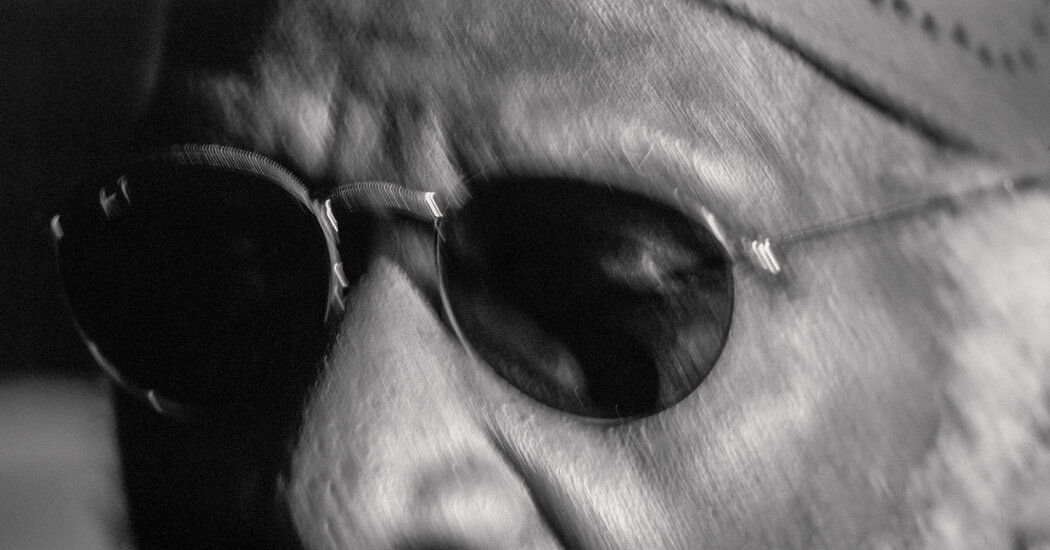
The modern bluesman Taj Mahal will turn 84 on May 17. He still plans to make a lot more music. “There are always songs,” he said on a visit to New York City in late April. “If I were blessed to not be concerned about making a living, then I could just get up every day and make music. I’d be able to come up with literally an album a day.”
Since the 1960s, Mahal has been making music that’s grounded in the blues but finds connections worldwide. “Jazz will give you back your mind, reggae will give you back your body, but the blues will give you back your soul. That’s why they ain’t goin’ nowhere,” he said. “You can never chew all the flavor out of the blues. It’ll never happen. The blues is a fact of life that happened with the collision between the West and the East, a crash in the Delta. It’s always going to exist.”
Taj Mahal’s blues are anything but revivalist or purist. He has recorded with musicians from India, Hawaii, Jamaica, Mali, Zanzibar and beyond. “My sweep is global,” he said. “It’s always been diasporic.”
We met at Arthur’s Tavern, a venerable jazz and blues club in Greenwich Village. Mahal wore a purple African-style two-piece suit, a brown cap, a blue bandanna and sunglasses — at once regal and casual. Arthur’s is a few blocks away from where the young Henry St. Clair Fredericks Jr. — the name he changed to Taj Mahal after dreaming about Mahatma Gandhi — soaked up the 1960s folk revival, playing at hootenanny nights and meeting musicians like Bob Dylan and Richie Havens backstage.
“I lived in Massachusetts, but where was it happening? It was happening in the Village,” he said in the amiable growl that has served him for dozens of albums since his debut LP in 1968. “So you get your guitar, you get your thumb out and you hitchhike down to the city.”
Mahal has just released a new album, “Time,” backed by his Phantom Blues Band, which is joining him on summer tour dates. The title track is a previously unreleased song written by Bill Withers; it takes a consoling long view, promising that “time will see you through.” Withers retired from recording rather than letting corporate pressure change his music.
“You had people who were not musicians standing up telling someone who was obviously successful that he must change for the industry,” Mahal said. “He needs to add women to the background. He needs synthesizers, horns, to step up the pace. And he needs to sing like what they’re doing over there. How do they get all these other guys to just roll over and do that?”
The rest of the album is a good-timey collection that touches on blues, Memphis soul, salsa, reggae (with a guest appearance by Ziggy Marley) and R&B — especially New Orleans R&B, since the songs were recorded when the English-born, New Orleans-based, two-fisted pianist Jon Cleary was in the Phantom Blues Band.
Mahal is also planning to rerelease “Kulanjan,” an album from 1999 that he recorded with the masterly kora player Toumani Diabate (who died in 2024) and other musicians from Mali; it will be expanded with video from its recording sessions. On “Kulanjan,” Mahal dovetailed his blues with the griot traditions of the Songhai empire in West Africa, which in the 15th and 16th centuries encompassed much of modern-day Mali, Senegal, Gambia, Guinea and more.
“If I had made nothing more than ‘Kulanjan’ in this life I’d be happy,” he said. “It was like we had a 500-year separation and I gathered all the parts that sounded like they came from home. And I came back and played them and they said, ‘Sure, we know that.’”
On the road and in the studio, he continues to juggle multiple lineups. He performs solo shows playing guitar, steel guitar, piano, banjo, harmonica and kalimba. He has also led a trio, a quartet, a sextet, the Phantom Blues Band, the Hula Blues Band (with Hawaiian musicians), his International Rhythm Band and a swing band, Savoy. He’s recorded tracks with celebrated rappers — hip-hop with a bluesy foundation — that are still unreleased.
TajMo, Mahal’s blues duo with Keb Mo’, is touring later this year; they won a Grammy Award for contemporary blues album in 2018. In a telephone interview, Keb Mo’ described TajMo as “a master-disciple relationship.” When Keb Mo’ was a teenager, a Mahal show was life-changing.
“What he represented was a path that I never would have seen,” he said. “When I saw him perform, it really sparked something. I wasn’t even looking at it as the blues. It was like, it’s just another way to express yourself musically. I kept being drawn to his music, drawn to how he did things and the intention behind it, and how he approaches it — the spiritual side of it, and the African lineage.”
Mahal developed his global ear from the beginning. His father, who was a pianist and composer before starting a family, was from St. Kitts, and his mother, who sang in church and worked as a schoolteacher, was from South Carolina. Six months after Mahal was born in Harlem, the family moved to Springfield, Mass., where his father found steady work as a day laborer. After his father was killed in an accident, his mother married a Jamaican man. So Mahal picked up cultural cues from both the Caribbean and the American South, and more. His neighbors, he recalled, were “Jewish, Armenian, Polish, Sicilian — we were all together.” He’s still fond of polkas.
His father had a shortwave radio, and one of the presets was a station from Hawaii, where musicians developed a sweetly sighing, otherworldly approach to slide guitar. “I punched in on Honolulu and this music came out of that radio,” Mahal recalled. “It filled every single molecule in my body. And whoever these people were, I wanted to get a chance to meet them, to see what makes them play from that deep of a human space.”
Attending the University of Massachusetts expanded his tastes further; among other things, Jewish students who had worked at kibbutzim in Israel introduced him to the music of the Egyptian singer Umm Kulthum, whom he still reveres. “If I hadn’t gone to the university and seen that there was a whole musical aquifer that was out there, it might have been a different thing,” he said. “You began to hear that there was a framework beyond what was coming from record companies.”
Mahal moved to California to start a band with a teenage guitar virtuoso — Ry Cooder — and was signed to a major label, Columbia. His albums quickly ranged beyond vintage blues. In 1969, he put an indelible down-home stamp on “Take a Giant Step,” a Gerry Goffin-Carole King song previously recorded by the Monkees. His 1971 album, “The Real Thing,” presented a band with a horn section of four tubas — a raucous, exuberant lineup that couldn’t support itself on the road.
By the end of the 1970s, major labels had lost interest in Mahal, and vice versa. He had never courted pop hits or radio airplay. Instead, he has built a huge discography on independent and international labels, while sustaining his career on the road like a latter-day griot. “The griots don’t have an uber-corporate situation telling them what to do,” he said. “And they were powerful enough to know that it was the music that accesses the information.”
By his count, Mahal has been to 85 countries, “playing music without big hits,” he said. Implicitly, Taj Mahal’s music is about African roots and American pluralism: the common humanity that unites diverse cultures. Yet his recordings and performances don’t spell that out in political terms. “I like to see people happy,” he said. “We’ve got enough things to move us in the wrong direction.”
But he added, “I think that just being able to do what I do, the way I do it, is a political statement itself.”
He believes that too many people remain ignorant about Africa’s cultural contributions to America and the rest of the world. “You beat these people, you wrecked them, you hung them,” he said. “You got 258 years of free labor out of them. You built the West off of it, excuse me. Hey, it’s not going to go away just ’cause you want to put blinders on and not see it.”
As a Black American, he said, “I relate to all the people that have been colonized and had to deal with it. You know. Where your language has been stolen, your lifestyle, your life. Your culture’s been stolen. You know I see that, see us as being kindred people. Everywhere I go, if there are Indigenous people, I’m going to find out who it is and where they are, and connect with them.”
Lately, Mahal has been working with Narada Michael Walden, a drummer for the Mahavishnu Orchestra who went on to produce sleek pop hits for Aretha Franklin, Whitney Houston and Mariah Carey.
“He said, ‘You’re 83 years old and you’re still doing your music and you still creating. What is it that makes you do this?’
“I said, ‘Every day you have to build it. If you are lucky enough to be gifted with the ability to come onto this planet, in this physical plane, as a musician or an artist, whatever good thing that you can bring out to humanity, you get the opportunity to do it,’” he said. “‘You’re one of the luckiest people in the world.’”

