
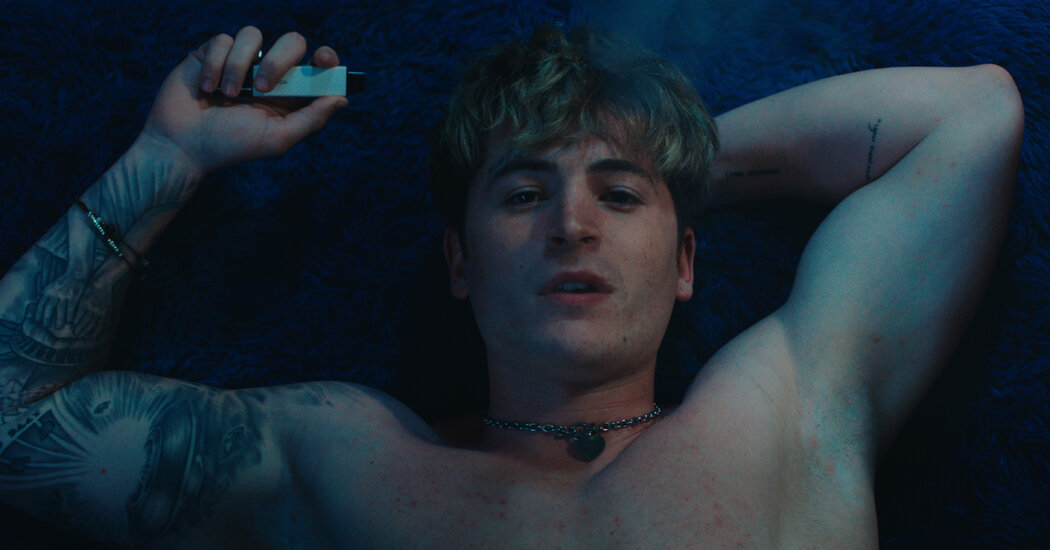
Let’s say you’re one of those livestreaming camboys. You just spent another tighty-whitied afternoon frothing up your worshipers who love it when you call them that certain anti-gay slur and bully them into all kinds of virtual submission. And now you’re making a house call, in Los Angeles, to a very special lust bucket. This guy’s promising $50,000 for a night with you. But the vibe is off. When he opens the door, he’s in a balaclava. And he wants to make a video of you just answering questions about where you’re from and why’s the word “diablo” tattooed near one eyebrow. Your Spidey senses are telling you to turn around. Sex yes. But an interview? I’m out. Except you’re not. This masked man has reeled you in. The ensuing evening is the night of your life, in part because it’s a night about your life.
Welcome to the first 10 minutes of “Blue Film.” It’s with considerable reluctance that I’m disclosing what comes after them. So much care and risk have gone into the writing, directing and acting of Elliot Tuttle’s movie that it feels lousy to lay everything out. The what here, though, is secondary to how Tuttle dares to explore sexual deviancy with what can only be considered compassion and true existential wonder.
The man who opens the door is Hank (Reed Birney), slightly built and late-middle-age (tail end of his 60s maybe). He speaks softly, in bookish, proper sentences. He used to teach the younger man standing on the porch. Aaron Eagle is his nom de cam. And Kieron Moore plays him a little twitchy. Aaron sucks on his little smoke box like it’s oxygen. He remembers this guy. It’s Mr. Grant, his middle school English teacher. And he also recalls improper sexual contact between Mr. Grant and one of his students. Nothing critical (or illegal) ever transpired between him and Aaron, but the elder man says he clocked preteen Aaron because he seemed lonely and isolated, because he brooded; teaching with Aaron in the room, Hank says, gave him butterflies.
Now, Hank has become besotted with Aaron’s aggro, rapey live streams. (He can still detect isolation and probably insecurity.) He’s scraped together the money to fly across the country, rent this house and pay Aaron for — well, for what? The movie’s comfortable with Hank’s ambiguous mission. “I wanna know if I still love you” is how he puts it to Aaron. But he’d like to discover so much more besides that, too. And Aaron’s reasons for staying put are just as open-ended. He wants more than the money. He wants to know if he’s still worth loving. By this old creep, by anybody. So for the movie’s 80-something minutes, they talk, first about their pasts, about what Hank’s paying Aaron to do, then eventually what it means to be into what they’re into, sexually, and whether their attractions define their humanity. “That’s all perversity is,” says Hank stepping onto one of his lofty Tennessee Williams planks. “It’s loneliness.” “But maybe it makes you evil,” says Aaron, revealing further trace elements of some inner Stanley Kowalski.
The psychodrama Tuttle is staging would have been intriguing enough. He could’ve settled for a musky piece of theater, having each man curled up or reclined somewhere as the other sits at his feet, or an empty bathtub’s, and listens. But “Blue Film” is serious about the “film” part — well, the cinema of it. Maybe halfway through, things turn physical (starting with a shower), and there’s a major shift in perspective. The movie’s patient observation erupts into the camcorder-ed invasiveness of some porn. The cinematographer Ryan Jackson-Healy’s heretofore stable, yet angular camera ideas turn into the more garish, less dimensional lighting of video. The jump is startling. Suddenly, the formal quiet of two people talking gets visually noisy, and the “noise” has a familiar style that belongs to so-called adult movies. What the camera’s going haywire for is Aaron letting Hank shave away his fur. The video rhymes with the movie’s other camcorder imagery: Aaron’s live streams, but especially all the home-video footage.
By this point, Hank and Aaron have been drinking and Aaron is high and aroused by Hanks’s lowered guard (Hank claims he’s sober and is guzzling beer only for Aaron). But then Hank makes his move, and the reason the switch to video is such a shock is that you realize the new format is an expression of his urges, and what he wants is to make Aaron into someone more, what’s the word, prepubescent. The shock is the sensual spell everybody’s under — the filmmakers, these men. This passage is wrong. It’s dangerous. But Tuttle and the actors are going for it. And the audacity to let the desire speak becomes the movie’s power. The film knows it’s crossing a line: This is hardcore, too.
Then the spell breaks. The format reverts to its original, lamp-lit quiet. And we’re all left to wonder about what has just transpired. Literal grooming, for starters. But other procedural questions abound: Is this really role play? Is Hank performing pedophilia? Aaron’s in his late 20s. If he’s pretending to be, say, 12, does that make this encounter officially pedophilic? Is this muscle memory for Hank or some new frontier? Progress or regression? Have they tapped into their worst selves? I’m not a psychologist! Am I even asking the right questions? One beautiful aspect of this movie is that the sex just keeps deepening the rumination.
The power and durability of this thing is that it’s such a work of moral philosophy, existential angst and interpersonal recrimination. The surprises in it have more to do with the nerve of all the candor. There’s no plot to twist. It’s merely two men increasingly astonished by what they’re saying to each other about themselves, surprised by what they’re hearing, doing and feeling. It’s also possible that the astonishment is just mine.
It’s funny, that title. “Blue movies” are what adult films used to go by. Andy Warhol’s “Blue Movie” is a now-elemental envelope-pusher notorious in 1969 for its intercourse when, really, it was a peacenik’s love-in. Terry Southern’s got a satirical novel, from 1970, called “Blue Movie” that supposed how star-studded, big-budget porn might go. Tuttle is stressing the “adult” in “adult movie,” testing the grace maturity should grant. He’s got company. Of all the talking — the physical, sensual talking — I’ve been watching men do lately, often in each other’s arms, on shows like “Heated Rivalry” and “DTF St. Louis,” in movies like “Pillion,” the conversations in “Blue Film” take some alternative route to revelation. The talking isn’t porn, the way it feels like it is on “Heated Rivalry.” That series was making up for everything that gay men haven’t been saying on screens to each other, from their hearts.
The talking in “Blue Film” concerns our souls — the mess our psyches and upbringings can make of them — and what or who could save them; whether they can be saved at all. Is salvation even the right concept here? I’ll never do some of this talking justice, and transcribing it would cheapen how devastating it is to hear two actors debate it. Let it happen to you and see where you come down.
Moore has the soft fitness, arm ink and adolescent thuggishness of certain personal trainers and white rappers and boy band recruits. He has to perform an answer to questions asked by some of us who’ve watched gay porn and wondered about its stars. What’s this like for you? When did you know you were good at it? Are you happy? Aaron thinks he knows, but Moore is a sneaky actor. The key to making us believe the character is in the performer’s eyes, the vacancy Moore creates behind them. Those thousand-yard stares of his are landing this guy somewhere profound. And every drag he takes on that vape pen feels like an almost medicinal reminder not to stay there.
Birney has the harder job, surprise, surprise. It’s not simply that he’s playing a man talking about his attraction to children. It’s that he has discovered ways to confess what few of us have heard someone with this sexual curse admit, so that what he’s saying doesn’t sound like a revelation at all. He’s acting self-acceptance but also self-indulgence, relapse and shame. Heaven help people like me who’ve had a hard time keeping straight the difference between him and the actor Dylan Baker. Baker played an active, scheming pedophile in Todd Solondz’s “Happiness,” a 28-year-old comedy remarkable for Baker’s serene, declarative helplessness. Birney could be playing that character’s conscience, an exploration of atonement, a rumination on personal ruin and spiritual rot.
I left this movie with an exhilarated kind of heaviness. Here is a work of art that wants to know what makes us us. There’s no caution. I don’t sense any compromise, either. Nor do I detect judgment. We’re being trusted with these souls, entrusted with them. Actually, I left “Blue Film” thinking about this new smash-hit Michael Jackson movie, “Michael,” and the travesty of its distrust. What if the people who manage his legacy and helped make that movie dared to wonder, really, about his desire, what was in his heart and his head, what weighed on him. Nobody has to go even half as far as “Blue Film” does, but what if somebody dramatized any sort of belief that Jackson was fallibly human, too. Some of what feels good about Tuttle’s movie is that, for all of the places it’s bold enough to go, I couldn’t describe it as fearless. It’s full of fears, and it’s daring us to face them.
Blue Film
Not rated. Running time: 1 hour 22 minutes. In theaters.

