
Forecasters say a powerful El Niño weather pattern could form later this year, with a chance of becoming one of the strongest in three decades. The winds above the Pacific are shifting, the ocean is releasing stored-up heat, and a cascade of effects on rain, droughts and wildfires could be on its way.
The National Oceanic and Atmospheric Administration says there’s a roughly 60 percent chance of an El Niño developing between May and July. That’s a major reason scientists now say next year could surpass 2024 as the planet’s warmest year since modern records began in the mid-19th century.
El Niño and La Niña are the opposite phases of a natural climate cycle that has been active in the Pacific for thousands of years. They appear at irregular intervals, and no two events are ever the same. But Earth’s steady warming from the burning of fossil fuels is also influencing the way these episodes shape the weather around the globe.
“We are now in a different base line climate,” said Clara Deser, a senior scientist at the National Center for Atmospheric Research in Boulder, Colo. That means past El Niños don’t necessarily tell us how the El Niños of the future will look, Dr. Deser said.
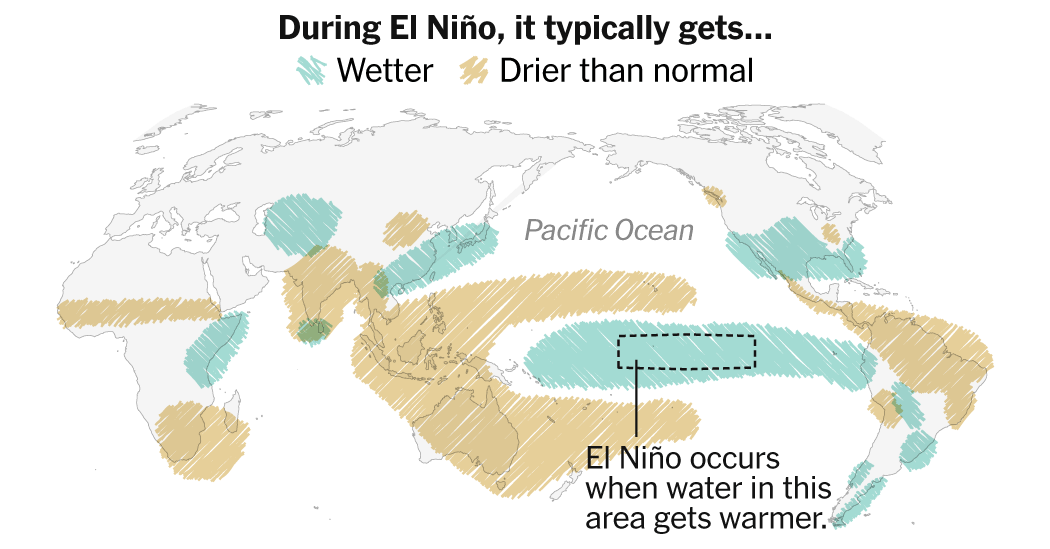
Here’s how El Niño affects the world.
Life in South America has been entwined for centuries with El Niño and its distinctive pileup of warm ocean waters off Peru and Ecuador. Meteorologists classify El Niños as strong or weak depending on how much warmer those waters are than average. The strongest events cause a variety of effects across the continent: severe floods in southern Brazil in 1982-83, drought in Colombia that ravaged coffee crops in 1997-98, and below-normal rain and wildfires in the Amazon in 2015-16.
Technically, the most recent El Niño, in 2023-24, wasn’t as strong as its predecessors. Yet its effects in some areas were more catastrophic. Scarce rainfall brought some rivers in the Amazon basin to their lowest levels in 120 years. Fires scorched the Pantanal, the world’s largest tropical wetland. Record-breaking rains in Brazil’s southernmost state, Rio Grande do Sul, displaced half a million people.
A major amplifying factor, scientists found, was human-induced warming.
The effects followed the expected pattern for El Niño, but they were “much worse because of climate change, because now this impact is happening in an atmosphere that is warmer,” said Regina R. Rodrigues, a professor of physical oceanography at the Federal University of Santa Catarina in Brazil.
The extra warmth increased evaporation, which supercharged drought in the Amazon. It also intensified the rains in Brazil’s south, because warmer air can hold more moisture.
In North America, El Niño typically delivers wetter conditions across the southern tier of the United States and warmer, drier weather up north. The very strong El Niño that began in 1997, for instance, saw weeks of drenching winter storms in California and heat records smashed in the Midwest and Northeast. Atlantic hurricane activity in the months before was below normal, another El Niño result.
But the effects of the next two strong El Niños were relatively muted in North America. One reason in 2023-24, scientists found, was a pattern of unusual warmth in the tropical Indian and Atlantic Oceans that offset El Niño’s effects. This pattern was likely to have been driven both by warming from greenhouse-gas emissions and by natural, long-term climate variations that scientists are still trying to decipher.
“Stronger El Niño events can only make certain outcomes more likely, but it does not ensure them,” said Michelle L’Heureux, a meteorologist who coordinates NOAA’s updates on El Niño and La Niña.
El Niño brings extra heat and dryness to South and Southeast Asia, but for China, it’s what happens next that’s often more consequential. After the very strong El Niño of 1997-98, the country experienced its worst flooding in nearly five decades. The Yangtze River and its tributaries were battered by two months of heavy rain, killing some 3,000 people.
The reason was the quick swing in 1998 from a strong El Niño to a strong La Niña, said Wenju Cai, a climate scientist at the Ocean University of China. The rapid switch caused a high-pressure system over the western Pacific to channel warm, wet air from the tropics and ram it toward China.
Scientists expect both strong El Niños and strong La Niñas to become more frequent as humans continue heating the planet. That means sharp seesaws between the two could happen more often, too.
So far, it’s been relatively rare for a strong La Niña (when the eastern and central Pacific is cool) to flip to a strong El Niño (when it’s warm), “because it takes multiple years to warm the Pacific,” Dr. Cai said. But Earth’s overall warming might be making that more common, he and his colleagues found in a recent study.
In Africa, El Niño tends to dry out two regions’ rainy seasons: July through September in the Sahel and November through March in southern Africa. It also often coincides with winds that blow warm, moist air across the Indian Ocean and toward East Africa, leading to floods, landslides and malaria outbreaks there. The human consequences can be enormous: The 2015-16 El Niño caused crops to fail across southern Africa, with food production falling by two-thirds in some countries.
Warming caused by greenhouse gases in the atmosphere is worsening many deluges and droughts in Africa, whether they’re brought about by El Niño or not, Dr. Cai said. “The dry extremes and wet extremes both increase,” he said.
El Niño usually spells below-average rains for Oceania. Nearby Indonesia braces for forest fires; its neighbors brace for smoke. Now, though, global warming is reshaping where and how warm the seas around the region become. This can modulate the amount of rain that El Niño and La Niña actually deliver, said Andréa Taschetto, a climate scientist at the University of New South Wales in Sydney, Australia.
Despite all these uncertainties, El Niño and La Niña remain remarkably useful signals of future weather, Dr. Taschetto said.
For farmers, land managers, disaster agencies, insurance companies and more, nothing else provides such a reliable indication of how the world might look a few seasons ahead. “This is the best thing that we have,” she said.

