
The evolution of life on Earth is largely interconnected with living organisms sharing characteristic features among themselves. These connections often help scientists to deduce indirect conclusions about various living beings by observing patterns across species. Recently, the discovery of previously unknown sensory hair cells on the body of squids has offered the scientists a new way to investigate how human hearing works. The findings, led by researchers at Case Western Reserve University, were published in the journal Current Biology in September 2026.The research titled ‘An anatomical map of squid lateral lines’ has found that sensory hair cells are spread all across the body of a squid and not just around their heads and arms. These microscopic structures help the animals sense movements in the surrounding water. The recent study includes the first full-body mapping of lateral lines on squid, which are made up of arrays of hair cells.Squids are remarkable marine creatures that change color, evade predators and move through the dark ocean. For a long time, scientists believed that squids have cells with many hair-like protrusions, similar to the ones present in the human ear that allow us to hear. These were believed to be present only on their heads and arms. Now, researchers have found out that such cells, called hair cells, occur on the entire surface of a squid’s body.The team of researchers used light sheet microscopy for this experiment. It is a state-of-the-art imaging process that uses a laser to create a thin sheet of light, illuminating just one plane of the specimen at a time. This allows researchers to build detailed 3D images and minimize damage to the tissue.
How do squid “hear” without ears like ours?
The human hearing mechanism depends on tiny sensory cells that are found deep inside our inner ear, in a snail-shaped structure called the cochlea. The sound waves create vibrations when they enter the ear, bending the hair-like projections on these cells. These cells then convert that movement into electrical signals that are transmitted to the brain, where they are interpreted as sound. Any damage to these delicate structures can lead to issues in hearing ability including hearing loss in extreme cases.
(Image Credit: Wikimedia Commons)
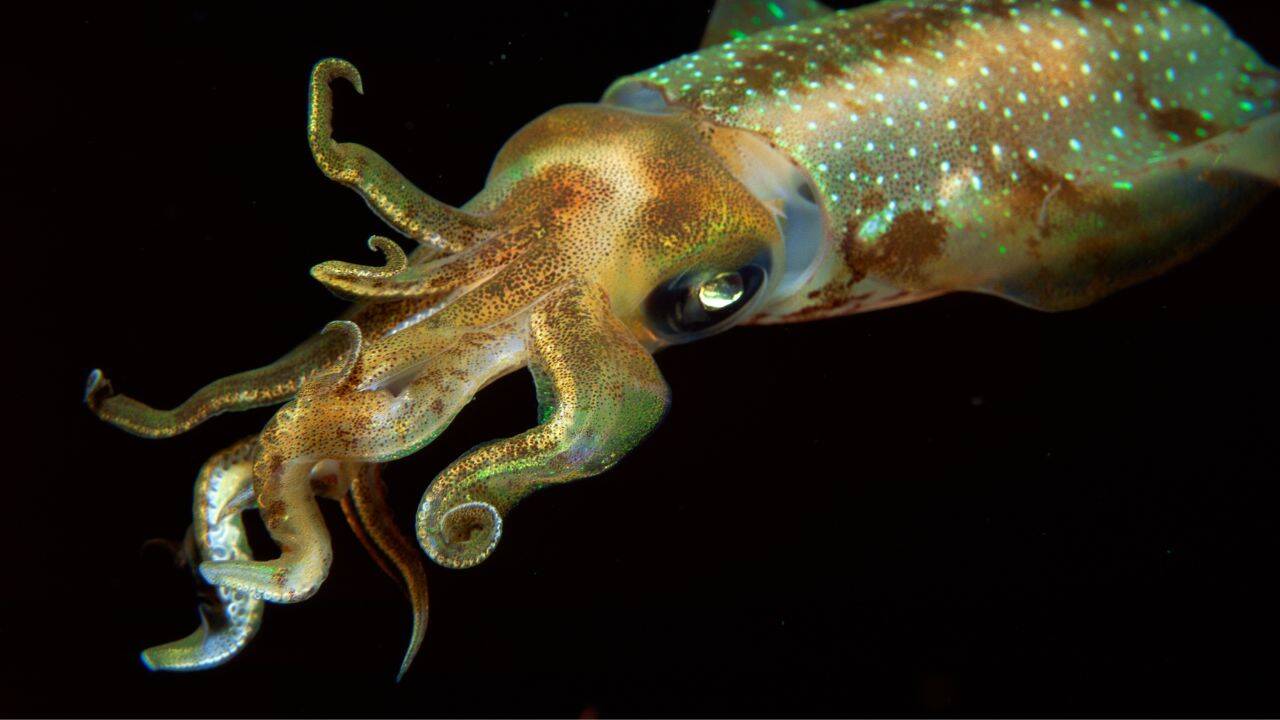
Squid, like other sea creatures, use similar-looking sensory machinery for a different purpose. Rather than relying on ears like ours, they use hair cells on their bodies to detect local movements in the surrounding water. A passing animal, a shifting current or another disturbance can produce movements that these specialised cells register. The similarity in mechanism of detecting movements to understand different pitches of sound led the scientists to conclude that the skin of the squid seems to act like a human ear.The fascinating part is that unlike fish lateral lines which have hair bundles that do not vary in length, squid have hair bundles that appear to vary in length. According to the researchers, this variation may help the cells respond to different frequencies of water movement, much as the human ear. This distinction in squids from other sea creatures have made them potential models to study human hearing.
Could a squid help us understand hearing loss?
The hair cells inside our ears are extraordinarily delicate. When their sensory bundles are damaged, they may no longer transmit sound information properly. Such damage can occur through exposure to loud noise, ageing, certain medications or inherited conditions.Unlike some other cells in the body, damaged human inner-ear sensory hair cells generally do not regenerate naturally in a way that restores normal hearing. This is one reason researchers continue to investigate how these cells develop, function and become damaged.Studying them directly in humans presents challenges. The cochlea is small, intricate and protected deep inside the skull. Squid, by contrast, have hair cells distributed on the outside of their bodies, making their sensory structures more accessible for observation. That accessibility could give researchers an opportunity to investigate how hair bundles are built, how their lengths are controlled and how they respond to mechanical stimulation.

