
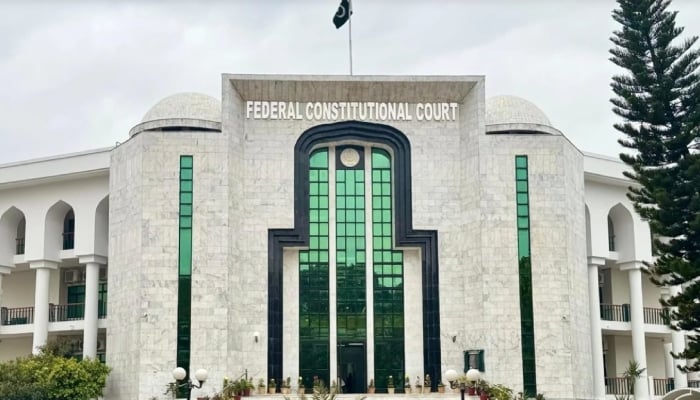
- Court rules Super Tax additional income tax under Entry 47.
- Judgement says Federal Legislative List gives constitutionality.
- No Super Tax payable where capital gains already tax-exempt.
ISLAMABAD: The Federal Constitutional Court (FCC) of Pakistan upheld the constitutionality of the super tax introduced under Sections 4B and 4C of the Income Tax Ordinance, 2001, backing the Federal Board of Revenue (FBR).
However, it excluded capital gains from the disposal of immovable property or securities held for a prescribed period, The News reported on Thursday.
The FCC passed its judgement in a case filed by DG Khan Cement Company Limited and others. This judgement vindicates the position pursued by the Federation of Pakistan and the FBR.
The FCC ruled that the super tax is an additional tax on income, drawing its legislative sanction from entry 47, Part 1 of the Federal Legislative List of the Constitution.
“The necessary corollary to the above is that if a certain class of income is exempt from tax under the law regulating it i.e. the ordinance,” the judgement read and added, “For instance, where no tax is payable on capital gains arising on disposal of immoveable property or securities either for being held beyond a certain period or is inherited or is otherwise exempted from the ordinance, no super tax shall be payable on such capital gains on disposal of immoveable property or securities”.
The FCC ruled that the same principle “shall apply” to any capital gains on disposal of agricultural property, which even otherwise cannot be subject to income arising therefrom either by usage or by disposal.
Top official sources in the FBR said that the tax machinery so far collected Rs290 billion on account of Super Tax in the first nine months of the current fiscal year, and it might go up to Rs315 billion by the end of June 2026.
In the extensive and detailed, almost 300-page judgement, the court critically examined several complex taxation issues.
The court held that the super tax levied under Section 4B (introduced by the Finance Act, 2015 for the rehabilitation of temporarily displaced persons from tax years 2015-2022)) and Section 4C (introduced by the Finance Act, 2022 imposed on ‘High Earning Persons’ from tax year 2022 and onwards) is a valid exercise of parliament’s taxing power under Entry 47 of the Federal Legislative List of the Constitution of Pakistan, being a tax on income.
In the case of section 4B, the court rejected the argument that the levy was a fee and not a tax, holding that the mere mention of a purpose did not automatically render the tax a fee in the absence of any direct service linkage to any beneficiary.
The court placed Section 4B squarely within the domain of taxation, validly passed through the Finance Act, thereby upholding all the high courts’ judgements to this effect.
In respect of Section 4C Super Tax, the court further held that the provision is a self-contained provision with its own charge, assessment, and payment mechanism; there is no constitutional bar on so-called “double taxation”.
Significantly, the court reaffirmed the doctrine of judicial restraint in fiscal matters, holding that the wisdom and policy of taxation lie with the legislature, and that judicial review is confined to questions of legislative competence, constitutional compliance, and absence of arbitrariness.
In another significant finding on the jurisdictional side, the court found the FBR and the Commissioner Inland Revenue (if properly authorised) to enjoy the powers of instituting and defending proceedings relating to tax matters arising from constitutional challenges.
