
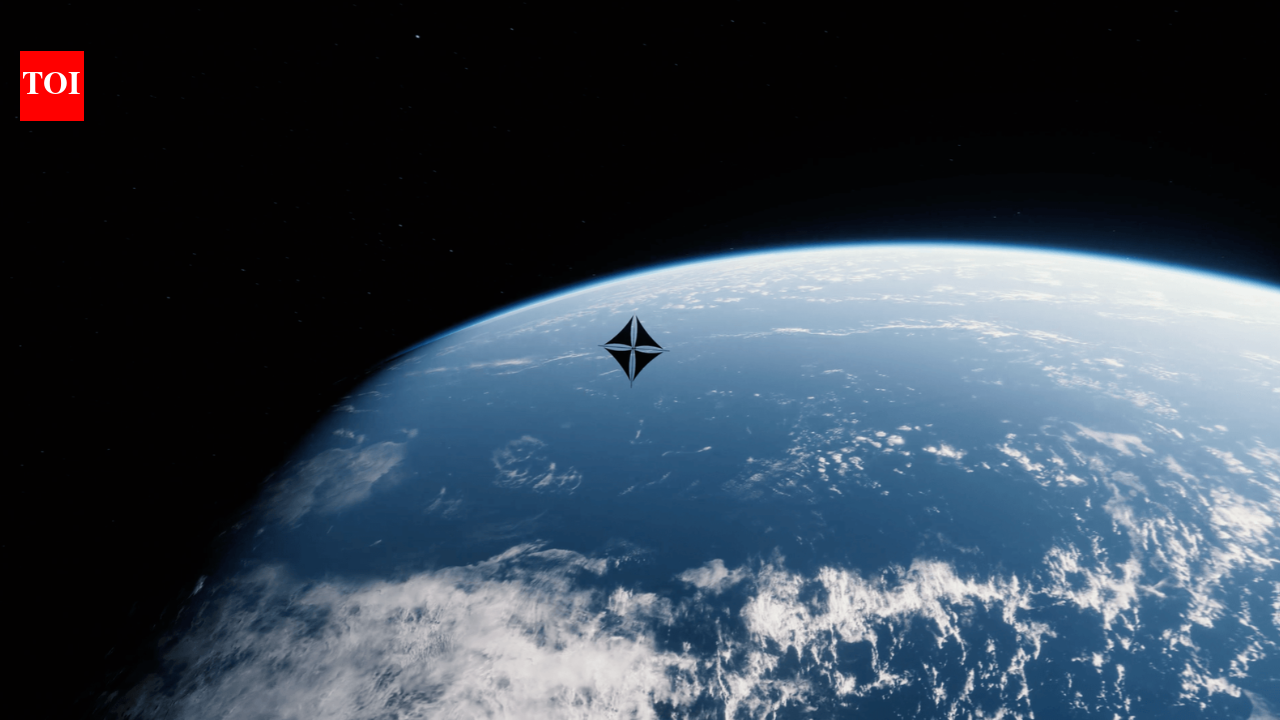
Sunlight at night, sold on demand by an American space start-up using Indian rockets, is moving from science fiction towards commercial reality. California-based Reflect Orbital plans to place giant mirrors in low-Earth orbit and steer reflected sunlight onto chosen spots on the ground after dark. Customers could include solar farms wanting longer generating hours, rescue teams searching disaster zones, and industrial sites working through the night. The company has booked two launches with Hyderabad-based Skyroot Aerospace, tying India directly to a service no business has sold before. The first launch will use Skyroot’s Vikram-1 rocket, the second its newer Vikram-1U.
Sunlight you can dim or switch off; five-kilometre swathe, with defence sites and events in mind
According to PTI, the company intends to build a constellation of satellites rather than a single mirror. The Vikram-1U, which will fly the second mission, has additional first-stage boosters and improved performance, the company’s statement added.The company says its sunlight can be switched off at any moment, with brightness adjustable across a five-kilometre swathe. Beyond energy and emergency work, it pitches the service to defence operations that need critical infrastructure lit up, and to organisers of events in public spaces who want memorable experiences.In 1993, Russian scientists and engineers sent a 65-foot mirror into orbit and used it to send a roving beam of sunlight down to Earth. The experiment, named Znamya, was successful, yet it was shelved for want of funds.
The United States regulator licensed the demonstration satellite but not the light it would reflect
As The Conversation reported, the Federal Communications Commission authorised Reflect Orbital in July to deploy and operate Eärendil-1, its first orbital demonstrator. The licence, however, covers only radio communications, namely the frequencies used to send telemetry from, and commands to, the satellite. Astronomers asked the commission to impose safeguards against optical effects, but it declined, concluding that astronomy sits outside the scope of its rules. The American Astronomical Society and other groups have since challenged that decision.PTI reported that several environmental organisations have also urged the commission to scrap the permission. They argue that bright beams at night could disturb wildlife, interfere with astronomy studies and affect human circadian rhythms, the body’s sleep-and-wake cycle.
What the scientific model says space-mirror glow would do to the night sky, far beyond the beam
It is tempting to imagine a mirror lighting only a single chosen site, but Earth’s atmosphere has no sharp edges. A peer-reviewed study in The Astrophysical Journal Letters modelled what happens as reflected sunlight passes through the air. Molecules and tiny airborne particles scatter part of the beam across the surrounding sky, and light that reaches the ground is reflected upwards and scattered again.For a proposed future mirror 54 metres wide, the study’s authors found the resulting sky glow could stay substantial far beyond the target area. At 14 kilometres from the beam, it could outshine a full Moon across most of the sky, and at 34 kilometres the sky towards the beam could still be brighter than under a full Moon. These are model predictions, not measurements from real space mirrors.

Image: Canva
The harms the authors describe begin inside the beam. Within the lit patch, which has a radius of about 2.5 kilometres, the ground would be lit to roughly 9.5 lux, about street-light level, and the mirror itself would shine about 40 times brighter than the full Moon. The sky would be as bright as dusk shortly after sunset, too bright for even the brightest stars to show, and the authors conclude that the night sky is lost within the illuminated patch. Outside the beam, they call the night sky seriously compromised up to about 30 kilometres, the distance reached over snow-covered ground. They say the pollution would far exceed the upward glow of a town of similar size, since street lighting covers only a small share of a town’s area. Their figures assume a cloudless atmosphere, and they warn that thin high cloud lit by the beam could make the pollution visible from much larger distances.Eärendil-1 would be one-ninth as bright as that 54-metre mirror, the paper notes, which still means about four times full-Moon illumination over the same patch. The authors calculate that 400 such mirrors lighting one patch at once would reach about 10,000 times full-Moon brightness, with a glow visible from 80 kilometres, and they note that Reflect Orbital’s wider plan is a constellation of about 50,000 of the larger mirrors. The Astrophysical Journal Letters paper also says the commission approved the demonstrator without considering environmental and safety impacts, and that Reflect Orbital’s plans neither quantify the light pollution nor consider the environmental damage it could cause.A Reflect Orbital spokesperson told The Conversation that most people and places will never see the light. Customers, the spokesperson said, would need permits, local authority sign-off and identity checks, and anyone who does not want the light would not receive it.
Launching from India could force a space regulator to rule on deliberately reflected sunlight
A launch from India requires authorisation from the Indian National Space Promotion and Authorisation Centre. Its rules cover launch safety, registration and environmental effects, and they specifically require operators to limit negative effects on Earth or in space, including adverse changes to the atmosphere. No publicly available authorisation had shown how the centre would treat deliberately reflected light at the time of the analysis.Jurisdiction is also unclear. Reflect Orbital is American, Skyroot and the launch site are Indian, and the spacecraft could illuminate territory in a third country, while atmospheric scattering could carry the effects beyond the intended target. That leaves open whether a country must agree before a foreign operator lights up a site within its borders, how a neighbouring community or observatory hit by scattered light would be heard, and which regulator could make a space mirror operator change its behaviour.
Eärendil-1 could give regulators real brightness data before sunlight becomes a paid service
Eärendil-1 will carry an 18-by-18-metre reflector, and its flight could give regulators measurements of brightness, atmospheric scattering and how accurately reflected light can be controlled. Reflect Orbital’s co-founder and chief executive, Ben Nowack, said in the company statement that, having been licensed in July, Reflect Orbital will keep working with astronomers, local communities and regulators to earn the right to scale up. Questions over who may switch the light on, and who may object when some of it lands beyond the customer’s boundary, become much harder once reflected sunlight is a commercial service rather than an experiment.


