
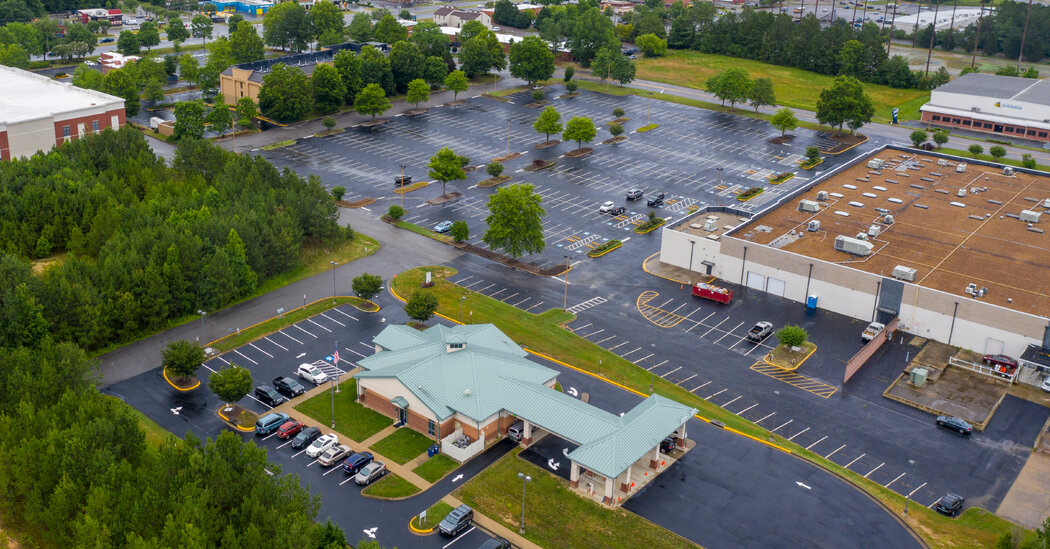
When the Call Federal Credit Union outside Richmond, Va., was robbed at gunpoint in 2019, the suspect took $195,000 from the bank’s vault and fled before the police arrived.
A detective interviewed witnesses and reviewed the bank’s security footage. But with no leads, the officer relied on a so-called geofence warrant to sweep up location data from all the cellphones in the vicinity of the bank for the 30 minutes before and after the robbery.
The data he gathered eventually led to the identification and conviction of Okello T. Chatrie, now 31.
Geofence searches have become increasingly popular as a tool for law enforcement, but critics say they put at risk the personal data of everyday Americans and violate the Constitution. The Supreme Court on Monday grappled with Mr. Chatrie’s challenge to the use of a geofence search in his conviction, in a case that tests the limits of law enforcement tools in the digital age.
During two hours of oral arguments that scrambled the court’s usual ideological alliances, the justices debated how the Constitution’s traditional protections apply to the rapidly changing technology that has made it easier for the police to scoop up vast amounts of data to assemble a detailed look at a person’s movements and activities.
Justice Neil M. Gorsuch, a conservative, and Justice Sonia Sotomayor, a liberal, lobbed the toughest questions at the Justice Department’s lawyer, expressing a deep concern that the government’s position on accessing location data would apply similarly to other forms of electronic data, including emails, photos and documents.
On the other side, Justices Samuel A. Alito Jr. and Brett M. Kavanaugh seemed most worried about disrupting the work of law enforcement. Justice Kavanaugh asked Mr. Chatrie’s lawyer to explain how the detective’s actions constituted “bad police work,” suggesting that he believed it was the opposite.
Chief Justice John G. Roberts Jr. and Justice Amy Coney Barrett, who are often in the majority, posed difficult questions for both sides.
Justices from across the ideological spectrum appeared concerned about our changing expectations of privacy at a time when cellphones are ubiquitous.
It has been eight years since the court last took up a major Fourth Amendment case involving the expectations of privacy of the millions of people carrying cellphones in the digital age. In that 2018 case, the court ruled that the government generally needs a warrant to collect location data drawn from cell towers about customers of cellphone companies.
The court has also limited the government’s ability to use GPS devices to track suspects’ movements, and it has required that law enforcement get a warrant to search individual cellphones.
In Mr. Chatrie’s case, the government did obtain a warrant, but one that his legal team said was overly broad, violating Fourth Amendment protections against unreasonable searches. The Justice Department has insisted that a warrant was not needed to sift through anonymous location data. By the end of the Monday’s argument, it seemed likely that a majority of the court would reject that position and find that warrants are generally required for searches of location data. Several justices also suggested they might seek to provide some guidance for ensuring that such warrants are as narrow and specific as possible.
It was not immediately clear what that outcome would mean for Mr. Chatrie’s case.
Millions of Americans use a Google service known as “location history,” which gathers data roughly every two minutes about where its users travel and when. Unlike traditional warrants, which target an identified suspect based on probable cause that they have committed a crime, geofence warrants operate in reverse. Law enforcement draws a virtual “fence” or boundary around a geographic area where a crime has been committed and asks Google for data on every user whose device happened to be in the area during a particular time.
Mr. Chatrie’s lawyer, Adam G. Unikowsky, compared geofence warrants to fishing expeditions, saying they allow the government to “search first and develop suspicions later,” in violation of the Constitution and the longstanding prohibition against warrants that are too broad or general.
“The technology may be novel, but the constitutional problem it presents is not,” Mr. Unikowsky wrote in a court filing. “The potential for abuse is breathtaking: The government need only draw a geofence around a church, a political rally or a gun shop, and it can compel a search of every user’s records to learn who was there.”
A person’s location history, which can be reviewed, edited and deleted, is private data, Mr. Chatrie’s lawyer said. The lawyer argued that even if Mr. Chatrie had agreed to share it with Google, he had not agreed to share it with the government.
D. John Sauer, the solicitor general, countered that Mr. Chatrie had voluntarily shared his location data with Google. Similar to a person’s bank or phone records, which are held by a business, Mr. Sauer argued that there is no expectation of privacy for information that someone chooses to share with a third party.
Plus, the administration contended that surveillance video showed Mr. Chatrie holding his cellphone just before the robbery, meaning he had chosen to keep it with him during the crime. Mr. Sauer argued that a person in Mr. Chartrie’s position “has no reasonable expectation of privacy” over the stored location data, and that the time period specified by the warrant was too brief to be overly intrusive.
Google says it stopped responding to geofence warrants last year, because the company no longer stores such data and instead keeps location data on each user’s device. But law enforcement has made geofence requests of other tech companies, including Apple, Lyft, Snapchat, Uber, Microsoft and Yahoo, meaning the Fourth Amendment questions before the justices remain relevant.
Officers used automated license plate readers, for instance, to help identify the man suspected in the Brown University shooting last year. Investigators identified the “Golden State Killer” using artificial intelligence-powered genealogy tools.
In Mr. Chatrie’s case, a federal judge said the geofence warrant violated the Fourth Amendment because it did not meet probable cause requirements. But the judge allowed the evidence to be admitted in court, finding that the officer who had requested the warrant had acted in good faith. Mr. Chatrie, a Jamaican immigrant who came to the United States in 2017, eventually pleaded guilty to charges related to the robbery and is serving a nearly 12-year sentence.
A divided three-judge panel of the U.S. Court of Appeals for the Fourth Circuit ruled against Mr. Chatrie, but for a different reason. The panel found that the search was valid because Mr. Chatrie did not have a reasonable expectation of privacy for the two hours’ worth of location history data that he voluntarily shared with Google.
Mr. Chatrie asked the Supreme Court to weigh in after a full complement of Fourth Circuit judges had divided 7 to 7 and, in a one-sentence order, left Mr. Chatrie’s conviction in place.
In the last major Fourth Amendment case heard by the court, Carpenter v. United States, the justices in 2018 made a major statement about privacy in the digital age. In general, they said, law enforcement must seek a warrant for cell tower location information. The court found at that time that it did not matter that the records at issue were in the hands of a third party.
But the court’s membership has changed since that decision. Chief Justice Roberts wrote that opinion joined by four justices who had all been appointed by Democratic presidents, including Justices Sotomayor and Elena Kagan. Of the court’s other current members, Justices Clarence Thomas, Alito and Gorsuch dissented.

