
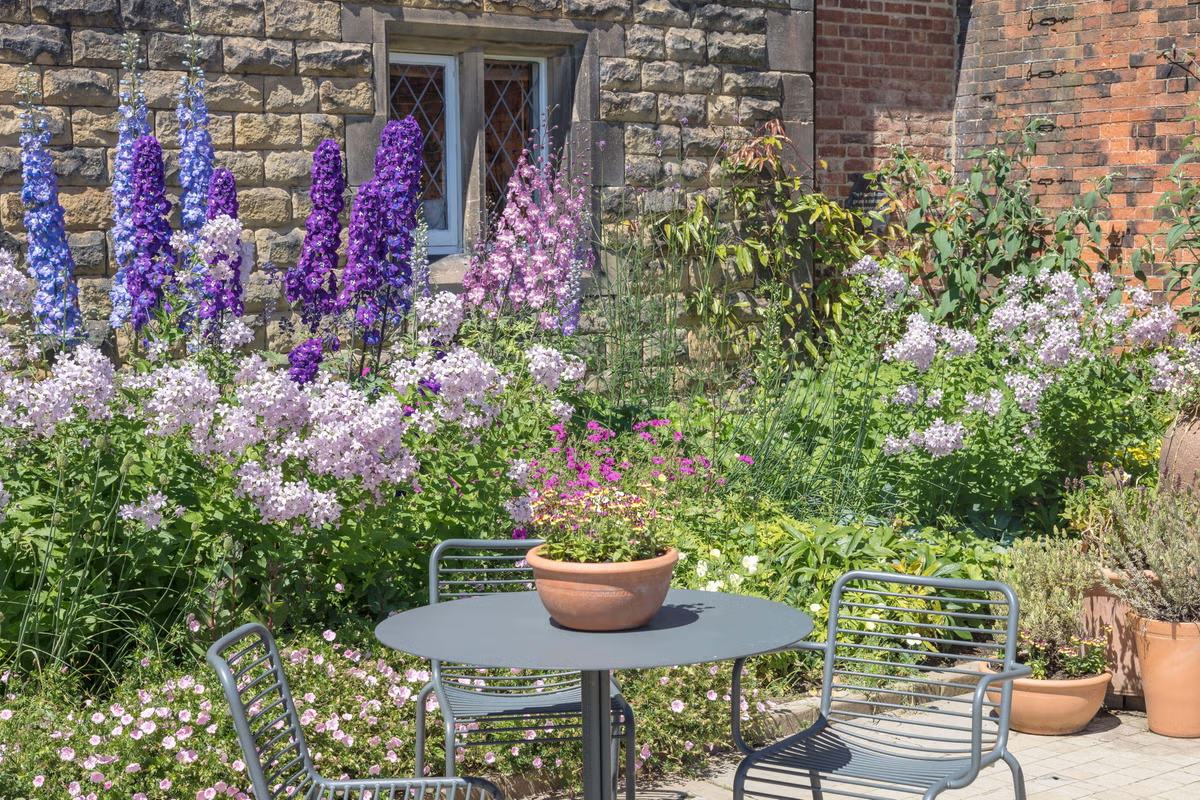
The vision of a cottage garden may be one of a countryside scene in a rural retreat like the Cotswolds, with clouds of peonies, roses, lupins, delphiniums and all other manner of classic blooms wafting in the summer sun.
“When we think of cottage gardens we do often think of small spaces which are quite heavily planted but with a loose hand,” says writer and gardener Joff Elphick, whose new book, A Year In A Cottage Garden, co-written by Sue O’Neil, documents just that.
“From the point of design we almost let the plants get on with it themselves, so things like self-seeders are encouraged and we like to think that where they seed, the spot they’ve chosen to come up, is the place that’s probably best for them.”
So, what do you expect from a cottage garden in a small space?
“We don’t necessarily expect a lawn but we expect almost a tapestry of plants and maybe a light hand from a design point of view. I like to think it’s grown over the years on its own.
“People are attracted to that tapestry of plants and the idea that in some ways the garden is fairly low maintenance. We let the plants get on with it – that’s the attraction.”
You don’t need an old property
“With the use of pots and the right plants, you can do it. When you live in urban houses or apartments you are wanting to bring a little bit of the countryside in.”
Keep landscaping simple, he suggests, with maybe a gravel path that isn’t overly engineered. And if you have a boundary, wire it up for climbers, or if you have a border you might add a natural wigwam out of hazel sticks or other twiggy stems.
Check your soil
See if your soil is claggy or dry and light, and dig in some organic matter to enrich it, he advises. Leaf mould also is a great additive and plants are more likely to thrive in a balanced soil.
Leave colours loose
“I like to go for mixes where you haven’t got a beautiful blended colour scheme but you’ve just an absolute mix so it doesn’t look like the designer has been at it.”
Support plants early
Plan ahead and get stakes in early, as if the plants have any height it’s important to stop them flopping and smothering other nearby plants.
He suggests a variety of cottage garden plants suitable for small spaces.
Annuals
“They can play a big part because they self-seed around, things like Papaver somniferum, the opium poppy. It’s quite tall but doesn’t take up much ground space and self-seeds, and once the flowers – which come in ranges of pinks and purples – are over, they have wonderful seedheads on top of them.
“The smaller poppies, such as Papaver rhoeas ‘Mother Of Pearl’ and ‘Amazing Grey’, are only about 18in tall, self-seed and come in a wonderful range of colours.
“Nasturtiums are also great for a cottage garden, French marigolds, primulas and petunias are all good, and forget-me-nots are a lovely choice because once you’ve got them you’ll tend to have them forever.
“Honesty is also wonderful, I wouldn’t do without foxgloves and Cosmos bipinnatus is one that we all like to grow.
“If you want to keep the size down you can also go for the Cosmos sonata series.”
Perennials
Choose varieties carefully for a small space, he advises.
“The Hidcote variety of lavender is not too big and fairly well-behaved, and if you’re looking at (wild) geraniums I wouldn’t go for the classic ‘Rozanne’ because it gets big. I’d go for the lower-growing types like the macrorrhizum varieties, which have lovely scented stems and leaves.”
The other plant that has really caught on in the last couple of years is the Erigeron karvinskianus (Mexican fleabane).
“They have really dainty flowers which flower on and on. They are such good performers,” he enthuses. “If you find by late summer that they are a bit straggly you can cut them back by half and they will come back again.”
Be careful which catmint (nepeta) you choose for a small space, he continues.
“They can get huge if you go for the ‘Six Hills Giant’ and don’t be fooled by ‘Walker’s Low’ which gives you the impression it’s going to be small but it’s not. But there are things like ‘Little Trudy’ which is more compact.”
Elphick also wouldn’t be without Alchemilla mollis (lady’s mantle) in a smaller cottage garden, he says.
“Again it’s perennial and can be cut right back to the ground if it starts looking tatty.”
Include flowering shrubs
Heavily scented candidates include Philadelphus (mock orange). “There’s a small one called ‘Manteau d’Hermine’ which grows to about a metre with double white flowers.”
For those who want to grow something tight against a wall, Cotoneaster horizontalis is brilliant, he says. “It has very unnoticeable tiny white flowers in the spring, and then you have berries as well and they make a very good habitat for birds and insects.”
Feature classic favourites
“I’m always a bit careful about recommending delphiniums as I know many gardeners find that they are eaten by the slugs, but if you can overcome that issue, they are great performers.”
Roses are also classic cottage garden favourites. “There’s a rose called ‘Phyllis Bide’, which is not too big and you can train it against a wall. I’m about to try another called ‘Blush Noisette’, which has a pale pink flower and is remarkably trouble-free in terms of disease.
“One climber which is stunning is the Clematis ‘Princess Diana’ which has these tulip-shaped dark pink flowers and it doesn’t get too big.”
Other classics include the orange-peel clematis (C. tangutica), which can get big but if you manage it well it can fit into a lot of places, he says.
“You can cut it to the ground any point in winter to sprig and it will come back like a perennial.”
A Year In A Cottage Garden by Joff Elphick and Sue O’Neill is published by Genus, priced £19.50. Available now

