
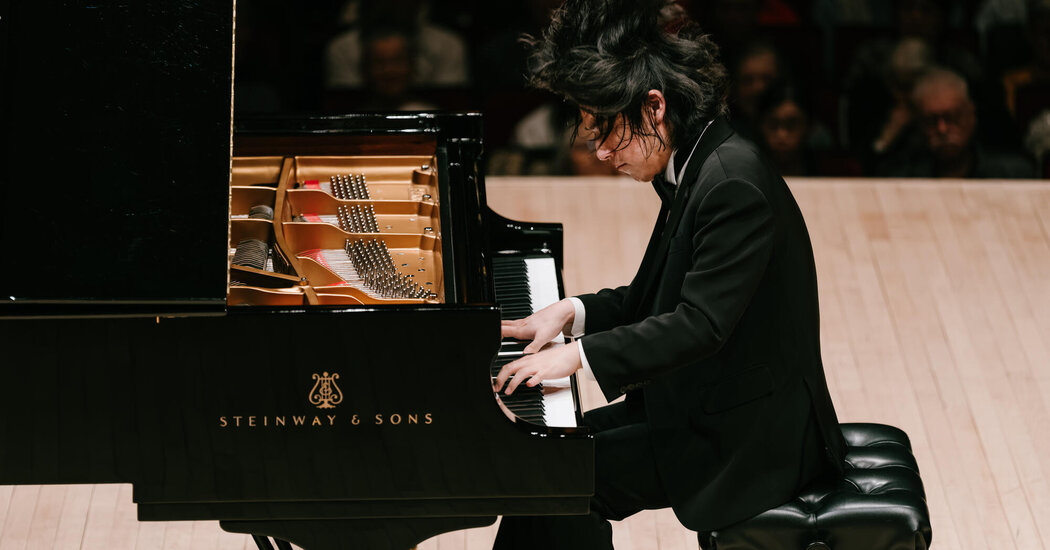
Most music students prepare for their graduation recitals alone in a practice room. On Friday night, though, the pianist Yunchan Lim had Carnegie Hall.
It can be hard to remember that he is still a student. A phenomenal 22-year-old who shot to stardom when he became the youngest winner of the Van Cliburn International Piano Competition, Lim has performed on some of the world’s most prestigious stages and has a recording contract with Decca. But he doesn’t have a degree from the New England Conservatory.
He enrolled there two years ago in the school’s Artist Diploma program, so he could follow his teacher Minsoo Sohn from South Korea to the United States. Lim is set to receive his degree next month and is giving his graduation recital at Jordan Hall in Boston on Sunday. It may be the hottest free ticket for a student concert in history.
Two days earlier, he tested out his recital program in front of a full house at Carnegie Hall. As he entered the stage for an evening of sonatas by Schubert and Scriabin, he barely acknowledged the audience. He just took a quick bow and, with the no-fuss demeanor of a pianist like Grigory Sokolov, began to perform as soon as he sat at the keyboard. Between movements, he didn’t wait for anyone in the theater to finish coughing before he continued; after intermission, he started to play while people were still getting seated. The enormous auditorium might as well have been a private practice room.
The composers on offer were an unlikely pair. Schubert’s music often feels like an intimate confession, with a sad smallness even to his grandeur; Scriabin’s, on the other hand, is extravagant, the outpourings of an oversharing romantic. Lim is a shy performer, but of the two composers, he is more suited to Scriabin than Schubert.
Lim has a muscular, decisive sound, with an honest virtuosity that translates into its own kind of charisma. He responds to the music with whatever physicality it deserves, as if trusting that his tone will communicate enough to the audience without added dramatic gestures. If his hands dazzlingly blur along the way, it’s because they must.
He has such astonishing control over each of his fingers, they are capable of untangling the knottiest scores; his account of Rachmaninoff’s Third Piano Concerto, with which he won the Cliburn, is so colorfully eloquent, you can imagine the composer, a virtuoso himself, being awed by Lim’s skill. And in Scriabin’s Second, Third and Fourth sonatas on Friday, he played with the sublime clarity, complexity and strength of a gemstone.
Unusually, and exhaustingly, Lim presented the three sonatas as a suite, performed together with no pauses. That’s a bit strange, since they are distinct and at times programmatic, accompanied by descriptive text and poetry. There was a bit of whiplash from movement to movement and sonata to sonata in Lim’s impatient delivery, a whirlpool of effusive thoughts and bravura expression. Yet he was also a captivating protagonist as he charted the flood-like flow of notes in the Second sonata, the emotional serves of the Third and the majestic apotheosis of the Fourth.
Schubert’s Sonata No. 17 in D opens with a noble fanfare, but quickly turns less imposing. The piece is rather pastoral and pleasantly discursive; like most of Schubert’s music, it also catches you off guard with underlying heartache that surfaces in moments of brief hesitation or, in the final seconds, a wistful tune of music-box lightness and innocence.
Lim applied the same lucid power of his Scriabin to Schubert, which made for a performance that was faultless on a technical level but not necessarily fitting the soul of the score. There is a similar tension in his take on Bach’s “Goldberg” Variations, which he brought to Carnegie Hall last year; compare his resolute force with the grace and levity of the piece’s finest interpreters.
The mood throughout his Schubert was predominantly heroic, retaining the character of the opening fanfare. His moments of softness were well articulated but incomplete, as if wanting to say more but not quite knowing the words. As Lim continues to learn this composer’s work, perhaps he will get a better feel for its subtlety and wit. He just isn’t there yet.
For a student, however, his performance on Friday was more than worthy of a passing grade.
Yunchan Lim
Performed on Friday at Carnegie Hall, Manhattan.

