
It’s getting ridiculous in the best possible way. With each passing year, seemingly as teams realize that the extended Champions League league phase offers plenty of leeway if they lose a game or two, the guardrails slip a little bit more.
In 2024-25, teams averaged 1.63 goals per game in the league phase, a robust amount but not dramatically off of what we see in domestic leagues. In 2025-26, it was 1.69.
This year, through four matchdays, teams are averaging 2.02 goals per match and on Wednesday alone, six of nine matches saw at least five combined goals scored.
There were three 3-2 matches, including Fenerbahce’s comeback win over Liverpool and lovely back-and-forth away wins for Manchester City (over RB Leipzig) and Real Madrid (over AEK Athens). And of course, there was Como’s eye-popping 9-1 in over poor Lens; in their first Champions League campaign, the Italian side have scored 19 goals in their first four matches, winning three.
– UCL Talking Points: Are Como the real deal?
– Yamal makes more history for ruthless Barcelona
– Soccer’s rich history of fan protests
The lack of consequence certainly has something to do with all this swashbuckling play, but maybe it’s rubbed off on the rest of Europe? The season is still young, but scoring is up 7.8% in Ligue 1, 8.0% in the Bundesliga, 10.0% in LaLiga, and a whopping 20.1% in the Eredivisie and 23.9% in Serie A. Most of the increase has come from open-play, too — it’s not like teams are just earning a lot more penalties or something. (Meanwhile, Premier League scoring is actually down 2% so far this season. Fuddy duds.)
This is certainly a trend worth looking into, but for now I just want to say … thank you. Goals are fun.
Let’s once again look at five of soccer’s main characters following another rousing Champions League matchday.
 Main character No. 1: Manchester United’s path forward
 Main character No. 1: Manchester United’s path forward
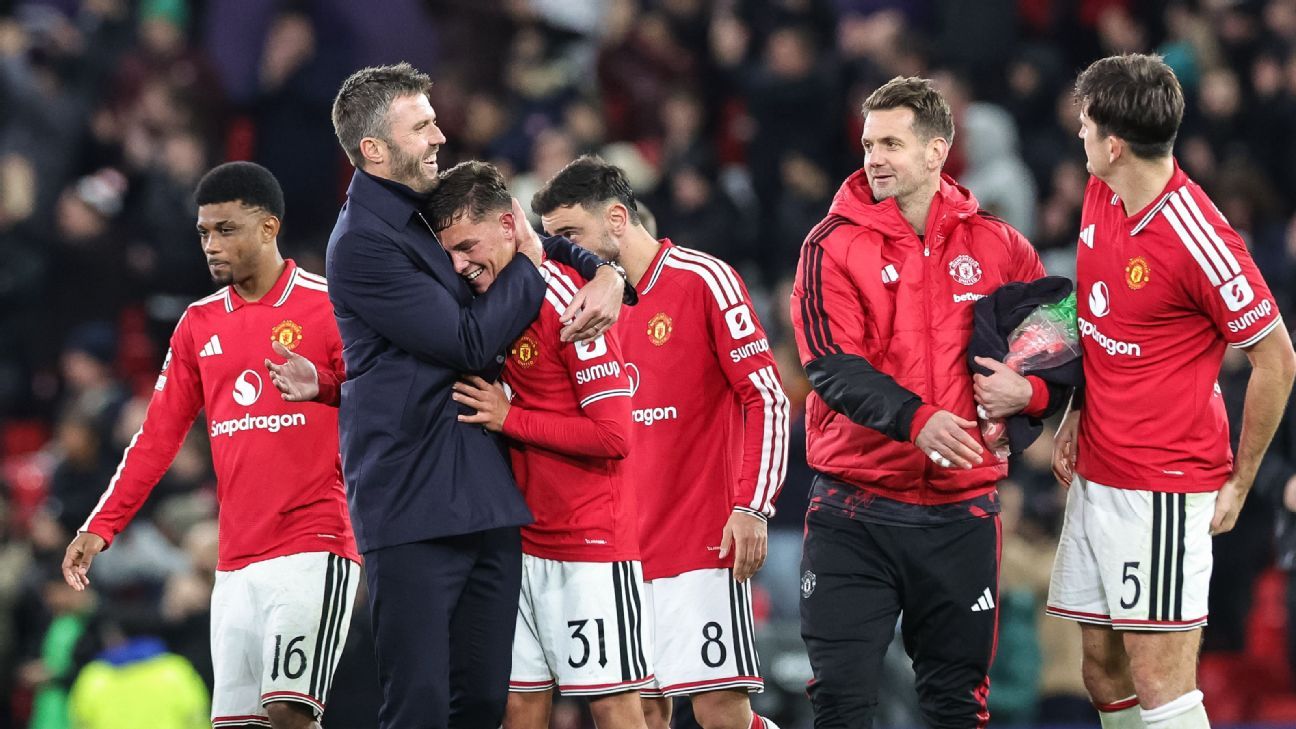
Ninety minutes is a long time. It’s easy to forget that when you’re an American fan accustomed to 3.5-hour American football games, but on Tuesday at Old Trafford, 90 minutes was long enough for Manchester United to play maybe their most listless 45 minutes of the 2020s (a high bar to clear), watch their fans rain tennis balls onto the pitch in protest of administrative incompetence and a nine-match winless streak, grab a lifeline in the form of a penalty, miss said penalty, take advantage of a second chance via VAR, spend a good 20 minutes blowing a number of great chances to tie, and still have enough time left to tie, take the lead and hold on for what might (or might not) be a season-saving and trajectory-defining win.
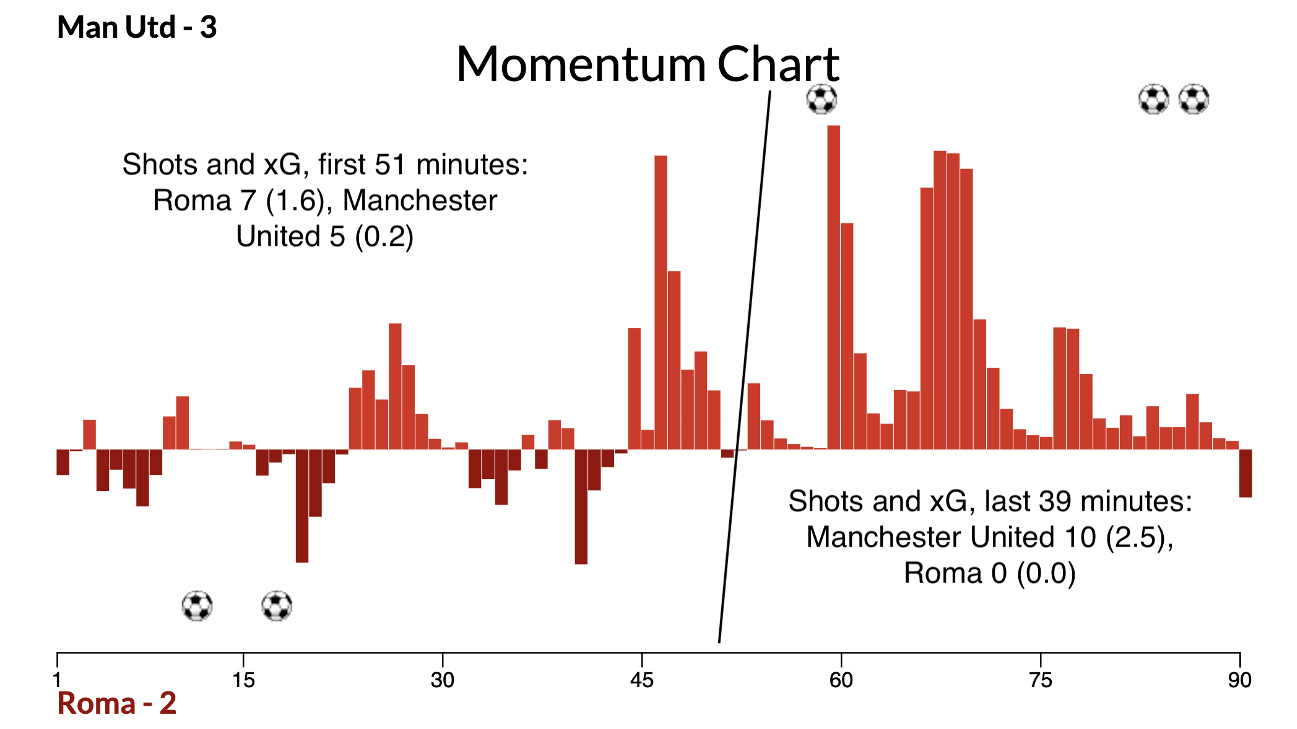
Roma’s two early goals made United look completely hapless, and when United fell behind 2-0, it almost looked as if Bruno Fernandes started trying to pick a fight and land a red card so he wouldn’t have to watch the rest of the match. It even took Fernandes a second penalty attempt to get the home team on the board.
But from the moment his retake went into the net, Old Trafford seemed to flip into Fergie Time mode. Gone (for now) were the complaints and protests; back was the deep, guttural boom that stadium can generate when the home team scores a huge, late goal.
WHAT A COMEBACK FROM MANCHESTER UNITED 🤯
It’s Matheus Cunha at the double and Old Trafford is rocking 🔴
Stream the #UCL on @paramountplus 📺 https://t.co/8N2rsHQ1q3
— CBS Sports Golazo ⚽️ (@CBSSportsGolazo) November 3, 2026
Roma have suffered some serious late-game issues in Champions League play, blowing a one-goal lead in a draw at Fenerbahce and now blowing a pair of two-goal leads in outright losses to United and Real Madrid. They’ve led in all four matches, but have just four points to show for it, and they certainly played a major role in their own demise on Tuesday.
Still, something like this can definitely light a fire. Or at least, it better.
While the entire Michael Carrick tenure looks a little different after Tuesday night’s display, and the win kept their winless streak from reaching double digits, United’s upcoming schedule is still pretty brutal: This Sunday, they host Aston Villa (who had a nice hot streak going before taking one on the chin against Barcelona on Tuesday), and when they return from the international break they visit Liverpool and Sporting CP, host Brentford and visit an equally desperate Newcastle. Without a major upgrade in form, the good feelings from this match won’t last an incredibly long time.
During United’s nine-match winless streak, the team suffered elements of poor fortune, scoring only six goals from shots worth 9.9 xG and allowing 18 from shots worth 16.6. But that isn’t massive, and United had at least a slight negative xG differential in every game of this stretch. They were genuinely poor, and that obviously reflects on Carrick to some degree.
I actually liked the idea of making Carrick the full-time manager early on in his interim tenure last season, if only because he wasn’t some overpaid Great Man type of manager — the type that United typically try to hire — and with Carrick in charge, the club might actually pursue a more sustainable roster-building strategy that isn’t based entirely on the whims of said Great Man.
Carrick is simply a coach, and I thought that might work better. It certainly hasn’t in 2026-27.
1:44
Burley: Hard to tell if Man United were good or Roma were bad
Still, it’s not Carrick’s fault that the club has spent so poorly in both the short and long term. It’s not his fault that his left back options are either an injury-prone 31-year-old (Luke Shaw), a right back (Diogo Dalot) or a young center back (Ayden Heaven). It’s not Carrick’s fault that €75.9 million addition Carlos Baleba has managed only 397 minutes because of injuries (and just got hurt again), and it’s not Carrick’s fault that the club is, according to the estimates at FBref.com, paying Benjamin Sesko, Matthijs de Ligt, Harry Maguire, Mason Mount, Shaw, Noussair Mazraoui, Lisandro Martinez, Manuel Ugarte and Joshua Zirkzee nearly $100 million per year to not play close to the level required.
Carrick has gotten more out of players like Bryan Mbeumo, Matheus Cunha, Kobbie Mainoo and even Fernandes than the last Great Man hire (Ruben Amorim) did. And while this is probably a lost season regardless — United aren’t winning the Champions League, and per the Opta projections they have only a 9.5% chance of finishing even in the Premier League top 7 — it would benefit the club to not jump back into the Great Man waters just yet. But that will probably require Carrick generating quite a bit more magic in the coming weeks.

Main character No. 2: PSG and the biggest movers
Villarreal thumped Napoli and lost track meets against Borussia Dortmund and Liverpool to start Champions League play. They probably didn’t expect to beat Paris Saint-Germain at home on Tuesday, but PSG were without star attackers Khvicha Kvaratshkelia and Ousmane Dembele, midfielder Marquinhos and also Nuno Mendes, maybe the best left back in the world.
Maybe they could keep things fun and competitive?
Nope. PSG led 4-0 after 17 minutes and rolled 6-0.
Even without that star power, they fielded a lineup loaded with Desire Doue, Maghnes Akliouche and Senny Mayulu up front, world class midfielders Vitinha, Fabian Ruiz and Joao Neves and right back Achraf Hakimi, the best right back in the world. They brought World Cup-winning goal scorer Ferran Torres off the bench, and they got a goal from 17-year old fullback David Boly.
This is getting unfair. PSG at least made other teams think they had a chance the last couple of Champions League campaigns, easing into the league phase each year before shifting into gear when it counted. This time around, they’ve won their first four matches — including matchups with Manchester City and Barcelona — by a combined 20-5. Manager Luis Enrique is rotating as heavily as he ever has early in this season, both because of injury and because he wants to, and they’ve won 10 straight in all competitions by a combined 36-9. And the two-time defending Champions League winners’ expected league phase point totals, per Opta’s power ratings, have improved more than anyone else’s in the competition.
Finally, those plucky Paris underdogs find some traction. Life’s been so hard for them lately.
Three other teams have seen their expected point totals rise by at least 4.4 points: Real Madrid, who are also off to a perfect start — albeit one full of late-game drama (and three one-goal wins) — plus the ever-delightful Club Brugge and a Real Betis team that was off to a perfect start until Wednesday’s 2-1 loss at Borussia Dortmund.
The biggest drops aren’t quite as stark, primarily because they’ve all come from teams that weren’t expected to do so hot anyway: Slavia Prague (down 4.2 points), Lille (3.9), AEK Athens (3.0) and Slovan Bratislava (2.6) have combined for one win and five points in 16 matches, though Slavia did frustrate Arsenal in a competitive 2-1 loss on Wednesday. It wouldn’t be entirely surprising if one of these teams found their footing and made a run in the second half of league play, a la Bodo/Glimt last year.
Okay, it would be a little surprising.
Others with higher expectations certainly haven’t enjoyed the starts they were looking for: Porto (down 2.8) lost their first three before thumping Napoli on Wednesday, Roma (down 2.5) have suffered the aforementioned late-game collapses and have one win despite leading every match, and of course Manchester United (down 2.1) have had their well-publicized issues.

Main character No. 3: How the hell does a team score nine goals?
You can ask Manchester United: Como can play some pretty sexy ball sometimes. Even while balancing the rigors of domestic and continental play for the first time, they’ve lost just two of their first 14 matches in all competitions, and they’ve scored at least two goals 10 times and at least four goals four times. They’ve pummeled United and RB Leipzig and beaten Napoli away.
Cesc Fabregas seems to know what the heck he’s doing as a manager, and his squad has enough fun attacking talent — 22-year-old Nico Paz (six goals and eight assists in all competitions), 23-year-old Martin Baturina (five and two), veteran center forward Anastasios Douvikas (11 and one) — that they’ve barely missed a more established player like Moise Kean, who’s injured and has played only 158 minutes.
It’s clear that this is a good team. But they scored nine goals on Wednesday! On the road! Against a team from a Big Five league (albeit the fifth one)! How is that possible?
I guess the short answer is, “They couldn’t miss.” Como attempted 18 shots worth a massive 4.3 xG — elite in its own right (and shameful on Lens’ part) — but overachieved that xG by 109%. Douvikas attempted three shots worth 1.7 xG and put all three in the net.
For the longer answer, however, I went to the film. They weren’t just sending in lucky screamers from 30 meters – every shot they scored on was worth at least 0.12 xG, and all but one was from within 12 meters. This was a clinic in shot-making, so I wanted to walk through each goal. You can follow along here:
– Goal No. 1, seventh minute: Douvikas from 3.0 meters (assist by Maximo Perrone). A short corner exchange sets up a cross to the far side, where Perrone heads it toward goal; he doesn’t get much on it, but his shot becomes an assist for Douvikas, whom Lens tried to claim was offside.
– Goal No. 2, 32nd minute: Douvikas from 5.7 meters (assist by Alex Valle). On a quick transition, Paz gets the ball with space on the far right. He fires in a long and pretty off-target pass to Valle, but Valle saves it from going out of bounds and the flat-footed Lens defense doesn’t notice Douvikas right in front of the goal for the tap-in.
– Goal No. 3, 40th minute: Paz from 10.0 meters (assist by Douvikas). A quick transition from Lucas da Cunha to Valle to Maxence Caqueret to Douvikas, and suddenly Paz has far too much space on the right. He fires into the top shelf, then pays tribute to fallen Spanish forward Jesus de Miguel.
Nico Paz dedicates his goal to Jesús de Miguel, holding up a shirt in his honor ❤️👕 https://t.co/KNdexY0rKG
— CBS Sports Golazo ⚽️ (@CBSSportsGolazo) November 4, 2026
– Goal No. 4, 47th minute: Lucas da Cunha from 12.1 meters (assist by Paz). After a good 30 seconds of possession, it’s Paz to da Cunha to Yan Couto to da Cunha to Paz to a breaking da Cunha. Maybe the prettiest goal of the night, and Lens are officially broken.
– Goal No. 5, 53rd minute: Marc-Oliver Kempf from 8.1 meters (assist by Luis Milla). Caqueret quickly fizzes a ball to Luis Milla out on the left. He just as quickly fires a cross into the box, and Kempf heads it in.
– Goal No. 6, 57th minute: Douvikas from 15.6 meters (assist by Paz). After a series of horizontal passes near midfield, Como quickly go vertical and catch Lens flat-footed — Perrone to Paz to Douvikas for an instant transition goal.
– Goal No. 7, 62nd minute: substitute Mattia Liberali from 10.8 meters (assist by Jacobo Ramon). More instant transition as Ramon simply frees Liberali on the right, and the 19-year-old races into the box and fires. Paz, Douvikas, Da Cunha and Milla have been subbed out, and Como continue to pour it on.
– Goal No. 8, 69th minute: substitute Martin Baturina from 11.9 meters (assist by Liberali). Shortly after Lens finally score, it’s Baturina to Liberali, quickly back to a racing Baturina. Como played right through the middle on Lens, over and over.
– Goal No. 9, 90+1 minute: substitute Matteo Papaccioli from 11.7 meters (assist by Liberali). More fun interplay from the subs. After some quick passing, Liberali finds the 18-year-old Papaccioli in behind, and he converts. It’s initially ruled offside, but it eventually counts.
A MOMENT FOR THE HISTORY BOOKS! 📚
Como become just the second team in #UCL history to score NINE goals in a single game :😱
Stream the #UCL on @paramountplus 📺 https://t.co/kTqwyJunLm
— CBS Sports Golazo ⚽️ (@CBSSportsGolazo) November 4, 2026
My conclusion after all that is basically the same as how I started this section: Como play some sexy ball. Quick touches, lots of angles, lots of good chemistry. Lens had no idea where to look.
Watch this team whenever you can.

Main character No. 4: What’s wrong with Donnarumma?
Gianluigi Donnarumma has been a celebrated shot-stopper since he forced his way into the AC Milan lineup 11 years ago at age 16. He hasn’t ever been elite with his passing, but even possession-hungry clubs like PSG and Manchester City craved his services because of how well he keeps ball from going into net.
Over the past five seasons, he’s been mostly excellent in this regard. Using Stats Perform’s Goals Prevented measure — which looks at the post-shot xG totals keepers face from shots on goal and compares that to the number of goals they allow — he’s been well on the positive range in all competitions.
See if you can spot a recent development.
Donnarumma’s goals prevented, last 5 seasons
– 2021-22 (PSG): +5.0 (positive is good)
– 2022-23 (PSG): +7.8
– 2023-24 (PSG): +12.6
– 2024-25 (PSG): +2.0
– 2025-26 (Man City): +6.8
– 2026-27 (Man City): -1.2
He’s had some stellar games this season: He had three big stops in a 1-0 win over Coventry City, for example (+1.8 goals prevented), plus three more in a 2-1 win over Bournemouth (+0.7) and six in a 3-0 win over Liverpool (+0.7). But he’s in the middle of a pretty dire stretch: In his last six games in all competitions, starting with City’s 4-2 loss to PSG, he’s at minus-4.0 goals prevented. Simply breaking even might have turned losses to PSG and Aston Villa into draws, and he was relatively poor again on Wednesday against RB Leipzig, allowing two goals from shots on goal with a post-shot xG of 2.0.
Ridle Baku sneaks one in at the near post past Donnarumma 😤
Stream the #UCL on @paramountplus 📺 https://t.co/tgP6KwASuh
— CBS Sports Golazo ⚽️ (@CBSSportsGolazo) November 4, 2026
City did hold on to beat RBL, but they’ve still lost three of their last seven matches in all competitions, and they’ve allowed 12 goals in those seven. I’m not going to pretend seven matches is a sign of his end as an elite goalkeeper, but it’s been a costly stretch, and if not for City’s offense, it would be even more costly.
Main character No. 5: The midway point best XI
Even if the league phase is entertaining but reasonably disposable content, I still enjoy taking a moment to celebrate awesome players from time to time, so since we’re at the midway point of this phase, here’s a quick Best XI for the competition to date.
Goalkeeper: David Raya, Arsenal. It’s hard to evaluate Raya because he doesn’t typically have much to do behind Arsenal’s defense, but he’s saved 10 of 14 shots on target for a solid +1.8 goals prevented, and he has decent involvement in the buildup game. He had to make four saves against a game Slavia squad on Wednesday, but did so. Backup: Yann Sommer, Club Brugge
Right back: Achraf Hakimi, PSG. I could tell you his stats — one assist, 12 chances created, 57 line-breaking passes received (most of any defender) — but “best right back in the world” should do. Backup: Givairo Read, Feyenoord
Center-back: Mykola Matvilenko, Shakhtar Donetsk. He’s completed 57 progressive carries (second among defenders) and 36 progressive passes (fifth), and he has 1,401 meters of carry distance (first). The 30-year-old is a stabilizing force and strong buildup guy for a team currently in position to advance. Backup: Pau Cubarsi, Barcelona
Center-back: Dayot Upamecano, Bayern Munich. Upamecano’s another hard-to-evaluate player because he’s put on such islands in Bayern’s high-line system that you can probably remember him in the middle of a lot of breakdowns. But he’s in those awkward spots because he’s such a trustworthy 1v1 defender, and he’s a high-level passer too. Backup: Brandon Mechele, Club Brugge
Left back: David Raum, RB Leipzig. Among defenders, Raum is third in chances created (10), eighth in progressive passes (34), second in crosses (34) and second in tackle attempts (21). He’s been busy for RBL’s strained defense, but he’s always a pretty important contributor in attack too. Backup: Joao Cancelo, Barcelona
Defensive midfield: Declan Rice, Arsenal. Most progressive carries of any midfielder (48), most progressive passes (63), most carry distance (1,487 meters), third-most line-breaking passes (54), even eighth-most ball recoveries (24). He’s brilliant and indefatigable. Backup: Elliot Anderson, Manchester City
Central midfield: Fabian Ruiz, PSG. He has four goals (most of any midfielder), 14 shots (most), 283 passes received (most), 58 progressive passes (second-most) and 57 line-breaking passes (second-most). He seems to be getting better at 30. Backup: Vitinha, PSG
Attacking midfield: Nico Paz, Como. Maybe the player of the competition so far. He’s scored three goals with five assists, he’s received 60 line-breaking passes (only Lamine Yamal has more), and I mean, just watch him. He seems to make everyone around him more creative than they otherwise would be. (And he’s only 22.) Backup: Jude Bellingham, Real Madrid
Right win: Lamine Yamal, Barcelona. Another no-brainer. He also has seven combined goals (three) and assists (four), and he’s received the most line-breaking passes (73), attempted the most ground duels (70) and won the most 1v1s in the box (five). He’s even made the most ball recoveries in the attacking third (nine), including an easy one for a goal on Tuesday.
Lamine stands alone 😤
Yamal scores his 14th #UCL goal to become the competition’s all-time leading teenage goalscorer 👏
Watch #UCL on @paramountplus 📺 https://t.co/Va8Ks3SEHv
— CBS Sports Golazo ⚽️ (@CBSSportsGolazo) November 3, 2026
He’s the best winger in the world, and he’s still just 19. Unfair. Backup: Bradley Barcola, Liverpool
Center forward: Harry Kane, Bayern Munich. I wanted to get a little creative and give this spot to someone other than the reigning Ballon d’Or winner, but Kane is tied for second in combined goals (four) and assists (three), he’s attempted the most shots (20), and even with slightly below-standard finishing — four goals from 4.1 xG — he’s just the most complete player up front right now. Backup: Tasos Douvikas, Como
Left wing: Desire Doue, PSG. He’s seventh in the competition in combined goals (three) and assists (two), and he’s only played 218 of 360 minutes. Explosive, creative, ridiculously confident and, yes, still only 21. Backup: Zlatko Tripic, Viking


