
The 2026 MLB season ended on a high note, with the Milwaukee Brewers celebrating the first World Series title in franchise history.
Now, though, the sport enters the offseason under a dark cloud. With the current collective bargaining agreement set to expire on Dec. 1 and no sign of a new labor agreement between the league and the Major League Baseball Players Association, a lockout appears to be imminent.
As we get set for another drawn-out battle, who are the key names we need to know from both MLB and the MLBPA? Is a salary cap coming to baseball? What does a lockout mean for free agency? Next season? ESPN MLB experts Jorge Castillo, Alden Gonzalez, Buster Olney, Jeff Passan and Jesse Rogers break down the topics that will shape the future of the sport.
MLB made the first CBA proposal of the offseason — what is significant in this offer?
On Tuesday, MLB proposed postponing the implementation of a salary cap until the 2028 season, while still putting into place the other elements of its labor offer for 2027, citing the difficulty of teams navigating free agency amid the current uncertainty.
In its proposal, MLB also set new numbers for its proposed cap and floor in 2028. The cap would be $258.2 million while the floor would be $180.2 million. In its previous proposal, the league had offered a $245.3 million ceiling and $171.2 million floor. — Passan
Why is Dec. 1 such an important date?
It’s the day the current collective bargaining agreement between the players and owners expires. Technically, it runs out at 11:59 p.m. ET on Dec. 1. If, as expected, the sides haven’t agreed to a new CBA before then, one of two things can happen:
First, the owners and players could keep negotiating for a new agreement while the business of the sport operates under the rules of the old CBA (which is how the WNBA ran for a while during its recent labor negotiations).
Or second, and more likely, MLB owners can lock out the players right away, shutting down all league business until a new agreement is reached. That is what happened five years ago — the last time the CBA was up for renewal. If it happens again, players won’t be allowed to have contact with coaches or use team facilities until a new CBA is reached. — Rogers
What does a looming lockout mean for free agency this winter? Will there be a flurry of signings before Dec. 1? Will free agents wait for a new CBA?
The general consensus seems to be that free agency will go into turbo mode, as it did the last time a lockout loomed, when Corey Seager, Marcus Semien and Javier Baez were among those who secured nine-figure deals just ahead of the CBA expiring on Dec. 1, 2021.
Some teams will probably begin this month hesitant to jump in, given an uncertain economic model, but the sense is many of them will be pressed into action once free agents start flying off the board. And while it might be tricky for high-spending teams like the Los Angeles Dodgers and New York Mets to make big signings with a potential salary cap looming, it’s also easy to see how big contracts already in their books can be grandfathered in as part of a CBA negotiation.
High-profile trades will be difficult to execute in such a tight window, especially with players who would only be controllable through a 2027 season that could be truncated by a lockout — but free agency should be active. — Gonzalez
Who are the primary names fans should know from each side of the CBA talks?
MLB
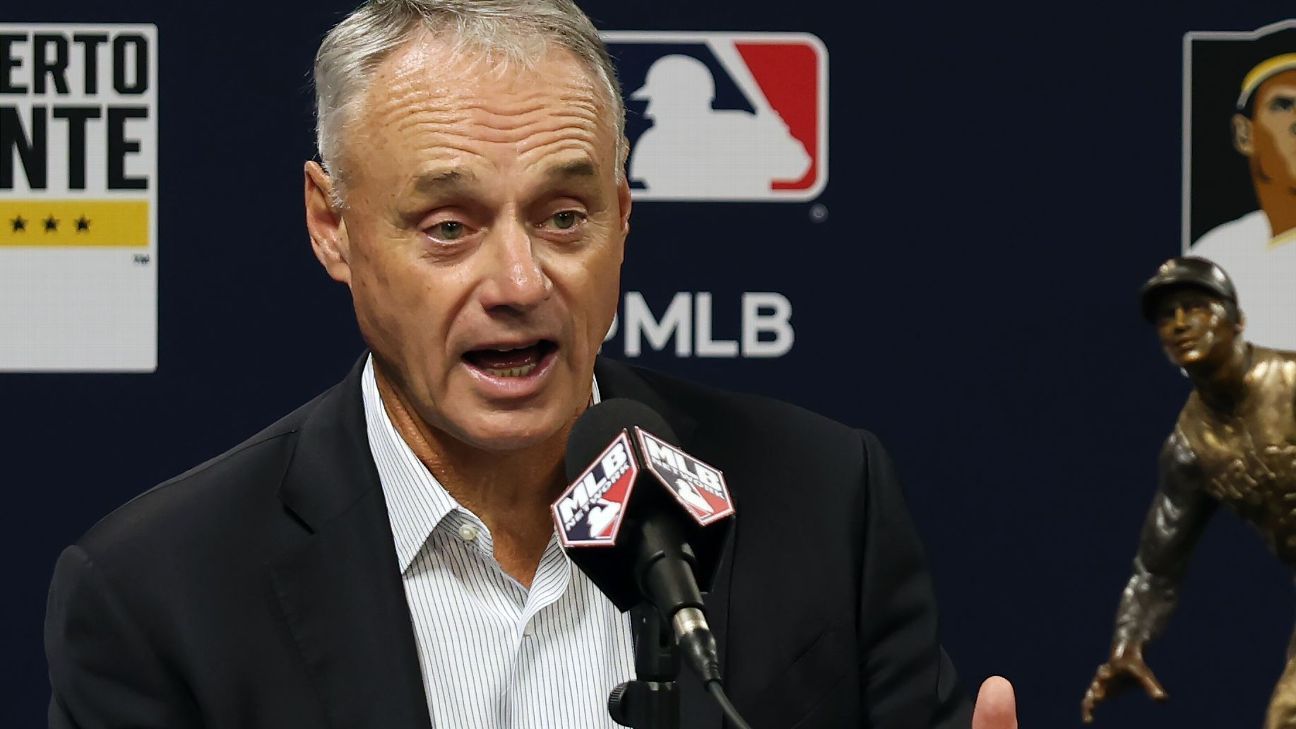
As commissioner, Rob Manfred will set the tone for the league. He’ll also be the public face for the owners. The more contentious the negotiations become, the more likely it is that he’ll be in the middle of conversations.
Here are some other names to know from the MLB side:
Dan Halem, deputy commissioner: Halem is Manfred’s right-hand man and will again serve as the chief negotiator for the league, meaning he will be the MLB exec most directly involved in day-to-day negotiations. Halem has held the position for more than a decade and has negotiated several previous agreements between the league and its players.
Morgan Sword, executive vice president, baseball economics and operations: Sword’s role touches all aspects of the game both on and off the field. He was a driving force behind the most recent rule changes, including the implementation of the automated ball-strike system incorporating challenges this season. He’ll attend negotiations for MLB, and if Halem is Manfred’s right-hand man, Sword is that for Halem.
Glen Caplin, special assistant, baseball operations: A former political strategist who most notably worked for Democratic nominee Hillary Clinton leading up to her 2016 presidential campaign, Caplin was brought in by MLB leading up the last round of CBA talks in 2021. He acts as the league’s spokesperson for labor.
Owners’ labor committee: Dick Monfort (Colorado Rockies), Hal Steinbrenner (New York Yankees), Jerry Reinsdorf (Chicago White Sox), John Sherman (Kansas City Royals), Ray Davis (Texas Rangers) and Mark Attanasio (Brewers). This group of owners on the labor committee will impact proposals and overall direction even though they weren’t regular attendees during early negotiating sessions. That could change the longer negotiations last. Monfort, for example, was heavily involved during the lockout last time around; he, or another of the owners in this group, could become so once again. — Rogers and Gonzalez
MLBPA
Bruce Meyer was front and center as the union’s lead negotiator during 2021 and 2022 — and he now has the added responsibilities of running the MLBPA as its interim executive director. He sets the union’s agenda and will guide its strategy, with the main area of his focus collective bargaining.
Matt Nussbaum, Jeff Perconte and Ian Penny: The core of Meyer’s legal team starts with Nussbaum, the union’s former general counsel who was elevated to deputy executive director upon Meyer’s promotion. Filling his role was Perconte, Nussbaum’s former teammate at Notre Dame and now the union’s general counsel. Remaining in the inner circle is Penny, a former MLBPA general counsel who worked at the NHLPA — where Meyer later worked — and serves as the interim head of human resources after the union fired the previous director.
Kevin Slowey and Andrew Miller: Longtime big league pitchers, Slowey and Miller have worked at the union since retiring and are trusted voices for Meyer. Slowey is a conduit to the players, updating them on the goings-on in collective bargaining, while Miller serves as a special assistant for strategic initiatives.
Chris Bassitt, Jake Cronenworth, Pete Fairbanks, Cedric Mullins, Marcus Semien, Paul Skenes, Tarik Skubal and Brent Suter: The MLBPA’s executive subcommittee consists of eight players voted into leadership roles by their peers. Though the union’s full board is 38 players — the subcommittee, plus one player representative from each team — subcommittee members typically spend far more time in the negotiating room than team reps, and their thoughts often carry more weight with owners. — Passan
What is the difference between the MLBPA board and the rank-and-file members?
Near the end of the previous CBA negotiations, the executive committee unanimously recommended rejecting the owners’ last offer. However, the rank-and-file overwhelmingly voted to go back to work, rejecting the advice of their leadership.
A question, then, hovers over these talks: Will the rank-and-file be in lockstep with the union leadership? A critical element during the players’ strike that ended the 1994 season and impacted the start of the 1995 campaign is that, generally speaking, the players maintained a resolute front, with the leadership and the players unified. — Olney
There is a huge revenue disparity among MLB teams. How will that influence the CBA talks?
Revenue disparity is the foundation for the owners’ argument for revisiting the idea of revamping the league’s economic structure with a salary cap. Clubs in the small and middle markets argue they cannot regularly compete with the big-market teams that hold a decided advantage. And it all starts with the Dodgers. Teams point to their ability to spend more than $500 million on payroll and tax — thanks to a lucrative local television contract, a fruitful revenue stream from Asia and nightly sellouts — as unfair.
The union argues that overhauling the economic system is unnecessary because small-to-mid-market teams have and can continue to compete with the richest clubs. These negotiations hinge on how long each side will stand its ground on the matter. — Castillo
Revenue disparity isn’t new, so why is the term ‘salary cap’ coming up so much more now?
It’s due to the fact that revenue disparity has grown increasingly wider, largely because the crumbling regional sports network (RSN) model has made it so that a select few teams have a bigger advantage than ever.
As Jorge stated above, the Dodgers are the symbol of it all. Though they lost to the Brewers in this year’s National League Championship Series, they won back-to-back championships in 2024 and 2025 and had a luxury tax payroll of more than $400 million. Shohei Ohtani brings in the type of revenue no player — perhaps in any team sport outside of soccer — comes close to matching. But the size and relative security of L.A.’s local-media deal is just as big of an advantage. When factoring in luxury tax penalties, Kyle Tucker will cost the Dodgers about $120 million annually. That alone is more than the entire payrolls of nine teams this season.
MLB believes a cap might be the only way to give small- and mid-market teams a fighting chance in this environment. — Gonzalez
How do salary caps function in other sports?
Each of the three other major men’s sports leagues feature caps with distinct flourishes.
NFL: a hard cap with minimal flexibility. Players receive 48% of revenue, there is no maximum salary, and contracts are not guaranteed.
NBA: a soft cap with reasonable flexibility — though less so since the introduction of the apron tax system. Players receive 50% of revenue, there is a maximum salary, and contracts are guaranteed.
NHL: a soft cap with limited flexibility. Players receive 50% of revenue, individual salaries cannot exceed 20% of the cap, and contracts are guaranteed.
It would take a massive break within the MLBPA for it to agree to a cap. The union’s position on a cap is simple: It limits what players can earn compared with the current system, it takes away guaranteed money — the NBA and NHL both use escrow systems that can claw back salaries — and once you’re negotiating a fixed percentage, it’s destined to go down.
Whatever the benefits of a cap might be, those beliefs reinforce the union’s position that a cap is a nonstarter. — Passan
What other topics will the players and owners need to address?
Service time: Service time is the amount of time a player spends on an MLB roster. It is important because it moves the player through the sport’s distinct economic phases.
For example, after being in the league for the equivalent of three seasons (spread out over any amount of time), a player is eligible for a third-party arbitrator to determine his salary for the upcoming season. Until then, players are essentially paid the minimum salary ($780,000 in 2026) with modest raises and some recently introduced pre-arbitration bonuses for top performers. After six years of service time, a player is eligible for free agency, allowing him to sign with any team in MLB. Ten years of service gives a player fully vested pension benefits.
Any and all of the above could be altered, eliminated or kept in place. — Rogers
International draft: An international draft would replace the current international bonus pool system used to acquire amateur players outside of the U.S., Canada and Puerto Rico. MLB has argued for an international draft for years, citing the need to better police a market riddled with issues, particularly in the Dominican Republic and Venezuela.
During the last round of CBA negotiations, the owners offered to eliminate the MLB free agency qualifying-offer system in exchange for adding the international draft. A deadline for the decision was set for July, more than four months after the CBA was ratified. MLB’s proposal was for a 20-round, hard-slot draft with 600 selections and $181 million in guaranteed spending for the players chosen. The union countered with a 20-round draft without hard slots that would allocate at least $260 million to the 600 players picked. MLB didn’t budge from its proposal and the MLBPA rejected the trade. It was the closest the sides have ever come to implementing an international draft. — Castillo
TV revenue: In an effort to pivot from a fading RSN model, MLB hopes to centralize media after the 2028 season, whereby it would own the local rights for teams — ideally all 30 but at least somewhere in the neighborhood of 25 — and distribute the revenue from selling those rights. That requires revenue-sharing discussions on the front end, which will come up in labor talks. At the moment, 48% of local net revenue — including media, which accounts for about 20% — goes into revenue sharing. The league would like to increase that in anticipation of bringing local rights under one umbrella, a strategy it believes will increase revenue and alleviate the blackout issue that has plagued the sport. — Gonzalez
Bottom line: Is the 2027 season at risk?
The last time MLB owners proposed a salary cap, it led to the player strike that ultimately canceled the 1994 World Series. So, yes, the 2027 season is certainly at risk. How likely is it that we miss games? How many are missed, if that is indeed the case? It is impossible to know. At this point, both sides are dug into their positions, and it would be a shock to see either side give any ground until the threat of lost games presents itself.
If the last CBA negotiation is any indication, though, neither side will make proposals in December and won’t reconvene until some time in the middle or end of January. Last time around, negotiations didn’t really pick up until the end of February and didn’t conclude until around the middle of March. That’s basically the timetable to not miss any games in 2027.
The big deadline this time around could be a bit later. If MLB loses 60 or more games in 2027, most of the league’s national television contracts will extend by an extra year, as first reported by The Athletic. In order to avoid that, games will have to start basically in June, which means a deal would have to be struck by, at the absolute latest, the start of May. — Gonzalez


