
What a weekend in soccer! Europe’s top leagues delivered, as they always do, when it comes to talking points.
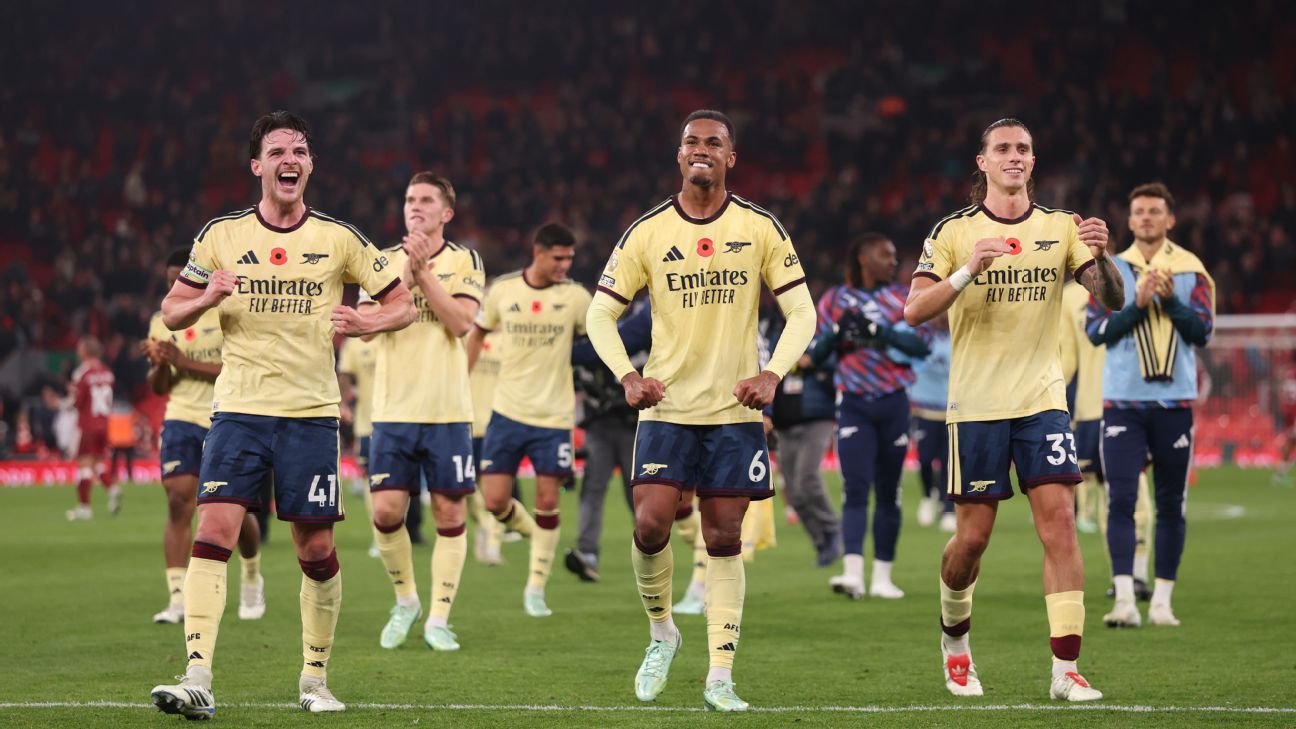
In the Premier League‘s big games, Arsenal got a huge win (and a little luck) Sunday in breaking a historic winless streak at Liverpool dating back to 2012, while Man United sank from bad to worse in losing heavily at Chelsea on Saturday.
In LaLiga, Real Madrid got a win that should make Jose Mourinho happy for how they did it (scoring early and often), while Bayern Munich drew against Borussia Dortmund in Der Klassiker, a game they really, really should have won. In Serie A, Ruben Amorim (remember him, Man United fans?) and Milan won the derby over Inter to cap a tough week in the best possible way. We also got narratives galore from Brighton (how do they keep doing it?), Tottenham (yes, they’re back), Juventus (shoutout to Kerim Alajbegovic), Barcelona (who rebounded from the Clasico loss in fine fashion) and much more.
It’s Monday morning, so what better time for some musings? Let’s get into it.
– United implode at Chelsea; they are now in Premier League relegation battle
– Arsenal hold on for a big win at Liverpool, one Iraola & Co. can learn from
– What soccer stars did for Halloween: James the Joker, DracuLucas, more
 Arsenal get big win at Liverpool, but referees owe us answers

I’ll get this out of the way and get to what we really want to talk about which is, you know, football.
Liverpool should have had a penalty for Jurriën Timber‘s shirt-pull on Alexander Isak — there’s really no gray area. If referee Andy Madley didn’t see it clearly or deemed it (as some have suggested) “normal physical jockeying,” VAR Stuart Attwell should have sent him to the monitor to have another look. There’s nothing normal about grabbing an opponent’s shirt, and it doesn’t take a physicist to figure out that without the tug, Isak would have headed the ball goalward.
In fact, it could have been a denial of goal-scoring opportunity (DOGSO) situation. Law 12 is pretty clear: “Where a player … denies an obvious goal-scoring opportunity and the referee awards a penalty kick, the offender is cautioned if the offence was an attempt to play the ball or a challenge for the ball: in all other circumstances [holding, pulling, pushing, etc.] the offending player must be sent off.”
1:59
Did VAR get Liverpool’s penalty calls wrong against Arsenal?
This is as open and shut as you’re going to see. And please, don’t spread the nonsense theory that Isak “should have made more of the pull” to influence the ref. I don’t want to see players trying to “win” penalties, and certainly not when it’s that obvious. I just want the VAR to help the referee do his job. (And I’m pretty sure Andoni Iraola feels the same way despite what he said postgame.)
Heck, later in the same game we had a perfect example of a player “making the most of it” to try to influence the referee. Alexis Mac Allister throwing himself to the ground, and staying there, writhing in pain, after being brushed by Noni Madueke‘s forehead was simply embarrassing. It’s pretty much the very definition of “unsporting behavior,” which is a cautionable offense. Mac Allister did get a yellow, but we don’t know whether it was for that or for moments earlier, when he leaned over a prone Martin Odegaard and talked trash before tapping him on the head.
On to the football. The three points are big for Arsenal. Their 1-0 victory — and first at Anfield in 14 years — reinforces the notion that they’re an elite defensive team that is willing to get physical and humble to defend the lead.
There are two elements to that. First, while it’s true that those attributes are critical at times, I’d feel better about them if they kept creating chances after taking the lead. The goal — starting with the clockwork press and continuing through Declan Rice‘s intelligent run — was hugely impressive. But for the remaining 74 minutes, they managed just 0.30 xG.
Second, while the stat of holding Liverpool to zero shots on target at home for the first time since they started keeping track sounds impressive, the fact is they gave up 17 shots and spent longer than Mikel Arteta would have wanted in their own area. This team can kick it up several notches. While this may be enough to win the Premier League, if they want to take the next step in Europe, they’ll probably have to. It’s one thing to sit and defend against Isak and Bradley Barcola, another to do it against Lamine Yamal and Raphinha.
1:04
What went wrong for Liverpool in attack against Arsenal?
As for Liverpool, I know effort and belief are supposed to be taken for granted, but that part was still impressive. Missing was their quality, and you’re not going to fix that overnight. Dominik Szoboszlai‘s return should help, but the elephant in the room remains the middle of the park. Playing a midfield two is tough enough with this front four; doing so with this crew is even harder. Throw in the fact that they’re still learning on the fly under Iraola, and it’s hard to see how this can be anything other than a rebuilding, transition season.
Emphatic derby win caps perfect bounce-back for Amorim, AC Milan

 Emphatic derby win caps perfect bounce-back for Amorim,
On Wednesday, they conceded three silly goals and lost at home to Bologna. On Thursday, they unveiled plans for a new 71,500-seat stadium and a naming rights agreement reportedly worth a whopping €650 million ($725 million U.S.) over 20 years — the most lucrative around, U.S. stadiums included. And on Saturday, they defeated Internazionale 3-1 in the derby.
Yeah, you could say it was a pretty nifty turnaround for Milan in the space of 72 hours.
They’re still fifth in the table, mind you — a whopping seven points behind Lazio, the little engine that could. It’s the fourth derby win in a row for the Rossoneri, so if they don’t follow it up with real achievement in Serie A and the UEFA Europa League, it will feel pretty hollow. And if you really want to be a Debbie Downer, Inter won the xG battle, Adrien Rabiot‘s goal was probably a mishit (if it was meant to be a pass, well, there was nobody in that area, so it wasn’t a good pass) and Mike Maignan had to pull off a miracle save on Djed Spence at 2-1.
But so what? Milan were entertaining — none more so than Diego Moreira, who rampaged down the right flank and scored a sumptuous free kick. Luka Modric showed (once more) that if you manage his minutes, he can be a game changer, Christian Pulisic scored again and Yunus Musah monstered the Inter midfield. Not bad for a club that, in the space of five months, changed its coach, sporting director, center forward, wing backs and CEO.
It’s also a personal victory for Amorim. He’s less tethered to the orthodoxy of the 3-4-2-1 dogma of the past, more in sync with the players at his disposal (some of whom show marked improvement over past years) and unafraid to put his faith in youngsters.
At first glance, the big takeaway for Inter is that with Lautaro Martínez injured and the other two forwards (Ange-Yoan Bonny and Pio Esposito) struck down by the flu, they had no option but to play a lone striker. Those absences messed up Christian Chivu’s entire approach, but that’s a bit of a red herring. Sure, Inter would probably have been better with a full complement of strikers at their disposal, but they had plenty of the ball, plenty of touches in the opposition box and plenty of chances. What they missed was the execution from their one fit striker, Marcus Thuram, and the usually dependable duo of Nicolò Barella and Hakan Çalhanoglu, who were effectively shut down.
Chivu said after the game that they were lacking intensity. Maybe so, but it sounded like coach-speak. Maybe it was the fact that for the sixth time this season they went two goals down, which really shouldn’t be happening to a side with this much talent. That speaks more to mindset and approach (they were 2-0 down after just 10 minutes) than the usual cliches. Maybe they felt that, having come from behind so many times before, they’d do so again. If that’s the case, some humility wouldn’t go amiss.
The good news is that Chivu is a calming influence and you imagine they’ll treat this as a bump in the road, nothing more. If that doesn’t happen, they’re in trouble.
Defeat at Chelsea should make no difference to Michael Carrick’s future

 Defeat at
1:02
Nicol slams Martinez for his red card vs. Chelsea
Yeah, I would have made the exact same point if Manchester United had converted some of those first-half chances that they squandered miserably and taken all three points, rather than collapsing in the second half and losing 2-0. Carrick is not the only problem at United — far from it. But he’s also not the solution, and because his bosses are unlikely to sack themselves and you can’t dump anywhere near the number of players who should be dumped, guess who’s going to be the scapegoat?
And you would imagine they’ll do it not with any sort of vision in mind, but in search of the proverbial “shakeup” and “new manager bounce” — all the stupid clichés that turn out to be true because many players are ultimately just overgrown teens.
This is Man United’s worst start since the 1980s, and anyone who affects surprise after their third-place finish last season following Carrick’s arrival either doesn’t understand the game or is the sort of person who reads the scores but doesn’t watch the matches. Action is required, because United are level on points with the third-bottom club, and if they drift further into their spiral of negativity, they risk missing out on the UEFA Champions League knockouts and the money that brings.
It’s a shame, to some degree, because they looked willing and hungry in the first half Saturday, albeit against a side almost as star-crossed as they are, who gifted them numerous opportunities to score. Then Lisandro Martinez‘s multiple brain fades opened the door for Chelsea, and they never looked back. United fans know what’s up. Their ire is rightly directed at the players, at Jim Ratcliffe (funny how that guy has gone silent), at the Glazers (the perpetual scapegoats) and Jason Wilcox (the incognito brain who assembled this team).
0:53
Nicol criticises Chelsea for not scoring more vs. 10-man United
As for Chelsea, the three points matter, almost as much as Xabi Alonso’s willingness to go 4-2-3-1 in order to find a spot for Estêvão. It’s pretty grotesque that having invested so heavily on wingers the club would have signed someone who prefers the 3-4-2-1 setup. As long as you have an attacking fullback behind him (and Chelsea have three to pick from down the left) you can put Morgan Rogers out wide left and he’ll be devastating. But Estêvão (or Pedro Neto, when he needs a breather) needs to play on the right. What Alonso needs most right now is a bit of stability in terms of personnel and formation. We don’t need to see the back three again this season, frankly.
Bayern Munich their own worst enemy in Klassiker draw


Tell me if you’ve heard this before: “The biggest threat standing in the way of another Bundesliga crown for Bayern are Bayern themselves.” You have, because that’s the reality, such is their dominance in German football. And it holds even truer after their 2-2 draw with Borussia Dortmund on Saturday.
This was a game they should have put to bed. Michael Olise hit the crossbar. Harry Kane — who paraded his well-deserved Ballon d’Or before kickoff — hit the woodwork twice (once from a penalty). They put together 4.48 xG but scored only twice, squandering four Opta “big chances” along the way.
Regular readers will know that I don’t worry about scores as much as I do performance, and the performance was there from Bayern. But this is a little different. They’re still top alongside Dortmund, but obviously, the return leg will be on the road. And they lost another two players to injury in the first half — Ismael Saibari and Serge Gnabry — within a few minutes of each other. Early indications are they’ll miss a chunk of time while Olise, thankfully, looks to have picked up a less serious knock. With Luis Díaz and Jamal Musiala in and out all season, they could be a little light up front.
This was a chance to put the first nail in the Bundesliga title race’s coffin, and they flubbed it. And they were frankly a little fortunate too, because if Carney Chukwuemeka had somehow gotten out of the way of Jonas Urbig, Jobe Bellingham‘s goal might have stood.
As for Dortmund, we can praise their never-say-die attitude, while also recognizing that, top-to-bottom, they are several rungs below Bayern, no matter what the table says. The most you can ask for is that they keep breathing down Bayern’s necks, ready to take advantage of any stumbles. Manager Nico Kovac will take that.
Quick hits
10. Seven wins on the bounce for Atlético Madrid … and there’s more to come: We recently did a segment on the FC TV show about whether Atleti could compete for the LaLiga title. The consensus seemed to be no; I was in the minority with an emphatic yes. Not just because of the semantics (what does “competitive” mean?), but because this team can legitimately get better. And while few seem to have noticed, they could actually go top next weekend if they beat Barcelona at home.
Their 2-0 win at Levante makes it seven straight. They’re obviously not better than Barcelona right now, and Hansi Flick’s side have a higher ceiling, but Atleti have many of the pieces in place, including Álex Baena, a guy who can create out of nothing at any time. His assist on Morten Hjulmand‘s disallowed goal was next level; his assist for the second wasn’t bad, either. And then there’s Julián Álvarez, assuming he can put his (self-inflicted) summer travails behind him. Again, I’m in the minority in not seeing why wise football folk salivate over him so much, but if they’re right and I’m wrong, he can carry a team.
9. Brighton & Hove Albion go third after winning at Manchester City; can they stay there? Let me address this straight away: I think so. Or at least in the Champions League places. It’s a three-point margin over Chelsea and a four-point gap over Liverpool, but even if both surpass them — and it’s not a given that they will — Brighton will still be fifth, which will be enough if the Premier League gets the performance-based slot. We’re not even a fourth of the way through the season, sure, but the other regular contenders are way back: Tottenham Hotspur (minus seven), Aston Villa (minus seven), Newcastle United (minus eight), Manchester United (minus 12).
The “Brighton model” has been much studied and copied (badly). Their scouts and recruitment guys have been poached, along with their players and coaches. And still they rise, which should tell you the secret sauce is elsewhere. Maybe it’s stability: other than Jan Paul van Hecke (seamlessly replaced by Luka Vuskovic, who might actually be an upgrade) and Danny Welbeck, most of last year’s big contributors are still there. They lead the league in xG but are vastly overperforming in xG conceded (they’ve gone up just seven, but the xG conceded is 13) so maybe they’ll regress to the mean. But for now, once again, what they’re doing is pretty darn special.
1:23
Are Brighton the most ‘complete’ team in the Premier League?
8. Barcelona bounce back without missing a beat: Nobody really believed that Alavés — winless in nearly two months — would offer much of a challenge to a Barcelona side looking to rebound after getting their nose bloodied by Paris Saint-Germain in the Champions League and Real Madrid in the Clasico. But this wasn’t just a victory — it was an emphatic, slam-the-door-shut-type stomping. Being 4-0 up at halftime (en route to a 6-1 win) with 3.26 xG tells its own story.
Barcelona remain on track to break all sorts of goal-scoring records: their team goal pace is 158 and the record presently belongs to Real Madrid in 2011-12, who scored 121 under Jose Mourinho. And at this rate, Raphinha (who bagged two) will end up with 52 goals and beat Lionel Messi‘s single-season mark of 50. Shoutout to Flick as well. Frenkie de Jong (now fully fit) at center back gives you much-needed depth. And 20-year-old Brian Fariñas — who made his debut at right back — continues the tradition of playing home-grown central midfielders at fullback (witness Xavi Espart). Then again, on a team that holds 77% possession, you’re basically asking your fullback to do a midfielder’s job anyway.
1:30
Nicol: Yamal gets too frustrated on the pitch for Barcelona
7. Yup, Spurs have turned the corner (and not because of their win over 10-man Crystal Palace): Yes, obviously it helps tremendously when you can play 77 minutes plus stoppage time at home against 10 men, thanks to Jean-Philippe Mateta‘s red card (unlucky, but justified). But how often do we see teams go down a man, enter lockdown mode and successfully frustrate the opposition?
Don’t let the 2-0 score fool you, though: Tottenham did not allow that to happen. They kept their shape and their principles, moved the ball to create openings and ended up with a whopping 34 shots on goal (and four “big chances” missed, none bigger than Mohammed Kudus‘ one at the end). As I’ve said before, they’re much better with Dominic Solanke up front, and if that means moving Omar Marmoush into the hole (like he did Saturday) or even out wide, so be it.
Heading into the last international break, they had two points from five games. Since then, it’s 10 points from four games, including away trips to Old Trafford and Stamford Bridge. I don’t know that you can get away with a Sandro Tonali–Mateus Fernandes midfield most weeks in the Premier League, but manager Roberto De Zerbi has the tools to change it in terms of personnel. What matters is the patterns of play and the cohesion, and it appears Spurs have that down pat.
1:42
Leboeuf: I enjoy Tottenham’s style of play under De Zerbi
6. Real Madrid wrap it up early at Racing Santander, just like Mourinho likes it: Or, for that matter, any manager. Away from home this season, it has been all about the late goals: Carlos Espi at Espanyol and at Elche, Endrick and Antonio Rudiger at Roma, Kylian Mbappe in El Clasico. If games ended in the 84th minute, Real Madrid would be fifth in LaLiga, 10 points back. That’s what made their 3-0 win in Santander — who may be newly promoted, but had yet to lose at El Sardinero — so encouraging. The big guns (Mbappe, Jude Bellingham and Yan Diomande) all scored in the first half, and they were never in danger.
Real killed the game and were able to conserve energy for the Champions League. A coach couldn’t ask for more. If you want to quibble and nitpick, maybe he could have used all five substitutions and gotten some minutes for some of his bench players, but really, this was about proof of concept: After delivering in the Clasico, could they do it against a very different opponent in very different circumstances? The answer was a resounding yes.
1:45
Burley: Real Madrid have been better without Vinícius Jr.
5. Nicolas Jackson is proving doubters wrong, but Villa pay the price for Zion Suzuki‘s howler: I know: If my aunt had wheels, she’d be a bicycle. But bear with me. If the season began on Sept. 7, and if Suzuki hadn’t let the ball slip out of his hands for the Fulham goal, or if John McGinn had converted his penalty, Villa would be third in the table, a single point behind Arsenal and Brighton. Oh, and they’ve also been perfect in the Champions League. All this after a summer of upheaval in which they lost Rogers, Ezri Konsa, Emiliano Martínez, Ollie Watkins, Lucas Digne and Youri Tielemans. I’ve said it before, but you can’t repeat it enough times: If they graded on a curve, Unai Emery would be favorite for manager of the year.
That said, I want to single out Jackson, who opened the scoring Saturday. When he arrived at Chelsea, many (including me) pointed out that he was raw. And still, the club persevered with him. Then, just as he was getting good, they loaned him out to Bayern (where he scored 11 goals in limited action) and then shipped him off to Villa in the summer to assuage the Gods of Player Trading. Guess what? At 25, he’s no longer raw. He has lost none of his athleticism, he’s making much better decisions, and he already has eight goals in all competitions. Chelsea’s backup strikers are Emmanuel Emegha and 35-year-old Welbeck. Enough said.
4. AS Roma are still on a tear: Maybe it took him a season to figure things out, but manager Gian Piero Gasperini has lost absolutely none of his relentlessness. On Saturday his Roma side stomped all over Udinese, going 4-0 up by halftime en route to a 5-2 road win that sees them move up to third in Serie A.
His Atalanta sides were legendary for their daring and attacking impetus, and Gasperini is doing the same at Roma while also putting his faith in younger players and turning older ones around. And once again, he’s doing it without his starting keeper, captain, midfield general and most talented player. Roma have 36 goals in all competitions. Only Bayern (37) and Barcelona (57) — two clubs with Ballons d’Or current and future — have scored more. And regular Serie A watchers know the attacking fearlessness is proving infectious, with the likes of Como, Frosinone and Monza in his wake. Long may it continue. This is fun.
3. Harry who? Niclas Füllkrug is the Bundesliga’s top goal scorer: It’s probably just me, but I love these types of stories, so I want to get ahead of it before he invariably slips down the scoring table. For the past two seasons — at West Ham United and at Milan — Füllkrug has been something of a punchline. Four goals in 46 games for a center forward who doesn’t do much other than score isn’t great. He probably didn’t take it too badly, because he was the classic late bloomer (he was in the second division just five years ago) and many turned up their nose when he was first called up to the Germany national side (and not just because of his gap-toothed smile).
But here he is, at Werder Bremen, where it all began, on loan from West Ham, and after opening the scoring in their 2-0 win over TSG Hoffenheim on Saturday, he has nine goals in eight Bundesliga appearances, plus another three in the German Cup (including two against Dortmund, no less). Füllkrug was never under any illusions when he was younger and certainly won’t be now that he’s 33, but it’s a feel-good story that he, of all people, can tell his friends and family that the only players who have scored more this season in all competitions are Raphinha, Kylian Mbappé and Erling Haaland.
2. Alajbegovic to the rescue for Juventus against Napoli, but is it fool’s gold? Another game, another system — this time a 4-4-2 formation, though manager Luciano Spalletti says it was an emergency solution — except this time, Juve got the three points. If you’re determined to be glass half-empty, you can point out the negatives. Like the fact that the goals came late and via gorgeous (but improbable) strikes from Kerim Alajbegovic and Jeremie Boga, rather than via patterns of play. Or the fact that Napoli, who aren’t particularly good to begin with and have a long injury list, lost the flu-stricken Rasmus Hojlund before kickoff and had to withdraw Kevin De Bruyne and Giovanni Di Lorenzo at halftime.
On the flip side, Alajbegovic is a legitimately gifted, fearless youngster who will only grow in confidence, and the three points should alleviate pressure on Spalletti, at least temporarily. That said, the issues are still there — Randal Kolo Muani and Nick Woltemade had another nightmare, with just one off-target shot between them — and won’t be resolved anytime soon.
1. Home defeat highlights Manchester City’s defensive issues (again): It’s not that the defending was horrid, per se, on the Brighton goal (though it was) in Saturday’s 1-0 defeat, or that City didn’t create enough chances at the other end to get a resounding win (they did, and Bart Verbruggen made some huge saves). It’s that, relative to last year, City look more fragile at the back, and that’s a pretty low bar. It’s not the numbers, though they’re worse than a year ago in terms of xG conceded (1.30 to 1.18). It’s the way they look vulnerable, especially in transition: Brighton could have added a couple of more on the break.
Enzo Maresca says he was pleased with the performance, and from his perspective, you can see why: They nearly doubled Brighton’s xG, they hit the post with Iliman Ndiaye, they created at least five clear-cut chances. But as good as the attacking output is, they’re not going to get where they want to be if they concede so much in transition. Ayyoub Bouaddi, making his second league start of the season, has margins to improve in that role, and the defense (all holdovers from last year) need to find the right balance to address the attacking tweaks Maresca has provided.


