
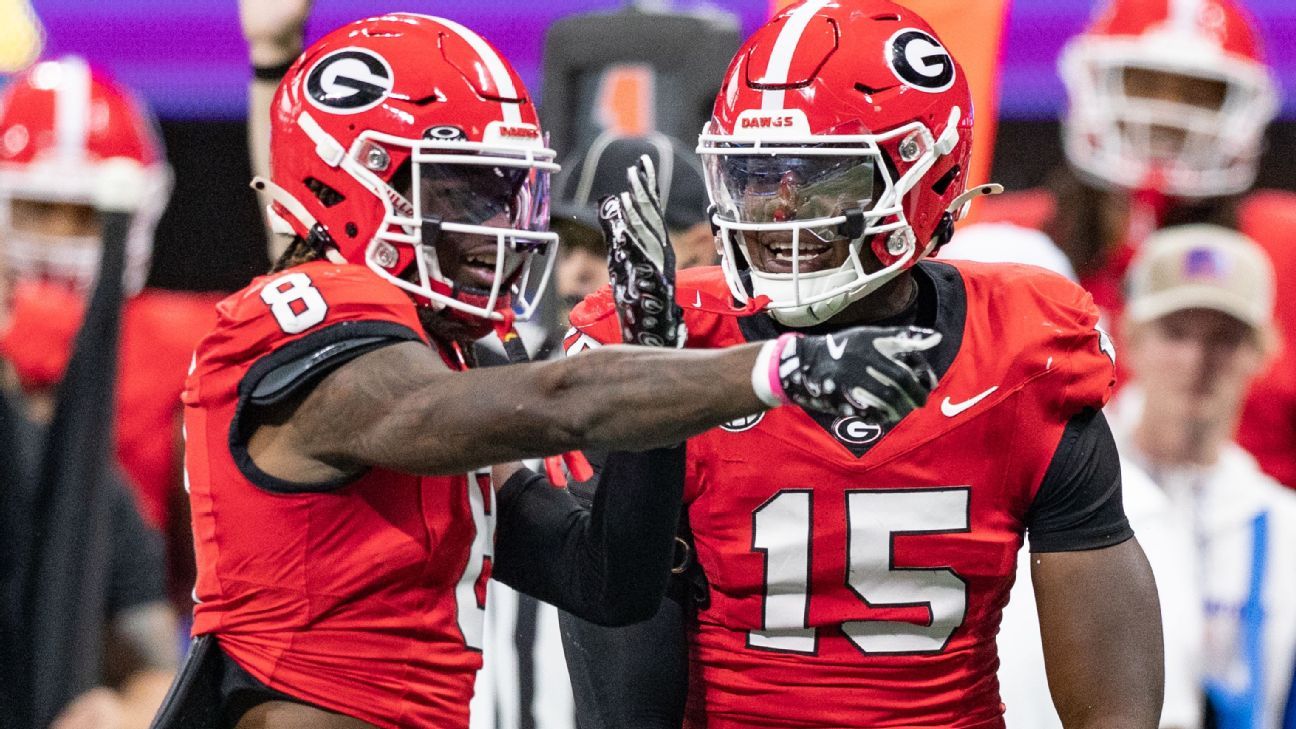
ATLANTA — The Georgia–Florida series has been played in Jacksonville, Florida, almost every season since 1933.
This year, the game was moved to Atlanta for the first time because of a $1.4 billion renovation of EverBank Stadium.
The No. 3 Bulldogs might want to consider playing the No. 17 Gators in their state capital more often after their dominant 27-8 victory at Mercedes-Benz Stadium on Saturday.
Two weeks after the Bulldogs had too many self-inflicted wounds in a stunning 27-24 loss to unranked Auburn at home, they flipped the script on the Gators. Georgia forced four turnovers, held the Gators to only 54 rushing yards and had four sacks.
“We did what we had to do,” Georgia coach Kirby Smart said. “We avoided turnovers for the most part and we got turnovers. The Dogs didn’t beat the Dogs today. They helped us with some of the turnovers they had.”
The Bulldogs won their sixth straight game over Florida and improved to 9-2 against them in Smart’s tenure. It’s Georgia’s most dominant stretch in the border rivalry since it won six in a row from 1978 to 1983.
The Bulldogs ran for 217 yards and went 4-for-5 in the red zone.
After struggling to tackle and slow down Auburn’s running game, Georgia’s defense was dominant. It shut out Florida through the first three quarters in a game for the first time since its 30-3 loss to Oregon State in the 2022 Las Vegas Bowl.
Florida’s NCAA-record 481 consecutive games with points remains intact after Gators quarterback Tramell Jones Jr. scored on a two-yard run — following a pass-interference penalty on fourth-and-goal — and threw a two-point conversion pass to Dallas Wilson to make it 24-8 with 6:59 remaining.
By then, it was too late.
“I thought [defensive coordinator Glenn Schumann] had a good game plan, a very disruptive game plan,” Smart said. “The defensive staff did a tremendous job trying to keep things simple. [Florida offensive coordinator Buster Faulkner] causes a lot of confusion, and we didn’t do a whole lot. We kept it simple and played fast [and] played hard.”
Florida made far too many mistakes in coach Jon Sumrall‘s first game against the Bulldogs. Aaron Philo and Jones combined to throw three interceptions, and the Gators were penalized eight times for 78 yards.
“I think they’re a really good football team and I have a lot of respect for them,” Sumrall said. “They didn’t need our help tonight, but we gave it to them, too.”
The Gators self-destructed in the first half. Sumrall elected to go with Philo, who started the first six games before he was sidelined with a throwing shoulder injury.
In Florida’s previous game, Jones threw for 155 yards and two touchdowns in a 27-24 upset of Texas on the road on Oct. 17.
The decision backfired on the Gators quickly. After Georgia missed a 43-yard field goal on its first possession, Florida faced third-and-6 at its 42. Philo scrambled to his right and tried to elude linebacker Raylen Wilson.
As Philo was falling, he inexplicably threw a wild underhand pass for tailback Jadan Baugh, which cornerback Ellis Robinson IV intercepted.
A roughing-the-punter penalty kept Georgia’s ensuing drive alive, and tailback Nate Frazier scored on a one-yard run for a 7-0 lead 1:50 to go in the first quarter.
After the teams traded punts, Philo’s pass to receiver Eric Singleton Jr. was high and the ball bounced off his hands. Cornerback Demello Jones caught the deflection and returned the interception 23 yards. A 15-yard penalty against the Gators for sideline interference gave the Bulldogs the ball at the Florida 17.
The Bulldogs had to settle for Peyton Woodring‘s 28-yard field goal and a 10-0 lead.
Tramell Jones replaced Philo on Florida’s next possession, and the results weren’t much better, and it punted again.
Georgia went ahead 17-0 on Bo Walker‘s one-yard touchdown run with 1:55 left in the half.
The Gators finally seemed to be putting something together in the final minute of the first half. On second-and-5 from the Georgia 37, however, tailback Evan Pryor whiffed on a block. Linebacker Quintavius Johnson hit Jones from behind just as he was preparing to throw and the ball popped out of his hand. Linebacker Chris Cole scooped up the fumble and returned it 66 yards for a touchdown to make it 24-0.
“That’s football, right?” Smart said. “If you get sacks, then you get turnovers. Most fumbles occur on sacks. We got pressure on the quarterback. We affected both quarterbacks. And I’ll tell you, if you can’t run the ball, it makes you one-dimensional and then everybody gets to feast and rush the passer.”
It only got worse for the Gators. With about five minutes left in the third quarter, Florida reached Georgia’s 3-yard line. But then Jones underthrew a pass to Singleton in the end zone on second-and-goal. Cornerback Braylon Conley hauled in the Bulldogs’ third interception of the game.
“Where we are as a program, every part of our team has to get better,” Sumrall said. “I’m not letting us off the hook for everything we do right now; we’re trying to build a sustainable program for a long time, and every little thing we do matters. So, to me, there was a lot of growth on defense; it still wasn’t good enough.
“Where they have been recently, we want to go.”
Next season, the Florida-Georgia game will be played at Raymond James Stadium in Tampa, Florida, before returning to Jacksonville in 2028.
The only other times the game wasn’t played in Jacksonville during the past 93 seasons was in 1994 and ’95, when the Gators won two lopsided contests at the teams’ on-campus stadiums because of renovations at the Gator Bowl.
“The venues are great,” Smart said. “They’re pro venues, so the Jacksonville venue is incredible. Apparently, it’s going to be even better [and] be one of the best in the world, possibly, with what they’re doing to it. This is one of the best in the world, so I love them.
“Yeah, if you tell me I can play in Atlanta every year for travel, we’ll get home a lot faster. That’s great. We all know the ramifications that come into that, financially, both ways. If we’re going to pay these players, we’ve got to make some money.”


