
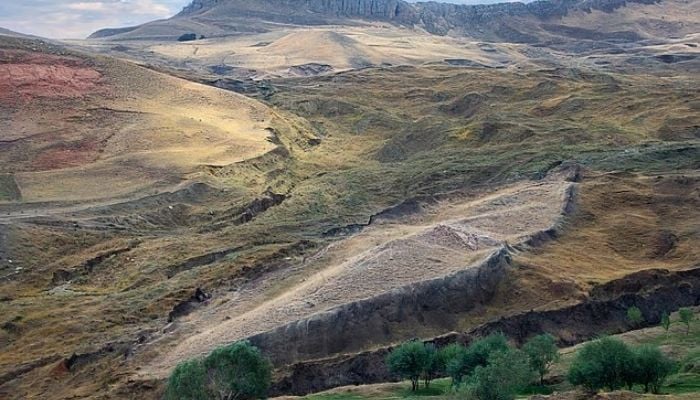
Researchers investigating a mysterious boat-shaped formation in Turkey, believed by some to be the resting place of Noah’s Ark, have discovered pieces of charred wood nearly 30 feet underground, potentially offering new clues about the centuries-old mystery.
The discovery was announced during a recent symposium in eastern Turkey, where researchers presented findings from their latest investigation of the Durupinar Formation, located near Mount Ararat.
According to Professor Cenker Atila of Sivas Cumhuriyet University, the recovered wood has been sent for carbon-14 dating and identification to determine its age and origin.
The formation, measuring approximately 157 metres (515 feet) in length, has attracted researchers for decades because of its resemblance to a large vessel.
Interestingly, the latest ground-penetrating radar surveys also revealed what researchers described as three distinct layers beneath the formation.
The findings have drawn attention because religious accounts describe Noah’s Ark as having three levels.
However, researchers have yet to establish whether the underground structures are man-made or the result of natural geological processes.
Andrew Jones, founder of the Noah’s Ark Scans project, acknowledged that the burnt wood could have originated from an ancient campfire rather than a vessel.
The Durupinar Formation was first identified in aerial photographs in 1959 and has since become the subject of numerous investigations.
Earlier geological studies concluded that the unusual shape was formed naturally through geological processes, including landslides and erosion.
The latest discovery has not overturned those findings, as the wood’s age and its connection to any ancient structure remain unknown.
Researchers are now awaiting laboratory results, which could help determine whether the material is associated with human activity or has another explanation.


