
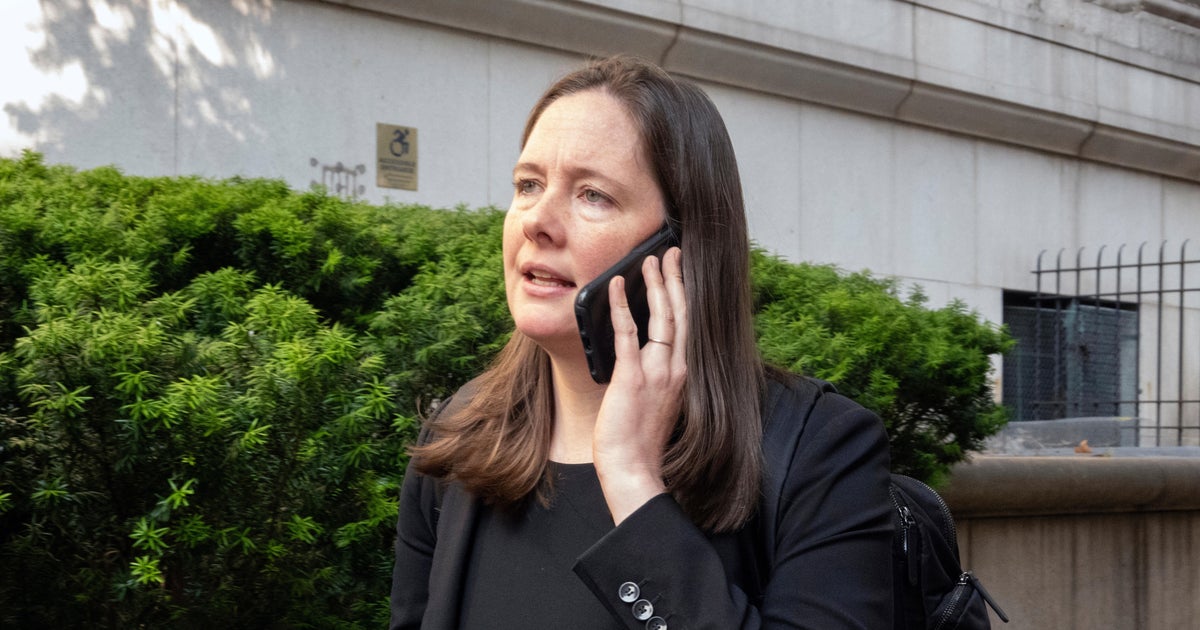
Washington — A federal judge on Monday found that the Justice Department unlawfully fired Maurene Comey, the daughter of ex-FBI Director James Comey, from her post as a federal prosecutor in the Southern District of New York.
U.S. District Judge Jesse Furman said in a 55-page decision that Comey’s removal violated the constitutional separation of powers and federal law. The judge retroactively reinstated Comey to her role as a federal prosecutor and ordered the Trump administration to provide her backpay from the date of her firing in July 2025 through Dec. 20, when she accepted a different job.
Comey’s lawsuit was one of several filed by former government employees who were fired by President Trump without cause that tested the limits of the president’s power to fire federal officials.
The Trump administration had argued that Article II of the Constitution gives the president unrestricted removal power, and said Congress could not limit the removal of federal prosecutors.
But in his decision, Furman ruled that Comey’s firing violated the Civil Service Reform Act, a landmark law enacted in 1978 that provides protections for federal workers. The Trump administration, he wrote, is attempting to “upend” long-settled case law allowing Congress to regulate the removal of so-called inferior officers.
“Indeed, to accept Defendants’ argument would be to unsettle the very equilibrium established by this Nation’s constitutional system,” Furman wrote.
Comey had served as a federal prosecutor in Manhattan since 2015, handling high-profile criminal cases against figures including Sean “Diddy” Combs, Jeffrey Epstein, Ghislaine Maxwell and former Democratic Sen. Robert Menendez.
In a letter to her former colleagues at the time of her dismissal, Comey said she was “summarily fired via memo” by the Justice Department’s headquarters in Washington, and was not given a reason for her termination.
In September, Comey sued the Justice Department over her firing, alleging she had probably been fired because Mr. Trump dislikes her father, who has been indicted twice during the second Trump administration.
“Ms. Comey’s termination — without cause, without advance notice, and without any opportunity to contest it — was unlawful and unconstitutional,” Comey’s attorneys wrote in their complaint.
The Trump administration attempted to dismiss the lawsuit on the grounds that Comey was required to bring her claims before the Merit Systems Protection Board, the agency tasked with adjudicating appeals from federal employees regarding adverse actions taken against them, but Furman denied the government’s motion and allowed the case to continue.
Furman found that because Comey’s firing rested on Article II of the Constitution — not a federal law governing the civil service — the federal court had jurisdiction to hear the case.
In court filings, the Justice Department admitted that Comey had received a rating of “outstanding” on her performance reviews from 2019 through 2024, but said that her firing had been carried out under the proper legal authority of then-Attorney General Pam Bondi.


