
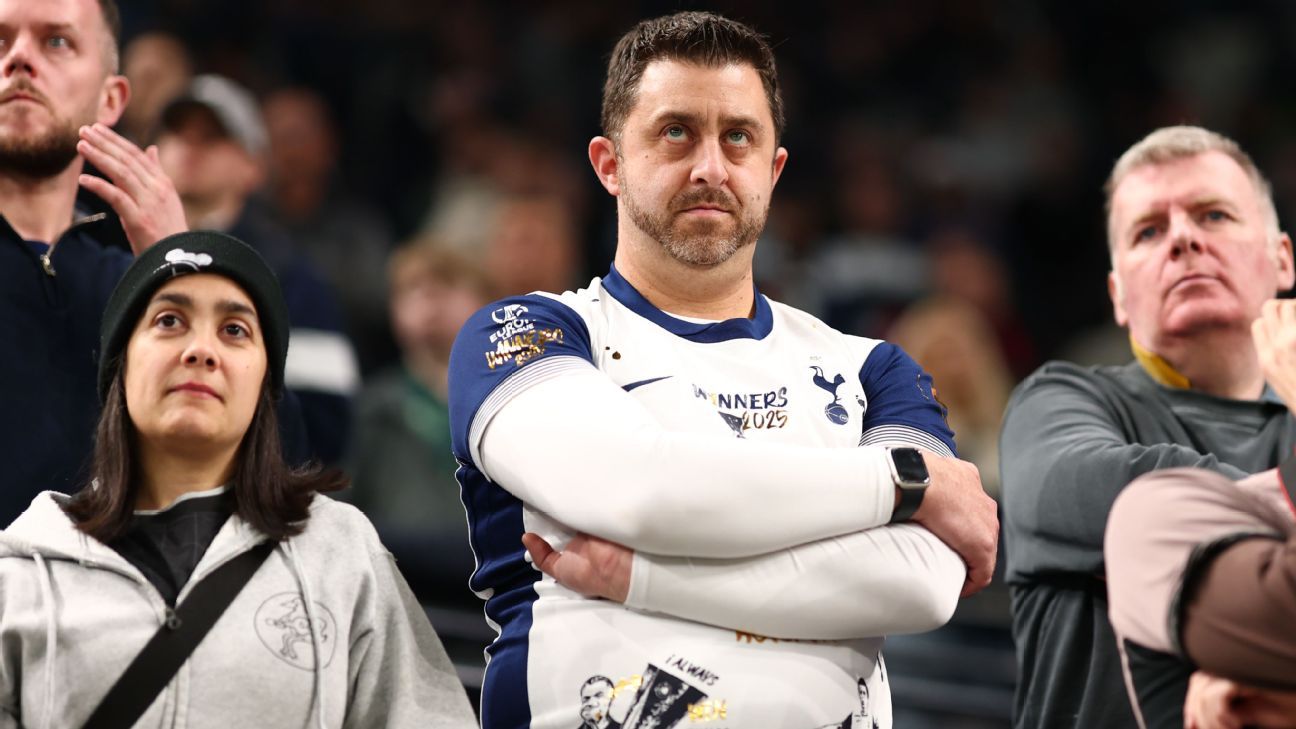
LONDON — The Champions League anthem was played at the Tottenham Hotspur Stadium on Wednesday. Atletico Madrid were in town, and Spurs were playing in football’s premier club competition with the prize of a quarterfinal against Barcelona at stake.
Despite a 3-2 second-leg victory for Igor Tudor’s team, Spurs suffered a 7-5 aggregate defeat that ended their Champions League dream. Heading into the weekend, they’re now faced with a relegation battle to save their Premier League status.
Who knows when the Champions League anthem will next ring out around Tottenham’s £1 billion stadium? Right now, it seems like it could be an eternity. If Spurs lose at home to Nottingham Forest on Sunday — Spurs (16th) are a point above the relegation zone, while Forest (17th) hover above it on goal difference — next season’s fixture list will be more likely to include Championship games against Preston North End and Lincoln City than Champions League nights against Europe’s elite.
“Nottingham Forest on Sunday is the biggest game in the club’s history for a long time,” former Spurs goalkeeper Paul Robinson, who suffered relegation from the Premier League with Leeds in 2004, told ESPN. “It would just be an absolute disaster for the club from top to bottom if they were to be relegated.”
– Lauren’s predictions: Will Tottenham save their season against Forest?
– Premier League Power Rankings: Arsenal down, Man City up on performance
– Messi reaches 900 goals … can he get to 1,000?
Spurs last suffered relegation in 1977. They bounced back after just one season, but in those pre-Premier League days, there was no financial hammer blow to dropping down a division. Clubs could ride it out, often keeping their team together and barely feeling the pain, but in the modern game, relegation can mean an instant £100 million hit and a player exodus. For a club the size of Spurs, the implications would be enormous.
But how has it come to this? Spurs were Champions League finalists under Mauricio Pochettino in 2019, they won the Europa League with Ange Postecoglou less than 12 months ago and their status as one of the Premier League’s ‘Big Six’ — alongside Arsenal, Chelsea, Liverpool, Manchester City and Manchester United — should make them too big and too wealthy to ever have to worry about relegation.
However, they are not too good to go down. Spurs haven’t won a Premier League game in 2026 — their last league win was a 1-0 victory at Crystal Palace on Dec. 28 — and since the start of last season, they have lost twice as many league games (36) as they won (18). Tudor, appointed as head coach until the end of the season last month, is the club’s sixth appointment since Pochettino’s exit in November of 2019, and he has taken just one point from four league games in charge.
There has been turmoil off the field too, with Daniel Levy’s 24-year reign as chairman coming to an abrupt end last September. Sporting director Fabio Paratici followed Levy out the door in January.
All of the ingredients of a club in turmoil are there. Bad results, underperforming players, managerial change, instability in the boardroom and supporter unrest. But still: could Spurs really go down?
Where did it all go wrong?
The consensus among many connected with Spurs is that the 2019 Champions League final defeat against Liverpool in Madrid was the fork in the road, with the club ultimately picking the wrong direction.
Pochettino’s team included Harry Kane, Christian Eriksen, Son Heung-min, Hugo Lloris and emerging talent Dele Alli. The coach wanted to take Spurs to the next level, turn them into winners rather than challengers, but the summer transfer window saw potential, rather than proven, talent arrive in the shape of Jack Clarke, Tanguy Ndombele, Giovani Lo Celso and Ryan Sessegnon. By November, Pochettino was out and in came Jose Mourinho, a change that triggered the downward spiral.
“By the time Mauricio left, it was clear he had to go,” a boardroom source told ESPN. “He and Daniel [Levy] just weren’t getting along, I think they were both worn out by each other.
“But Daniel was listening to too many people, wrong people, and I think he was seduced by the idea of having Jose as his manager. Jose is a great manager, but he inherited a squad built for Pochettino — young players who need encouragement and development — and he is just too volatile and aggressive for a young squad. Spurs needed another Pochettino type after Mauricio left, but they went in another direction and it’s never been the same since.”
Ricky Sacks, who hosts the “Last Word on Spurs” podcast, echoes that perspective, saying that the failure to develop Pochettino’s team was the root cause of the problems the club’s now attempting to deal with.
“The club has gone round and round in circles since 2019,” Sacks told ESPN. “There has been no clear idea or identity, nobody knows what they want to do, because they have gone from one style of coach to another.
“They sacked Mourinho four days before the 2021 Carabao Cup final against Man City, failed to back Antonio Conte, and then went from Ange [Postecoglou] to Thomas Frank who, although he seems a good guy, was just never equipped to upscale from Brentford to a club like Spurs. It’s just been a mess.”
Alongside the managerial churn, Spurs have consistently failed to compete at the top end of the transfer market. Tottenham’s biggest-ever signing — forward Dominic Solanke arrived from Bournemouth for a £65 million fee in August, 2024 — is by far the smallest record-transfer among the ‘Big Six’, who have all spent in excess of £100 million for a player with the exception of United, whose record signing is the £89.3 million deal for Paul Pogba from Juventus in August 2016.
Spurs have also earned a reputation for being frugal on player wages. In their most recently published accounts, for the 2023-24 season, Tottenham’s wage bill stood at £222 million — almost half of the £413 million paid by City in the same period — but that figure meant they paid just 42% of their revenue on wages. By comparison, Aston Villa‘s most recent wages to revenue ratio was 71%, while Newcastle United‘s figure was 68%, so Spurs are also falling behind clubs outside of the ‘Big Six’ when it comes to competing for new signings.
Spurs’ owners, ENIC, which is run by the Lewis Family Trust, injected £100 million of new capital into the club last October, but ongoing speculation of a potential sale has not gone away despite ENIC’s denials that they are looking to sell what is, off the pitch at least, a major football club.
It is the magnificent 62,000-capacity stadium, the club’s century-old history and their huge fanbase, both in London and globally, that earns Spurs their place in the ‘Big Six’, but former manager Postecoglou recently questioned whether they deserve to described as a “big” club.
“Obviously, they’ve [Spurs] built an unbelievable stadium, unbelievable training facilities,” Postecoglou told “The Overlap,” a popular podcast. “But when you look at the expenditure, particularly in the wage structure, they’re not a big club.
“I saw that when we were trying to sign players, because we weren’t in the market for those players. I was looking at Pedro Neto, [Bryan] Mbeumo and [Antoine] Semenyo and Marc Guéhi, because if we’re going to go from fifth to there [challenging for trophies], that’s what the other big clubs would do in that moment.”
Instead, Spurs went for Archie Gray, Wilson Odobert and Lucas Bergvall — players for tomorrow rather than today, just like Ndombele, Sessegnon and Lo Celso were in 2019.
Despite the poor recruitment and managerial changes, former Spurs goalkeeper Robinson believes that Levy has been unfairly labelled as the major reason behind the club’s fall from grace.
“Daniel gets a lot of stick and came under a lot of pressure, but when things are right on the pitch, the eyes don’t turn towards the director’s box,” Robinson said. “Spurs have a great stadium and training ground — and Daniel Levy was part of that — but the fans are sick to death of hearing about it because the football side of things has been neglected.
“I think Daniel was badly advised at times, maybe listening to a lot of people as the club grew, but to his credit, he listened to the fans when they were clamoring for trophies and employed two ‘win-now’ managers in Mourinho and Conte. He just didn’t back them enough with win-now players to get them where they wanted.
“You can’t deny that recruitment has been really poor in recent years, but Spurs have also waved goodbye to their top scorers — Kane, Son and Brennan Johnson — from each of the last three seasons.”
0:41
Tudor: Tottenham’s win vs. Atletico Madrid important for morale
Igor Tudor reflects on Tottenham’s Champions League exit after their 7-5 aggregate loss against Atletico Madrid.
Tottenham’s failure to sign the players wanted by the manager at the time proved to be an issue right until the end of Levy’s time at the helm. Last summer, Frank wanted Crystal Palace forward Eberechi Eze, Forest midfielder Morgan Gibbs-White and his former Brentford striker Bryan Mbeumo, but the club missed out on all of them. They also tried and failed to Antoine Semenyo in January, with the Bournemouth forward opting instead to move to City.
One source told ESPN that a talent drain of senior figures within the hierarchy has also hurt the club — “they’ve never been good at retaining people,” the source said — with Victoria Hawksley (LIV Golf), Michael Edwards (Liverpool), Paul Barber (Brighton), Damien Comolli (Juventus) and former chief scout and technical director Steve Hitchen all cited as staff who have been allowed to leave Spurs during the Levy era.
But with Levy gone and CEO Vinai Venkatesham — who joined from Arsenal less than a year ago — telling Tottenham’s Fan Advisory Board earlier this month that “significant change” is needed after criticizing Levy’s running of the club, more upheaval is likely in the months ahead, no matter what division Spurs find themselves in.
Can Spurs really go down?
Wednesday’s 3-2 win against Atletico on the back of last Sunday’s 1-1 draw at Liverpool have lifted the mood in and around Spurs, but the Forest game continues to generate anxiety among the club’s fan base.
“It feels like a genuine relegation six-pointer and the momentum from winning or losing will be huge,” Sacks said. “The last two games have raised morale, but they were free hits in some ways.
“Forest is different. The pressure is on and we have to win, so the players have to fight and scrap and we don’t know if they can do that. Let’s not forget that they have only won two home league games all season.”
Despite Spurs being regarded as a sensible, well-run, but cautious, club — something for which Levy has been praised and criticized in equal measure — the financial catastrophe of relegation cannot be overstated.
According to UEFA’s 2025 European Club Finance report published last month, Spurs recorded the third-largest pre-tax loss (at £129 million) in Europe last year, after Chelsea and Lyon, despite generating a club record turnover of £580 million. Revenue was the ninth-highest in Europe due to the stadium’s commercial activity, including NFL fixtures and concerts, and competing in European football. The club’s net debt, due to borrowings for the new stadium, stood at £772.5 million, while reserves dropped from £198 million to £79 million.
Tottenham’s losses led CEO Venkatesham to warn the fan advisory board of a need to monitor the club’s compliance with Financial Fair Play regulations, so there is no question that relegation would create severe difficulties for the club.
Last season, Spurs earned £127.8 million in Premier League prize money despite finishing 17th. Relegation would be cushioned by three years of parachute payments, but they would drop from £48.95 million in year one to just £17.8 million in year three; at the same time, they would be earning just £5.7 million-per-year from the EFL’s broadcasting deal. Villa, Sunderland and Leeds United were forced to close full sections of the stadium after relegation due to the cost of maintaining them without fans to fill the seats. Could the same happen at Spurs?
They would be the biggest club to go down since Leeds in 2003-04 and relegation led to a financial meltdown at Elland Road and the mass exodus of players. It took the club 16 years to return to the top flight.
“I think it would be more alarming and an even bigger story than Leeds if Spurs go down,” said Robinson, who was part of the 2004 Leeds team. “Spurs have been a regular European team, they reached the Champions League final seven years and won the Europa League last year, so it would be much bigger.
“When a team is going down, players know they will be leaving. At Leeds, you would turn up for training not knowing whether somebody would still be there or if the club had moved them on for the finances. That’s what relegation brings — the initial destruction, and then the fight to come back. It’s not easy to do that.”
2:17
Gibbs: Tottenham draw Liverpool’s ‘story of the season’
Kieran Gibbs explains what’s going wrong at Liverpool this season following their late draw vs. Tottenham in the Premier League.
The threat of relegation has, however, led to unity among the Spurs fan base. Plans for a protest against the owners ahead of the Forest game have now been abandoned in favor of a wholehearted attempt to create an atmosphere of support and positivity, with supporters now intending to welcome the team bus with flares and huge crowds on Sunday.
“Given the severity of the situation, nobody wants to be responsible for adding more negativity, so the focus is now on backing the players and being 100% united in that,” Sacks said. “There are still major issues with the ownership, and the majority of fans want new owners, but that is now a matter for another day. The biggest priority is staying in the Premier League, the team needs our help — the club needs our help — so we want to show support and Tudor is backing us to do that.
“He has told all of the players — even the injured ones — to travel on the coach this weekend, so we can give them a real welcome and show our support.”
The worst-case scenario of rivals Arsenal winning the league — worse yet, they could still do the quadruple — and being relegated by Chelsea in the penultimate game of the season at Stamford Bridge is keeping Spurs fans awake at night, as is the prospect of next season’s derby being against League One promotion-chasing Stevenage.
Richarlison‘s equalizer at Anfield, and Xavi Simons‘ match-winning performance against Atletico, have given Spurs hope, so maybe the season isn’t headed for disaster. But this is Spurs, and their fans have become accustomed to expecting the worst and being proved right.

