
Gulf states say any trust in Iran “shattered” as drones hit oil and gas infrastructure in Kuwait, UAE
Saudi Arabia said a drone hit the country’s SAMREF refinery Thursday in the port city of Yanbu on the Red Sea. The Saudi Defense Ministry said damage assessment was underway, without elaborating.
Yves GELLIE/Gamma-Rapho/Getty
An earlier drone attack on Kuwait’s Mina Al-Ahmadi refinery sparked a fire but caused no injuries, the state-run KUNA news agency reported Thursday. The refinery is one of the biggest in the Middle East, with a petroleum production capacity of 730,000 barrels per day. Shortly after, a drone attack set ablaze the nearby Mina Abdullah refinery, authorities said.
Authorities in Abu Dhabi said they were forced to shut down operations at its Habshan gas facility and Bab field, calling Iranian overnight attacks on the sites a “dangerous escalation.”
Missile alert sirens sounded in multiple other areas around the Gulf, and Israel warned of incoming Iranian fire.
Qatar, Saudi Arabia and the United Arab Emirates all denounced the Iranian attacks, with Saudi Arabia’s top diplomat saying assaults on the kingdom meant “what little trust there was before has completely been shattered.”
CBS/AP
Stocks slide and oil prices spike as Israeli strike hits “plumbing of the global energy system”
Stock prices were down early Thursday and oil prices rose sharply as the U.S.-Israeli war on Iran escalated.
Israel’s Wednesday strike on Iran’s South Pars gas field, which is shared with Qatar, and President Trump’s threat to destroy the vast reserve if Iran retaliates by striking Qatari infrastructure, have hit markets hard.
The Reuters news agency said U.S. crude futures rose above $97 per barrel early Thursday, while natural gas was up 3% and Brent crude futures rose to $111.87 a barrel, up 4% on the day.
Japan’s Nikkei stock index was down over 3%, South Korean equities fell 2.8% and European futures were down more than 1.5% ahead of the continent’s markets opening.
“This latest escalation feels like a turning point for markets because the conflict is no longer just about military headlines or Strait of Hormuz closure,” Charu Chanana, chief investment strategist at Saxo in Singapore, told Reuters. “It is now hitting the plumbing of the global energy system. What is unsettling markets now is the growing stagflation risk… It means this is no longer just a geopolitical story but a macro one.”
Iran launches deadly new wave of missile attacks on Israel
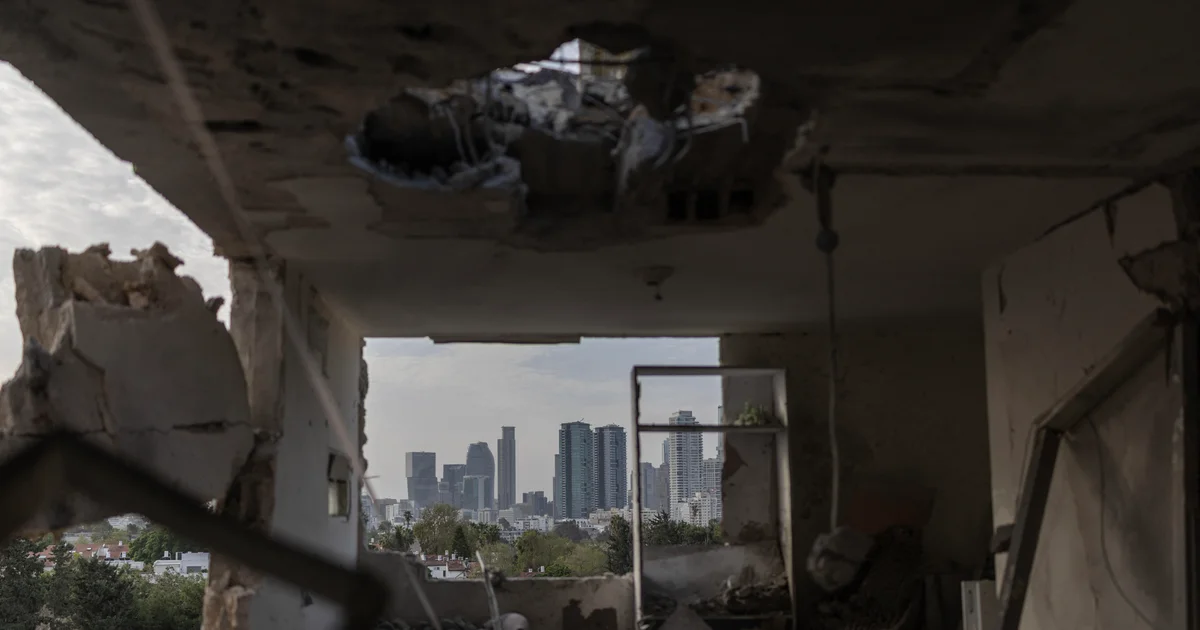
Iran launched at least six waves of missiles at Israel overnight, including new attacks using cluster bombs.
Air defenses intercepted most of the weapons, but debris and bomblets from the cluster munitions fell in several places, including in Tel Aviv where an elderly man was lightly injured in apartment building, according to medics.
Ilia YEFIMOVICH/AFP/Getty 
One cluster bomb struck the agricultural community of Adanim in central Israel’s Sharon area, killing a Thai agricultural worker, according to medics, while another hit a home in Jaljulia, an Arab town also in central Israel, but caused no reported injuries.
There was also a direct hit in the Palestinian town of Bayt Awwa, in the Israeli-occupied West Bank, which Palestinian media reports said had caused some fatalities. There was no immediate confirmation of the casualties there.
Vessel “hit by unknown projectile” just off Qatar’s coast
The U.K. military’s Maritime Trade Operations Center said early Thursday that it had received a report of a vessel being “hit by an unknown projectile” just off the coast of Qatar’s Ras Laffan petroleum industry area.
UKMTO did not identify the vessel or provide any further information about what might have hit it, but it said all crew members were reportedly safe and well.
Iran has attacked commercial vessels in the Gulf region for almost three weeks in retaliation for ongoing U.S.-Israeli strikes, paralyzing marine traffic through the Strait of Hormuz, a vital shipping lane for global oil supplies.
Fewer such attacks had been reported this week, but following Israel’s strike on the Iranian South Pars gas field, the regime in Tehran stepped up its strikes on Gulf states early Thursday.
QatarEnergy says Iran struck several liquefied natural gas facilities
QatarEnergy said that in addition to Iran’s Wednesday missile attack on Ras Laffan Industrial City, which it said caused “extensive damage to the Pearl GTL (Gas-to-Liquids) facility,” several other facilities were targeted in later attacks early Thursday morning local time.
QatarEnergy said the attacks caused “sizeable fires and extensive further damage” at multiple LNG facilities. No casualties were initially reported, QatarEnergy said.
Trump says “NO MORE ATTACKS WILL BE MADE BY ISRAEL” on South Pars gas field
President Trump said Wednesday on Truth Social that Israel would not attack Iran’s South Pars gas field again, but added a warning that if Iran continues to attack Qatar’s liquid natural gas facilities, the U.S. will destroy the Iranian gas field.
Mr. Trump wrote that the United States “knew nothing” about Israel’s attack on the South Pars field and that Qatar was “in no way, shape, or form, involved with it.”
Mr. Trump said Iran then “unjustifiably and unfairly” struck Qatar’s Ras Laffan gas facility in response.
The president declared that “NO MORE ATTACKS WILL BE MADE BY ISRAEL” on the South Pars field, “unless Iran unwisely decides to attack a very innocent, in this case, Qatar – In which instance the United States of America, with or without the help or consent of Israel, will massively blow up the entirety of the South Pars Gas Field at an amount of strength and power that Iran has never seen or witnessed before.”
Israeli officials have not commented on the South Pars strike or Mr. Trump’s remarks about it.
U.K. military planners working with U.S. on plan to reopen Strait of Hormuz
A team of military planners from the United Kingdom is working with the U.S. military to reopen the Strait of Hormuz, CBS News has learned.
The relatively small team is at U.S. Central Command — which manages U.S. military operations in the Middle East — working on options to reopen the strait. A U.K. official told CBS News that this is an enhancement to the U.K. planning staff already assigned to CENTCOM, which is headquartered in MacDill Air Force Base near Tampa, Florida.
The news was first reported by Radio Free Europe.
The U.K. and other U.S. allies have been reluctant to join U.S. military operations during active combat operations by the U.S. and Israel against Iran, according to multiple diplomats.
After hostilities conclude, allies like the U.K. and Japan may consider sending assets like mine detection materials, according to multiple officials familiar with the ongoing diplomacy.
This issue is likely to be raised Thursday when Japanese Prime Minister Sanae Takaichi meets with President Trump at the White House. Takaichi has already publicly indicated that Japan’s constitution would not permit the use of its self-defense forces to operate in an offensive operation.

