Albert Einstein is one of the most influential figures in the history of this world. He was not just a scientist as the world knows him to be, but a thinker and philosopher whose theories changed the way of thought and perception.Einstein was born on March 14, 1879 in Ulm, Germany, and went on to change our understanding of space, time, light and gravity. He was awarded the Nobel Prize in Physics in 1921 for his explanation of the photoelectric effect, one of his major contributions to quantum theory. But his influence goes well beyond physics, into technology, philosophy and discussions about humanity’s responsibility in the nuclear age.Early life A precocious child with a mind of his ownEinstein was born into a middle class Jewish family. His father Hermann Einstein worked in the electrical engineering field and his mother Pauline Einstein fostered his love of music. From an early age Albert was fascinated by mathematics, science and the mysteries of the natural world. An early encounter with a compass is said to have left a lasting impression on him, and led him to ask questions about the invisible forces that control everyday objects.He also acquired a lifelong love of the violin, which gave him a source of relaxation and creative expression. Music was always a big part of his life, even in his most demanding scientific years. Einstein’s schooling was not always comfortable, however. He didn’t like the rigid teaching methods that emphasised memorisation over independent thought. He was not prepared to accept explanations at their face value; he wanted to understand the principles that lay behind them. This questioning of authority, this willingness to explore ideas independently, would later be one of the hallmarks of his scientific method.He applied to the Swiss Federal Polytechnic in Zurich in 1895, but failed the entrance exam on his first attempt. He then completed his education in Aarau, Switzerland. He entered the institution in 1896 to study mathematics and physics. The set-back did not kill his ambition. Instead it was an early lesson that intellectual ability and traditional academic achievement did not always travel the same road.Years at the patent office and the year of revolutionAfter graduating in 1900, Einstein had difficulty in obtaining a university position. In 1902 he became a technical expert at the Swiss Patent Office at Bern. His job was to review patent applications, many of them regarding electrical devices and technical inventions. The job was not an academic research job, but it gave him financial security and the opportunity to think deeply about scientific problems. Outside of his working hours he continued to explore questions of light, motion and nature of the universe.The year 1905 was a turning point in his career. It is often referred to as Einstein’s annus mirabilis or miracle year, as a number of papers were published that changed physics. One paper described Brownian motion, the random movement of small particles suspended in a liquid, as evidence for the existence of atoms and molecules.His work on special relativity defied accepted ideas of space and time. Einstein asserted that the laws of physics are the same for observers moving with constant velocities relative to one another, and that the speed of light in a vacuum is constant for all such observers. These achievements placed him among the most original minds of his generation.The general theory of relativityBut Einstein did not stop with special relativity. He wanted to understand gravity . A fundamental force that shapes the universe . In 1915 he published his general theory of relativity, which provided a radically different explanation of gravity. Rather than considering gravity simply as a force that moves through space , the theory explained this as a curvature of space-time caused by mass and energy .The theory predicted that light would bend passing close to a massive object. Data gathered during a solar eclipse in 1919 confirmed this prediction and catapulted Einstein to international fame.His work was later fundamental to modern cosmology and the scientific investigation of black holes, gravitational waves and the evolution of the universe. More than a century later it remains one of the most successful theories in physics.Why did Einstein get the Nobel prizeEinstein was famous for his theory of relativity , but he actually won the Nobel Prize in Physics for something else . The 1921 prize, officially given in 1922, was for his contributions to theoretical physics, especially his explanation of the photoelectric effect. This is the phenomenon called photo-emission . When you shine light on certain materials , electrons are emitted . Einstein proposed that light carries energy in packets, and that the energy of each packet is proportional to the frequency. This helped explain why light must have some frequency to release electrons, no matter how intense it is.His explanation was a major contribution to the advancement of quantum mechanics and allowed scientists to understand the interaction of light and matter.The photoelectric effect later played a role in technologies such as light sensors and solar cells . Thus Einstein’s Nobel award highlighted a contribution that is still of practical importance.Personal life, Exile and new life in AmericaEinstein’s private life was complicated. In 1903 he married a fellow student, Mileva Marić, and they had two sons who reached adulthood. They also had a daughter, Lieserl, of whom nothing is known about later life. The marriage was dissolved in 1919, the year of his marriage to his second wife, Elsa Löwenthal.The more famous Einstein became as a scientist, the more hostility he faced politically. His Jewish identity, his international outlook and his opposition to nationalism made him a target for antisemitic attacks, particularly as extremist movements gained ground in Germany. When Adolf Hitler and the Nazi Party seized power in 1933, Einstein was in the United States. He never returned to Germany and eventually settled in Princeton, New Jersey, where he worked at the Institute for Advanced Study.He became a naturalised US citizen in 1940. His decision to leave Germany was not only a matter of the danger to Jewish people posed by the Nazi regime, but also the broader implications of political extremism for intellectual freedom.Beyond science: A voice for humanity and peaceEinstein was not only a physicist, but also a public intellectual who spoke on civil liberties, racism, education and international cooperation. He backed civil rights in the United States and claimed that discrimination was not compatible with human dignity.He also supported Zionism and the creation of a Jewish homeland, but he supported peaceful coexistence between Jews and Arabs. In 1952, he was offered the presidency of Israel, which he refused. He was interested in philosophy, music and pedagogy. He believed real learning required curiosity, imagination and the freedom to question established ideas. Humility was also a big part of Einsteins personal philosophy. He still considered scientific knowledge imperfect and the universe an object of endless investigation, notwithstanding his extraordinary successes.A world forged by a legacyEinstein died at Princeton April 18, 1955, at the age of 76. His work has continued to inspire research throughout physics and astronomy, and his name has become synonymous with genius. His theories have practical applications far beyond university laboratories. Satellite navigation systems require corrections for special and general relativity to keep the time and position accurate. His work on light quanta helped lay the foundations of principles central to modern quantum technologies.Quote of Day“Learn from yesterday, live for today, hope for tomorrow. The important thing is not to stop questioning.”Albert Einstein’s words give us a simple yet powerful lesson about how to live life. The quote encourages us to learn from the past, live in the present and look forward to the future with hope.“Learn from yesterday” emphasises the need to reflect on our experiences without being stuck in them. Every experience, happy or painful, is an opportunity to learn something about ourselves and the world around us. Mistakes can teach us patience, failures can teach us how to recognise our weaknesses, and difficult relationships can teach us the importance of boundaries and understanding. When we learn from yesterday, we put our experiences into perspective, and we prevent the same mistakes from affecting our future.“Live for today” is a reminder that life happens in the present moment. Looking back on things can help us to grow, but thinking about things all the time can make us forget what we have now. Likewise, obsessing too much about the future can cause us to miss out on the opportunities, relationships and little pleasures that are already within our lives. Living for today does not mean that you should neglect your responsibilities or act without thinking of the consequences. It is about being present in our everyday experiences, appreciating the people around us and making meaningful steps toward our goals. The present is the time we have the power to do something, whether that’s spending quality time with loved ones, pursuing a passion or even making a small change toward a healthier lifestyle.
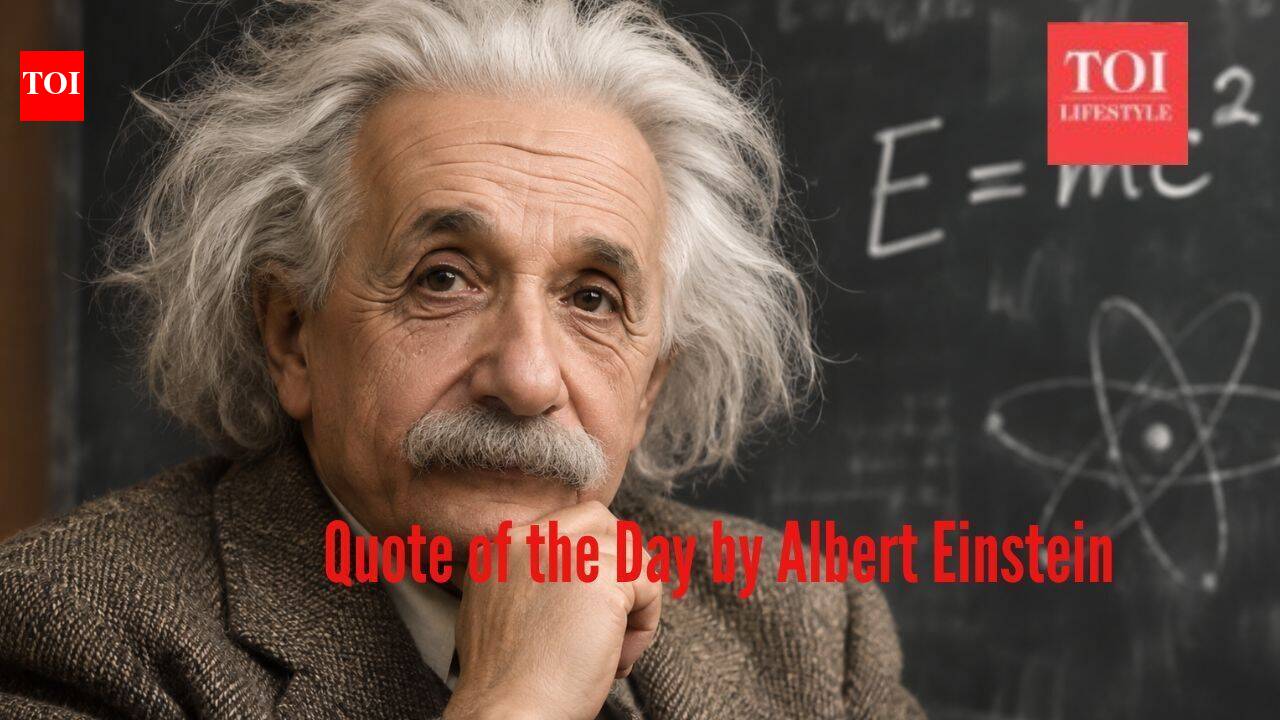
Quote of the Day by Albert Einstein “Learn from yesterday, live for today, hope for……”

By admin
0
11

RELATED ARTICLES

