
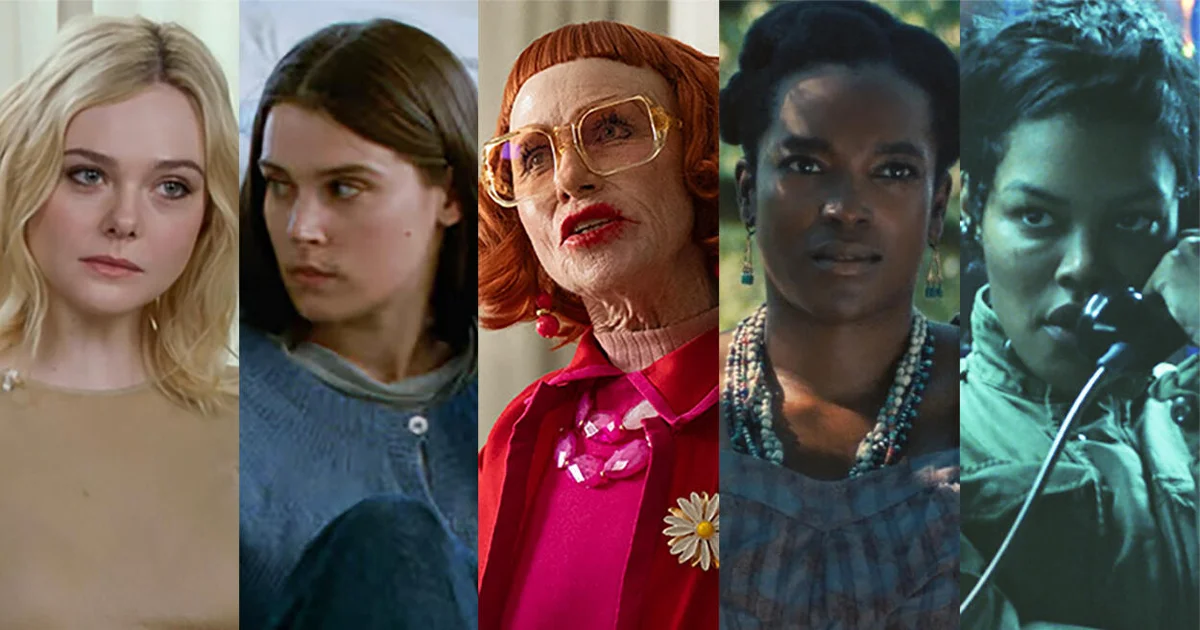
Watch scenes from the performances nominated for the Oscar for best supporting actress, as well as interviews with the nominees below. The 98th Academy Awards will be presented Sunday, March 15.
Neon; Warner Brothers
Elle Fanning, “Sentimental Value”
Elle Fanning began her professional career as a toddler in the Sean Penn film “I Am Sam,” playing a younger version of the character played by her sister, actress Dakota Fanning. Growing up on screen, Elle has appeared in more than 80 film and TV roles, from “The Curious Case of Benjamin Button” and “Super 8,” to “The Neon Demon,” “The Beguiled,” and “A Complete Unknown.” She received an Emmy nomination for “The Girl From Plainville.”
In “Sentimental Value,” she plays Rachel Kemp, a Hollywood actress who is wooed by Danish filmmaker Gustav (best supporting actor Oscar nominee Stellan Skarsgård) to star in his latest project – only after his own actress-daughter, Nora, has rejected him. The script is a deeply personal one, and Kemp finds herself struggling with the emotional depths of the role – a character based on Gustav’s suicidal mother.
At 27, Fanning received her first Oscar nomination for “Sentimental Value.”
Referring to Rachel Kemp, Fanning told The Hollywood Reporter, “We’re at different phases, but there was a little feeling while playing her that maybe I was looking back at a younger version of myself in this world.”
Fanning had just completed filming the Bob Dylan biopic “A Complete Unknown,” and was preparing for a film in New Zealand, when her agent called. She told the Los Angeles Times podcast The Envelope, “[He] said, ‘Joachim Trier has a new film and there’s a part for an American actress in a role, even though the film is predominantly in Norwegian. It’s going to film in Oslo.’ And from that moment, I was like, ‘Oh, I have to do this.’ I’m a really instinctual person. And I get feelings. I feel like I’m a little psychic.”
She said she wanted to avoid Rachel coming off as a silly character. “I saw the pitfalls that I could have fallen into,” she said, “the cliches that maybe could happen, that she could become kind of a joke. So when I talked to Joachim, I was happy to know we were on the same page of how we wanted Rachel to be presented.
“Joachim and I talked a lot about, maybe the struggles or the pressure that Rachel’s feeling in her own career. People are really quick to – especially women – put us into a box of limitations and tell you what you can or can’t do. I feel like I’ve been really lucky to navigate that. The show that I did, ‘The Great’ [in which she played Catherine the Great], I really felt like I broke out of that mold a little bit. People probably knew me most for ‘Maleficent’ … I felt like I came into my own a little bit.
“And I think that’s what Rachel is when we find her, that’s what she’s yearning for. That’s what she’s struggling with – she feels like this emotion inside her that she wants to unleash, but no one’s really [seen] her for her talent. … When she meets Stellan’s character, there’s something that he sees in her that she hasn’t experienced before. And so, playing Rachel, I feel like she’s a very different actress than me. But there was part of me that felt like I was kind of drawing from my younger self of maybe how I felt in the past and kind of bringing that into Rachel – and the discovery of being moved by a text.”
Inga Ibsdotter Lilleaas, “Sentimental Value”
Norwegian actress Inga Ibsdotter Lilleaas grew up in an acting family – her parents ran a theater company. But in addition to acting credits in European TV, she also worked as a dental hygienist, a drama teacher, and caregiver for the elderly. She told USA Today, “In the nursing home, you’re working with people who have lived long, long lives, and for a lot of them, those lives are slipping and they can’t remember. So, you’re a detective, in a way, trying to figure out who these people are. That’s what you do as an actor – you’re looking for what’s underneath.”
In Joachim Trier’s “Sentimental Value,” Lilleaas plays Agnes, the younger sister of Nora (played by best actress Oscar nominee Renate Reinsve), siblings who have each experienced trauma growing up in their broken family. When their father, Gustav, returns following the death of their mother, their own relationship is tested.
Lilleaas won best supporting actress from the National Board of Review for “Sentimental Value.” This is her first Oscar nomination.
In a Q&A held at last fall’s New York Film Festival, where “Sentimental Value” had its New York premiere, Lilleaas said the depth of the script resonated with her in many ways, like a novel.
“This whole sisterhood, working with the theme of sisterhood, is really interesting, that they lived the same life, but of course like all siblings it’s completely different. I think for Agnes she’s able to be a safer and more secure person because she had a protector growing up, which is really beautiful, and so she could be her sister’s protecter in adulthood because of that.
“There are some cracks, of course, like for everyone, but I think Agnes has chosen her life. She knows what she wants. We talked about that a lot actually. Her father and sister judge her a little, because it’s more conventional, her life. But it’s a very active choice that she makes. She wants love, she wants security and safety, and she wants a family, and she made that for herself. And she was able to because she’s able to receive love in a way that maybe Nora isn’t. But she also has traumatic experience with her father, with making a movie with her father, but she doesn’t necessarily know [it] was traumatic.”
Amy Madigan, “Weapons”
The clownish Aunt Gladys, in Zach Cregger’s jolting horror tale “Weapons,” is a pitiable fright when we see her: Orange wig, smeared makeup, cartoonish glasses, a wide grin, and a motormouth eager to soften her audience. But when she wields witchcraft, her true horror overtakes whatever empathy we may have felt toward her. She is a monster, with ice water in her veins, who cruelly uses her nephew, Alex, to further a vague plot that has thrown an entire town into turmoil when elementary school children disappear.
Madigan, who started as a rocker-performance artist, turned to acting, studying at the Lee Strasberg Institute, and appeared on stage, where she met future husband Ed Harris. Her film and television roles included “The Day After,” “Places in the Heart,” “Alamo Bay,” “Twice in a Lifetime” (which earned her an Oscar nomination), “Field of Dreams,” “Uncle Buck,” “Pollack,” “Gone Baby Gone,” and the TV drama “Roe v. Wade,” for which she won a Golden Globe.
For “Weapons,” director Zach Creeger told the Hollywood Reporter that casting the role of Gladys was vital, given that she was key to the film’s mystery. “If that character doesn’t work, this movie doesn’t work,” he said.
“Risky is kind of a really fun thing to participate in,” Madigan told Entertainment Weekly of how she developed the character. “I could create Gladys, and she’s a big personality, and it seemed to work for this, so that was very freeing. … Zach said to me kind of early on, ‘You just wait to see how people are gonna come to Gladys.’ And I kind of went, ‘Oh, well, let’s just see, Zach,’ and we’re in the middle of work. But he was actually correct.”
Working with the film’s hair, makeup, costume and special effects teams, Madigan conjured two looks for Gladys – her public face, and her startlingly decrepit, more witchy appearance. When they were doing tests, she said, “Zach was in sheer delight. ’cause that’s what he was hoping for.”
Madigan’s vivid portrayal of Gladys became a meme on TikTok, and a fixture among Halloween cosplayers. “People like Gladys. They want to hang out with Gladys,” Madigan told The Guardian. “Which I find kind of interesting. It’s crazy how people are responding to Gladys. But I have to accept that they’re also responding to me.” She said, of the nightmares Gladys may be causing to children fearful of a child-catcher coming for them, that she was taking it as a compliment.
Madigan won the Screen Actors Guild’s Actor Award for “Weapons.”
- “Weapons” has received one Academy Award nomination.
Wunmi Mosaku, “Sinners”
Born in Nigeria to academics who emigrated to England, Wunmi Mosaku studied at the Royal Academy of Dramatic Art. Her stage, TV and film roles led to a BAFTA Award for the TV series “Damilola, Our Loved Boy,” and a British Independent Film Award for best actress for “His House.” In Ryan Coogler’s “Sinners,” Mosaku plays Annie, a hoodoo practitioner in the Deep South, for which she earned her first Oscar nomination, and won her second BAFTA Award.
Mosaku talked with “CBS Mornings” about taking on the role: “There’s a distinction between voodoo and hoodoo, and so we had a hoodoo consultant [Yvonne Chireau]. I didn’t know anything about the culture, the spirituality, the connection to the Yoruba, the traditional religion of ifa – I didn’t know any of it. So, I went in completely clueless, complete blank slate. Except, actually, I did have a judgment, ’cause I was born and raised in a really strict Christian household and so I did have a judgment of ifa and voodoo and knowing it was all kind of connected to hoodoo. So I thought it was scary, and my mom was like, ‘Be careful, please be careful.'”
Mosaku said she felt she had grown as a person, a mother, a wife, and a member of society through playing the character: “I feel like more connected to my ancestry because of it and more connected to my purpose because of it. I think it’s such a beautiful reminder that we’re all going to be future ancestors and, like, what we’re going to do with that our gifts and our energy into this world and how it will reverberate,” she said.
Having played immigrants, Mosaku described to The Guardian that, as a youngster in England, she was discouraged from becoming fluent in her native language, Yoruba, because it would result in a “funny” accent. “That’s the stuff that’s really important,” she said. “You don’t appreciate the cost to people, the tax on a person’s spirit in order to assimilate into your country – and for what? It’s superiority. It’s ego. It’s brutal. It’s a cultural genocide.”
Teyana Taylor, “One Battle After Another”
In Paul Thomas Anderson’s “One Battle After Another,” a band of American revolutionaries takes on a militaristic government, in a story that, while based on a 1990 Thomas Pynchon novel, feels fiercely topically, as we witness militants attack a government detention center for undocumented immigrants. Perfidia Beverly Hills (best supporting actress Oscar nominee Teyana Taylor), a key figure in the armed band known as the French 75, displays a revolutionary zeal unmatched by her compatriots, even after giving birth to a child with a bombmaker known as “Rocketman” (best actor Oscar nominee Leonardo DiCaprio).
Taylor is a Grammy-nominated singer, choreographer and music video director, whose debut album, “VII,” topped the R&B chart. Her next two releases, “K.T.S.E.” and “The Album,” went gold. Taylor also acted in several film and TV roles (her credits include “Coming 2 America” and “White Men Can’t Jump”). She received a phone call from Anderson about “One Battle After Another” in that most L.A. of situations: while she was stuck in traffic.
In an appearance on “The Late Show with Stephen Colbert,” Taylor described her character: “I think Perfidia is very complex. Perfidia has a lot of layers, and I think a lot of her layers are color-coordinated. That’s what I chose to do with her character. I wanted to color coordinate her layers!
“This is a woman who was unapologetically herself. Of course, selfish at times, but for whatever good reason she feels like that is, she’s also coming from the pressures of coming from a long line of revolutionaries. I think that’s a lot of pressure for a person. They need to carry it on. It becomes her identity. I think throughout her journey of trying to figure it out, we have motherhood and things get tough. You have postpartum depression. It’s a lot, and I think a lot of what we see in Perfidia is her being in survival mode and navigating all these different things.”
In a conversation for the SAG-AFTRA Foundation, Taylor talked about performing a scene that gives Perfidia a voice to the 16 years she was away from her daughter, reading a letter about her wishes for Willa.
“The original ending was me in Cuba, or Mexico. I was somewhere and we originally had that in there. Then he wound up taking it out and was like, ‘Let’s just do a letter.’ And I remember it was just me, [Paul], and our sound guy. We went to this room. It was actually the last day of filming, I think. And we did it in one take. And yeah, it was so emotional to get through that letter, but we took our time. I didn’t rush through it. Those were real tears. It was real emotion. And at the time, you know, our producer Adam Somner, we were losing him. He was dying of cancer and he was still coming to work every single day. It was a lot. So, it was getting through that letter, we were dealing with a lot. I was crying. Paul was crying. Our sound guy was crying holding up the boom mic. And I’m sorry, it’s a serious moment, but like, it was just so cute because it was just like we just couldn’t. It was a lot, and I was happy that it made it. …
“I’m really most proud of that part because, you know, you still have the music in the background, and I’m not in the scene for people to probably feel or see how powerful it was while I was reading it. So, it really does make my day when people bring up the letter ’cause you do hear what she’s been through within the 16 years. That’s her moment to kind of redeem herself and show that she’s not just, like, unhinged. You hear her heart in this letter. … And also, the questions are so valid. Are you happy? Do you have love? Will you try and change the world? You know what I’m saying? These are questions that I ask my children, you know, and they’re just five and 10. You know, do you feel safe? Do you feel loved? What do you want to be? What do you want to do? Like, these are real questions that you ask.”
Taylor won the Golden Globe for her performance.
See more:

