
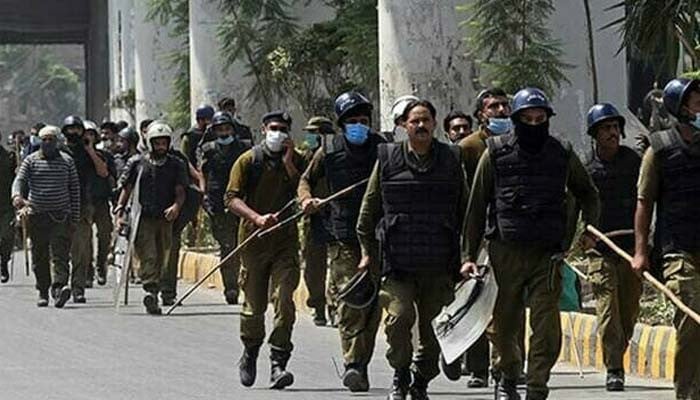
In less than 48 hours this week, two men at the centre of high-profile cases died at the hands of apparent police ‘crossfire’, and the police gave the same explanation both times.
In Islamabad, Muhammad Nauman, accused in the case linked to the suicide of student Laiba Ejaz, was allegedly hit by his own accomplices’ fire while police were taking him to recover evidence. No policeman was hurt, though. A day later, Tauqeer Nazir, prime suspect in the killing of orphaned teenager Waseem Abbas in Multan, died in a CCD encounter near Bahawalpur, allegedly from his accomplice’s gunfire. He had escaped from Multan’s DHA police station while on a four-day physical remand. No explanation is available for how he escaped and reached Bahawalpur.
Meanwhile, the Human Rights Commission of Pakistan (HRCP) documented at least 670 CCD-led encounters in eight months of 2025, in which 924 suspects died, and only two police officers were killed. The HRCP’s report for 2024 recorded 341 encounter deaths across Punjab and Sindh combined for the entire year. The police story rarely changes: Suspects’ accomplices ambush the police party to free them, the police fire back, and the suspect is killed by their own accomplices’ bullets, while they always escape unhurt.
In October 2025, Islamabad police gave a near-identical account when two suspects in the murder of CDA Director Land Ehsan Elahi were found dead after their accomplices allegedly opened fire. When the same improbable event happens hundreds of times, the story stops being probable.
Several factors drive this trend. The first cause is structural. Investigation is weak, forensic capacity is thin, witnesses are intimidated, prosecution is under-resourced and trials drag on for years. The encounter has become a shortcut around a justice system the state has failed to repair.
The second is political ownership. The CCD was created in 2025 through an ordinance amending the Police Order 2002, and Punjab’s leadership has hailed it as protecting citizens’ lives and property. Rana Sanaullah has defended it on the grounds that those killed were proclaimed offenders who did not submit to the law. When politicians condone extrajudicial outcomes and ignore process, policemen learn what is expected of them.
The third is the outrage economy. In the Laiba case, the prime minister directed Islamabad’s police chief to ensure immediate arrest. In Multan, CCTV footage of the boy being run over circulated widely. Under that kind of pressure, only a dead suspect is counted as service delivery. Another thing is about impunity. Punjab police’s own figures recorded 2,246 suspects killed in 3,424 encounters between 1990 and mid-2005. None of these cases produced a lasting deterrent, so each new one carries little fear for those who pull the trigger.
Unsurprisingly, authorities apply the encounter approach selectively to suspects without money, connections or influential surnames. In Karachi’s Karsaz case, the accused was acquitted after an out-of-court settlement. The Shahzeb Khan murder case ended the same way, with Shahrukh Jatoi’s acquittal in 2023.
The street learns a simple lesson: poor suspects are shot on some bypass road at night, while privileged ones walk free through legal compromises. Two legal systems, divided by class, damage the state’s credibility more than any gang.
That these encounters give victims justice is an outright farce. What victims actually get is raw retribution, without fairness, evidence or remedy. Police sources say Laiba gave Nauman Rs2.1 million, raised from the sale of her father’s plot, along with her stepmother’s jewellery, and they suspect he defrauded other women.
A due trial and thorough investigation could have traced the money, identified the racket and other victims, and led to court-ordered restitution and compensation to victims’ heirs. The family has lost a daughter and its savings, and the state has closed off the only legal route to recovering them. Even if Nauman was guilty, fraud carries a prison sentence, not death. Yet he ended up dead in police custody, and a society that cheers such deaths shares the blame.
Max Weber defined the state by its claim to a legitimate monopoly on violence. That violence is legitimate because it is bound by law and answerable to courts. Once police decide who dies by the roadside, the state becomes just the best-armed actor in a crowded field. Each staged encounter also deepens legal cynicism, the belief that law serves power. It teaches young people that brute force settles disputes and lends legitimacy to private revenge and jirga justice.
Unchecked power over life and death also becomes a source of unrestricted coercion. The HRCP recorded one family’s account of police pressure to bury the deceased immediately, with a warning that other relatives could be killed if they pursued the case. When citizens fear the thana rather than trust it, they stop reporting crime and witnesses stop cooperating. Investigation weakens, which produces more encounters. Officers who can close cases with a gun have no reason to develop investigative skill. Tauqeer died under a court-ordered remand, which turned the magistrate’s protection into a joke.
Has the crime declined? The Punjab Police reports that in 2025, compared with 2024, robbery and dacoity fell by 71 per cent, murder during robbery by 73 per cent and overall murder by 23 per cent. No independent audit or victimisation survey has verified this. Then, the picture is uneven: motorcycle theft, the crime that hurts ordinary citizens most, continued to rise, with over 75,000 thefts recorded in 2025, and crimes against women grew as a share of registered cases in the first half of 2026.
Lastly, correlation is not causation. More patrolling, faster response, and better surveillance may explain much of the decline, and criminology consistently finds that the certainty of being caught deters more than the severity of punishment.
A more lasting decline in crime needs a different set of measures. For instance, every custodial or encounter death should trigger a mandatory, time-bound judicial inquiry under relevant sections of the CrPC, with the findings published. The custody transfers need safeguards: body cameras, GPS-tracked vehicles, prior notice to the magistrate, no night-time recovery trips, and the burden of proof on the police when a suspect dies.
With this, the oversight must be independent. HRCP has recommended FIA investigation under NCHR supervision, a civilian oversight commission and mandatory compensation for families. To strengthen it further, invest in what actually reduces crime: prevention through lighting and design in crime hotspots, community policing, youth employment, drug treatment and prison reform, along with forensic laboratories beyond Lahore, specialist investigation cadres, a strengthened prosecution service, and real witness protection.
Finally, present encounter data to the respective provincial assembly and publish it quarterly. The two deaths this week may have removed two alleged criminals. They also ended any chance of uncovering the truth, denied two grieving families any recovery or compensation, and further weakened the public’s belief that the state is accountable to the law.
The writer is a sociologist with extensive work in social policy and development. He can be reached at: [email protected]
Disclaimer: The viewpoints expressed in this piece are the writer’s own and don’t necessarily reflect Geo.tv’s editorial policy.
Originally published in The News


