
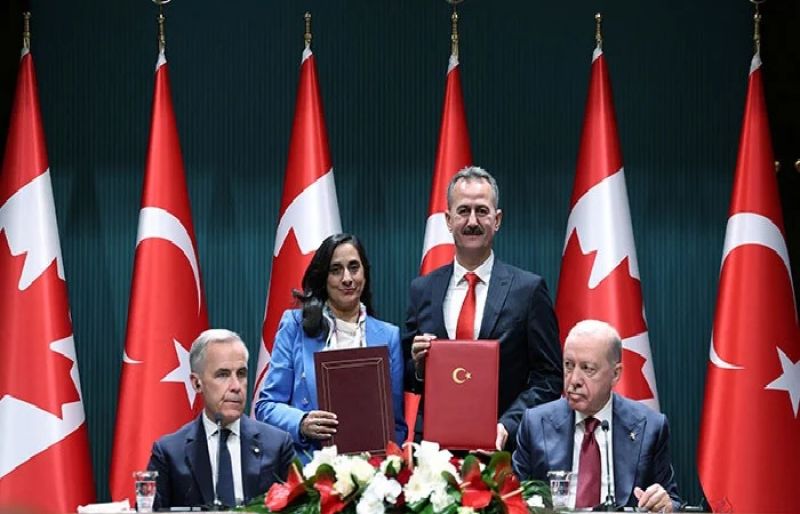
Nato allies Canada and Turkiye upgraded their relations to a “strategic partnership” during the first bilateral visit by a Canadian prime minister on Thursday, as Mark Carney seeks new global trade partners to reduce reliance on the United States.
The new partnership signed in Ankara focuses on trade and investment, defence and security, energy, and social and diplomatic ties. It aims to create jobs and opportunities for Canadian and Turkish companies to do more business together.
Carney is on a global trade blitz that he hopes will help buffer Canada from a trade war with the US, where President Donald Trump has applied sweeping tariffs and questioned the neighbouring country’s sovereignty.
Speaking next to Erdogan at Turkiye’s presidential palace, Carney said the strategic partnership would have four pillars and include a three-year action plan.
“We’ve planted the seeds of something new: a strategic partnership that will create new opportunities for our workers and businesses, and greater security and prosperity for both our peoples. With care and commitment, it will grow for generations to come,” Carney said.
At the ceremony, Canadian and Turkish ministers signed cooperation deals on energy, defence and air transport.
The agreement by Carney and Turkiye President Tayyip Erdogan marks a significant thaw in diplomatic ties that had long been cool over Canadian concerns over human rights and a past embargo on sending weapons to Turkiye.
‘Long-standing disconnect’
Turkiye, a major emerging market economy and regional military power, is seeking new investment and collaboration for its burgeoning defence industry, new nuclear power plants and mining sector.
Erdogan, who has led Turkiye for 23 years, praised Carney as a leader with “common-sense and acumen” on the world political stage.
“Today, we have alleviated the long-standing Turkiye-Canada disconnect. Now, we are starting a new era between Turkiye and Canada,” Erdogan said. The two sides expected to raise their trade volume from $3 billion first to $5 billion and then to $10 billion, he said, without giving a timeframe.
Canadian and Turkish negotiators will kick off the first round of free trade talks next month in Ankara, Carney said, adding that Export Development Canada and Turkiye’s Eximbank would sign a new deal to boost companies’ cooperation on projects in third nations.
Carney referenced the need to move forward with Turkiye amid the “rupture” and “new world order”, though neither he nor Erdogan mentioned the United States. Carney will meet prominent Turkish business leaders and investors in Istanbul on Friday.
In the energy sector, Canada and Turkiye pledged to ramp up collaboration in areas such as nuclear energy, critical minerals, and liquefied natural gas (LNG).
Reuters first reported this week that the countries planned to sign a declaration deepening cooperation in the four areas outlined on Thursday.
Less focus on rights
Although trade between Canada and Turkiye is tiny — Turkiye accounted for less than 0.3% of Canada’s total merchandise trade or C$4.34 billion ($3.09 billion) – bilateral trade has risen by nearly 50% in the past five years.
Still, Canada sends nearly 70% of exports to the US.
“This trip is part of the geopolitical necessity of signalling to Americans that we are not sitting around waiting for them,” said Bessma Momani, professor of political science at the University of Waterloo.
In the last year, Canada has signed more than 20 trade deals as part of Carney’s push to double non-US exports in the next decade.
Nuclear plant
At the Nato leaders’ summit in July, Carney and Erdogan launched negotiations for a free-trade agreement and Turkiye also agreed to join Canada’s Defence, Security and Resilience Bank as a founding member.
Turkiye has held talks with Canadian engineering firm AtkinsRealis as well as South Korea’s Korea Electric Power Corporation and China’s State Power Investment Corporation about potentially building its planned second and third nuclear power plants.
In 2024, Canada removed weapons-export controls on Turkiye, including on optical technology used in drones that Turkiye exports to dozens of nations. Canada mainly exports lentils, aircraft and electronics to Turkiye, and imports medical devices, fishing vessels, aircraft engines and jewellery.


