
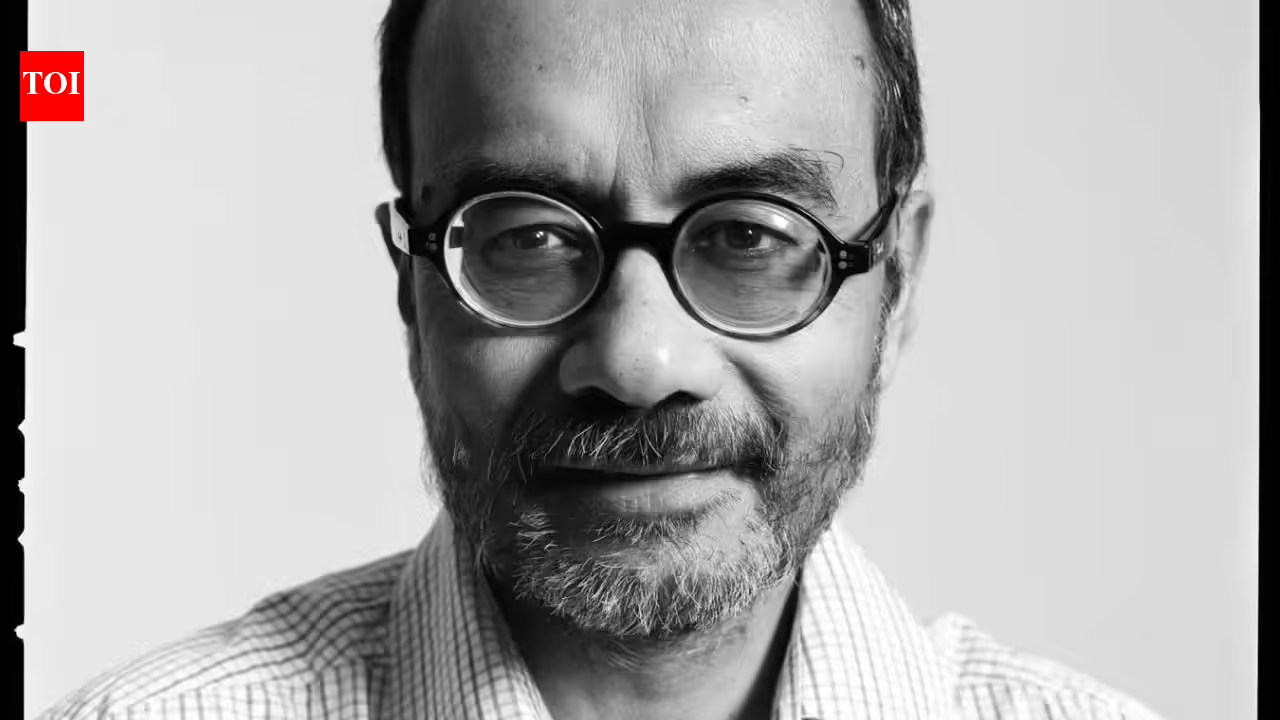
Ashoke Sen might be one of the quietest geniuses in physics. Born in Kolkata in 1956, he grew up fascinated by abstract mathematics and theoretical puzzles. While most kids were playing outside, Sen reportedly spent hours on equations, drawn more to thought experiments than everyday life. His journey took him from Sailendra Sircar Vidyalaya to Presidency College and later to IIT Kanpur for his master’s. Doctoral research at the State University of New York at Stony Brook and post-doctoral stints at Fermilab and Stanford followed. Many expected a life abroad, living in luxury, but Sen chose to return to India, driven by curiosity and commitment rather than wealth or fame.
How Ashoke Sen’s quiet work changed modern physics
Despite lucrative offers from overseas, Sen joined the Tata Institute of Fundamental Research in Mumbai in the late 1980s. By 1995, he moved to the Harish-Chandra Research Institute in Prayagraj. The office he built was modest, with chalkboards and stacks of papers. Experts say it was not grandeur that mattered but the ideas. He reportedly thrived in simplicity, often preferring the scratch of chalk on blackboard to any spotlight. Colleagues note that his calm and understated presence made him approachable, yet you could sense the depth of thought behind his quiet demeanour.His contributions to theoretical physics, especially string theory, are now legendary. Sen worked on strong-weak coupling duality and formulated what is now called the ‘Sen Conjecture’. It seems his insights helped unify different versions of string theory. Many describe this period in the 1990s as the second superstring revolution, reshaping how physicists thought about the universe at its most fundamental level.
Ashoke Sen: From global recognition to chalkboards and pedals
In 2012, Sen had been awarded the inaugural Fundamental Physics Prize. The prize was nearly three times the monetary value of a Nobel. Many assumed this would radically change his lifestyle. It didn’t. Instead, he reportedly donated a significant portion to support students and scientific research. The next day, he pedalled his bicycle back to work.It might seem almost surreal that a man with millions in his bank account still preferred a bicycle. Observers often comment on how his choices reflect a rare combination of brilliance and humility. Even with global recognition, he avoided excess, remaining focused on teaching, research, and mentoring. His office reportedly still relies on chalk and boards, proving that innovation doesn’t always need luxury.
Ashoke Sen’s quiet brilliance and the lessons beyond physics
Today, Ashoke Sen is celebrated worldwide, yet it appears his most enduring impact may not just be in physics equations but in how he conducts his life. He teaches that true achievement might be measured by curiosity, perseverance, and modesty rather than wealth or fame. Observers say his story inspires more than just scientists—it reminds all of us that brilliance can be quiet, and that sometimes, the simplest choices reveal the deepest character.

