

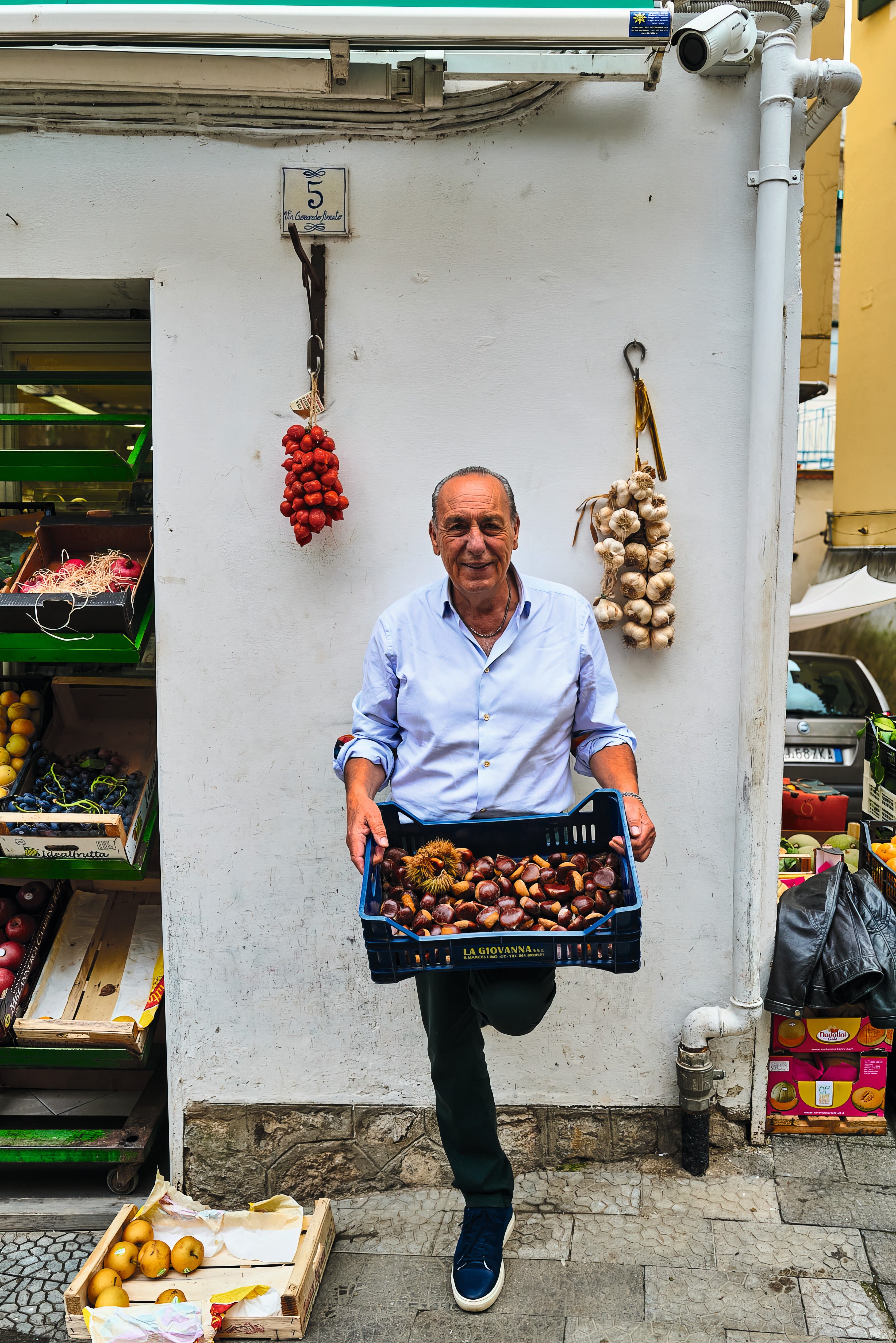
Gennaro Contaldo might have dedicated his life to Italian food, but admits he “didn’t know” just how much variety there is in his country’s cuisine.
“It’s incredible – I didn’t know myself,” says Contaldo, who grew up on Italy’s Amalfi Coast, before moving to the UK more than 50 years ago.
Contaldo – known for his numerous TV appearances alongside his protege, Jamie Oliver – cites with glee the fact there are “about 600 [known] shapes of pasta” and “God knows how many other thousands”.
“Each family makes their own versions, their own way,” he adds.
Contaldo explores the varied nature of his home country’s cuisine in his latest cookbook, Hidden Italy, which is divided into four geographical parts: central Italy, the islands, the north and the south.
Ultimately, he wanted to show people that Italian food “is not just carbonara, Bolognese, cacio e pepe”.
Not that it was particularly easy to find some of these recipes. “Nobody’s writing any books about those original recipes and where they come from, so there was a lot of research, nearly two years of research,” notes Contaldo. It’s not like these recipes “disappeared”, he says, but “they hide” – families are “still doing it”.
However, 77-year-old Contaldo is keenly aware that the “world is changing”.
“Generations are changing, the world is changing, and we don’t want all these beautiful recipes to get lost. They’re still there – nothing will be lost, but it’s nice to put them in writing.”
Through his research for the book, Contaldo met people still making some of these lesser-known recipes, and stresses that “there is a story for every single food”.
Take the pasticcio di pasta alla ferrarese, a type of pasta pie made from tortiglioni or rigatoni, baked in a mince meat ragu and bechamel sauce, all topped with pastry. Its origins come from noble banquets during the Renaissance times, with the recipe spreading from Ischia, an island near Naples, all over the country.
“They share recipes – Italy’s like that,” Contaldo explains. “Italians, they communicate, they speak, and they transfer their love through food.”
With so much history attached to each dish, Contaldo says: “It’s not just spaghetti and a glass of wine. Italy is an emotion.”
Italian households are used to making fresh pasta for their meals – something that is much rarer to see outside of the country. But Contaldo urges people to give it a try, calling it “so easy”. He adds: “It’s not scary, they should try – it’s cheaper.”
“Ordinary flour, mix with water – it’s so easy. If you do it with eggs, one egg for 100 grams of flour is all you need, then you have almost 200 grams of pasta,” he explains. Once boiled, this gives you enough to “easily feed” two people, “even three”.
One of the best things about making your own pasta is being able to “make your own shapes”, according to Contaldo, who says he makes “endless shapes”.
You can even use your pasta dough off-cuts to make something called fazzoletti, which translates to “silk handkerchiefs” – so nothing is wasted
If you do buy dried pasta (and nothing wrong with that, with Contaldo saying it can be “magnificent”), just watch out for what’s in it.
“You have to be very careful when you buy pasta, because they make pasta all over the world – but they use rubbish flour, and God knows what kind of eggs,” he says, urging people to buy “proper Italian pasta”.

And, of course, make sure it’s cooked al dente – your stomach might thank you. “You chew it longer when it’s inside your mouth, it tastes better, you digest it better… it’s beautiful.”
Compared to the Italian approach to food, Contaldo says that Brits eat “too quickly”. “If you go into an Indian restaurant, if something is hot and spicy, you find yourself [saying], ‘Oh it’s spicy, it’s spicy’. You eat faster, you don’t taste anything. Italian food is simple – what you see is what you eat. You want to taste the carrots. You want to taste the beans.”
He says of the difference between the two countries: “In England, it’s the culture of drink; in Italy, it’s the culture of food – and wine.”
In Italy, Contaldo says, “The food and wine are balanced. Water is to drink, but wine is to flavour [the food], to help ingest it. Everything else, it’s all [about] the friendships, the philosophy.”
That’s why Contaldo has dedicated his life to keeping Italian culture “alive”, he says – and he’s still constantly surprised by what he learns, even though he hasn’t lived in the country for decades.
“There are many Italian restaurants, especially in London, [where] you find a dish that you haven’t done before that’s a special – and the chef put it on because it’s part of his culture.”
Ultimately, Contaldo says, “I cook from north to south, and I cook from the Amalfi Coast. I want to remember where I came from. I want to know my roots.”
Stewed squid and potatoes
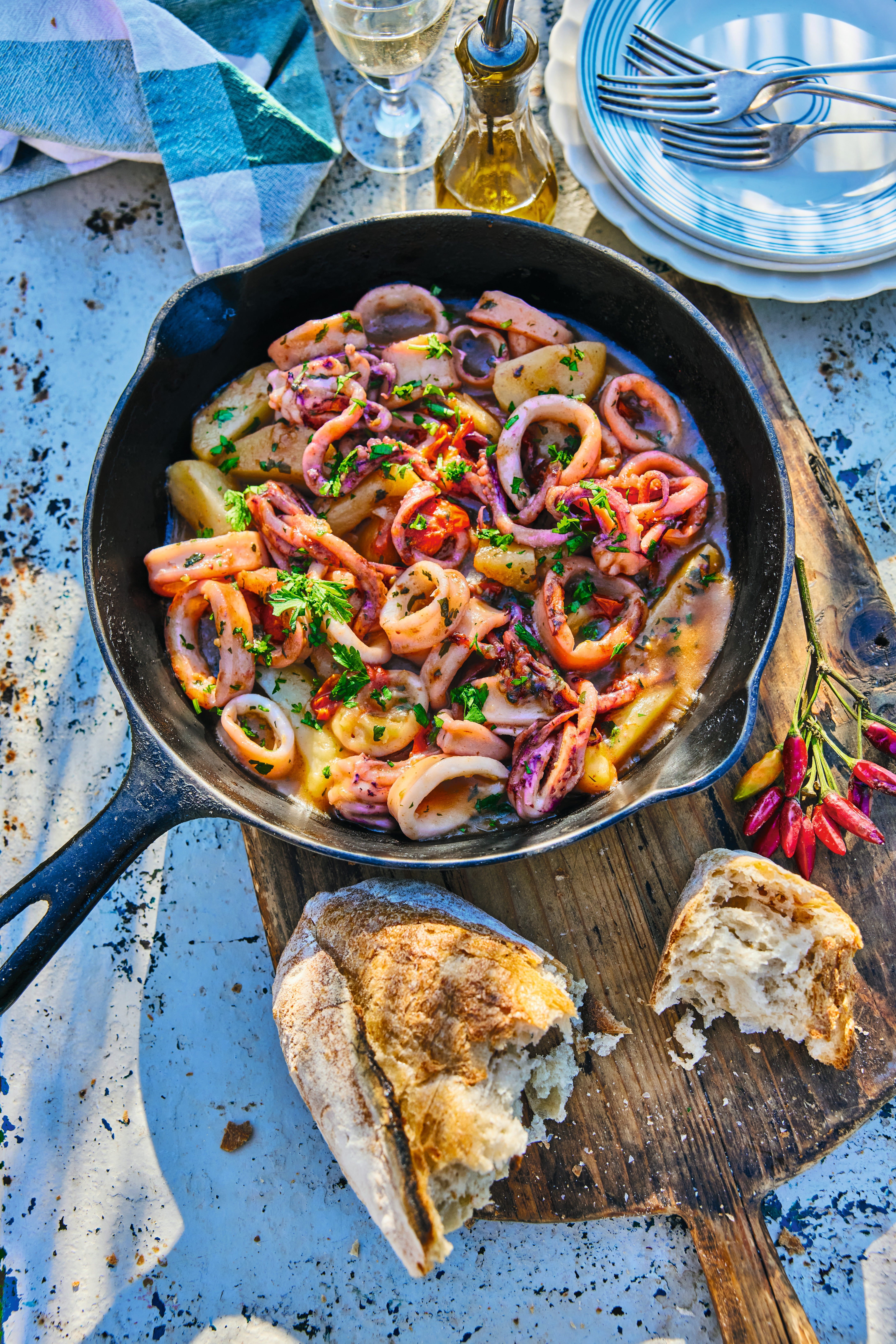
“This Amalfi Coast cucina povera classic combines sea and land perfectly,” says Contaldo.
“The dish traditionally uses a local variety of squid, known as totani, but as this is not available outside of the area, use whatever squid you can find. You can use ready-cleaned calamari rings, or otherwise ask your fishmonger to clean the squid for you.
“Serve with lots of good, rustic bread and a cool glass of Greco di Tufo white wine, as this will immediately transport you to the sensations of the Amalfi Coast.”
Serves: 4
Ingredients:
2 tbsp extra virgin olive oil
2 garlic cloves, finely chopped
½ red chilli, finely sliced
600g cleaned calamari/squid tubes, cut into chunks, keeping the tentacles
4 tbsp white wine
300g potatoes, peeled and cut into chunks
Handful of flat-leaf parsley, finely chopped, plus extra to garnish
100g cherry tomatoes, halved
Rustic bread, to serve
Sea salt and freshly ground black pepper
Method:
1. In a large pan, place the olive oil over a medium heat and sweat the garlic and chilli for about 30 seconds, then add the calamari and stir-fry for a minute.
2. Add the white wine and allow to evaporate slightly. Add the potatoes, parsley and cherry tomatoes and season with salt and pepper. Cover with a lid and cook for 25–30 minutes until the squid and potatoes are cooked through. If, during cooking, the pan becomes too dry, add a little hot water.
3. Remove the lid, increase the heat and cook over a high heat for about a minute, shaking the pan until you obtain a slightly creamy consistency.
4. Serve with lots of rustic bread and a sprinkling of extra parsley.
Pasta with anchovies and breadcrumbs
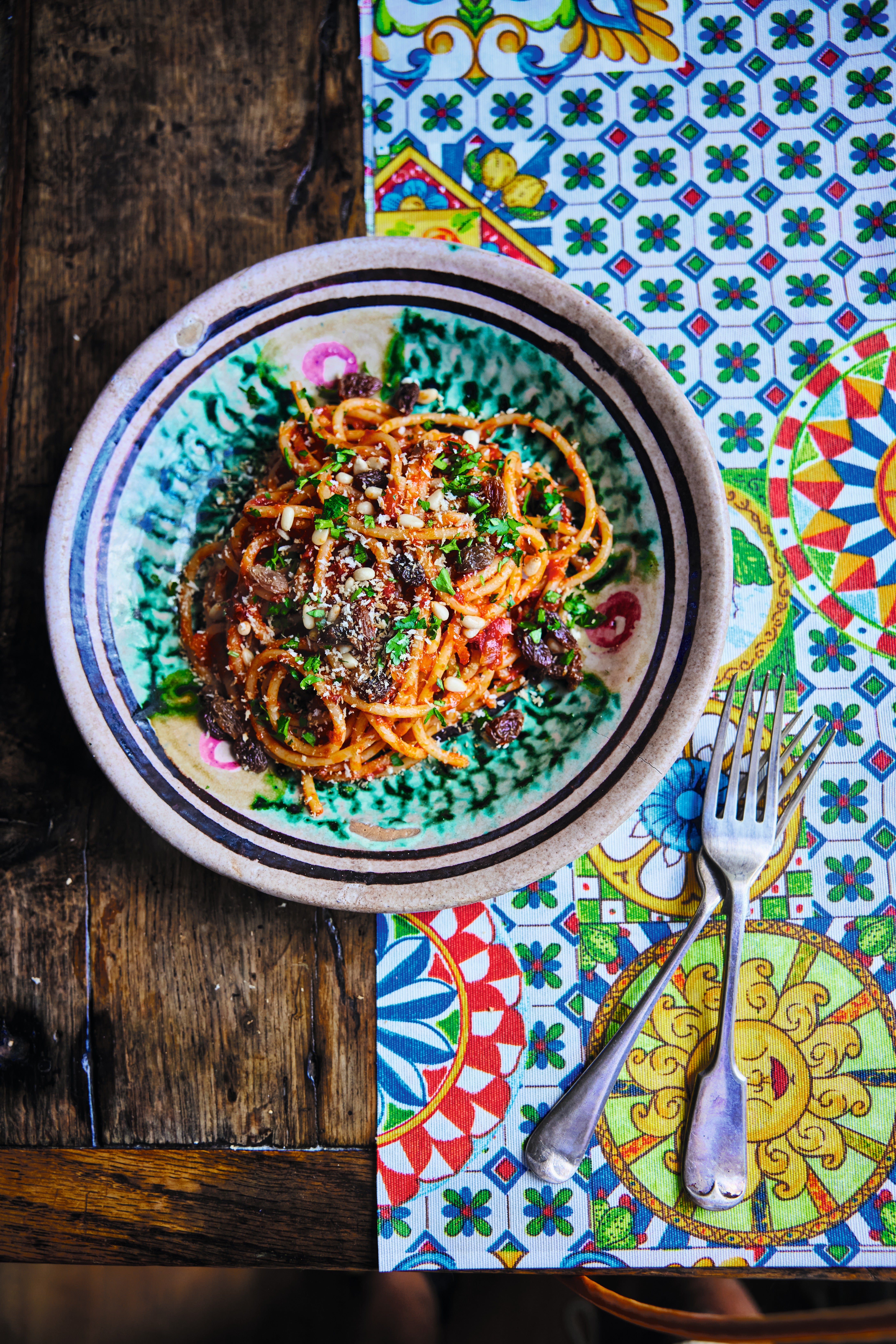
“This traditional dish from Palermo is linked to the migration of many Sicilians to Northern Italy in search of work, and so is often called La Pasta Milanisa (the Milanese pasta),” says Contaldo.
“They brought with them long-lasting ingredients from home, like preserved salted anchovies, homemade tomato estratto (a rich concentrate) and dried fruit, and would make dishes like this one to remind them of the sunshine of the South, while living in the cool and often foggy darkness of Milan in the winter.”
Serves: 4
Ingredients:
16 anchovy fillets in salt (approx 60g in total)
3 tbsp extra virgin olive oil
2 garlic cloves, finely chopped
2 small shallots, finely chopped
120g tomato purée
300g bucatini
Sea salt
20g sultanas, soaked in a little lukewarm water then drained
10g pine kernels
Handful of flat-leaf parsley, finely chopped
20g dried breadcrumbs
Method:
1. Rinse the anchovy fillets in water to remove the salt, then pat dry and set aside.
2. In a pan, heat two tablespoons olive oil over a medium heat and sweat the garlic and shallots for a couple of minutes until softened. Add the anchovy fillets and continue to cook for a couple of minutes until they have dissolved. Add the tomato purée and cook over a low heat for about 10 minutes, until it begins to thicken slightly.
3. In the meantime, cook the bucatini in a separate pan of boiling salted water until ‘al dente’.
4. In a smaller frying pan, heat the remaining olive oil over a medium heat and, when hot, lightly toast the breadcrumbs, stirring for about a minute. Remove from the heat and set aside.
5. Drain the pasta and add to the anchovy and tomato sauce along with a little of the hot pasta water. Cook over a medium heat, mixing well, for a minute or so.
6. Remove from the heat, sprinkle with the sultanas, pine kernels, parsley and toasted breadcrumbs and serve immediately.
Notes: Salted anchovy fillets can be found in good Italian delis or online. Please use the best tomato purée you can (not tinned or passata) as this, together with the anchovies, will impart a depth of flavour and richness to the dish, which is balanced by the sweetness of the shallots and sultanas. The addition of pine kernels and lightly toasted breadcrumbs adds a nice crunchiness.
Filled brioche
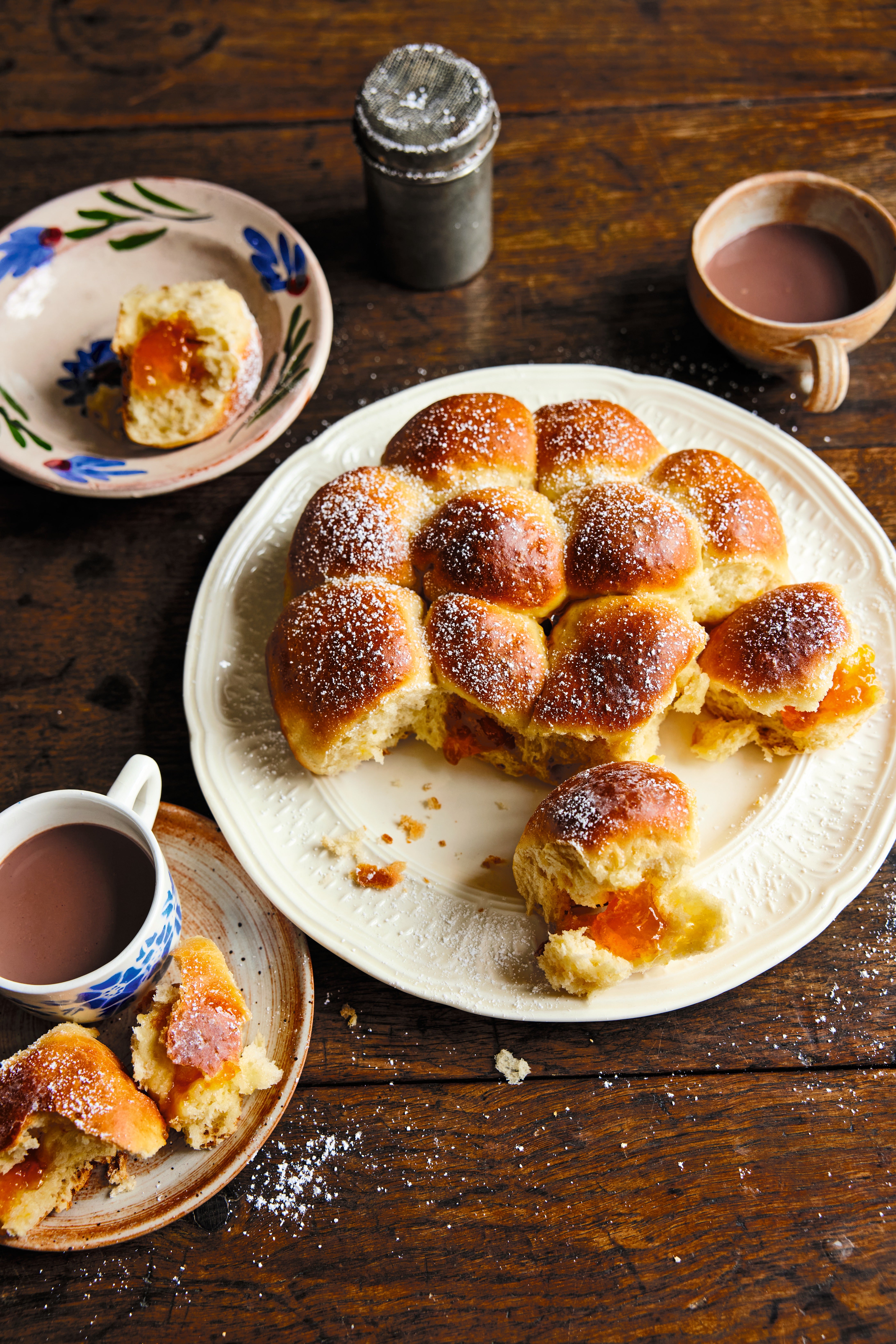
“This ‘tear and share’ brioche cake is a popular sweet treat from the Alto Adige/South Tyrol area of Northern Italy and is a typical example of how the cuisine of this region has been influenced by its border neighbour, Austria,” explains Contaldo.
“It takes a little time to prepare but is very simple to make and is really worth the wait. Delicious filled with a good-quality apricot jam, I like to serve it still warm for a teatime treat.”
Makes: 14
Ingredients:
150g 0 flour or strong white bread flour, plus extra for dusting
150g 00 flour
4g easy-blend dried yeast
45g caster sugar
4 tbsp milk, plus extra for glazing
2 eggs
50g butter, melted
1 tbsp rum
1 tsp vanilla extract
⅓ tsp sea salt
Zest of 1 lemon
14 tsp apricot jam
Icing sugar, for dusting
Method:
1. In a bowl or stand mixer, combine the flours, dried yeast and caster sugar. In a smaller bowl or jug, gently whisk together the milk, eggs, melted butter, rum, vanilla extract, salt and lemon zest and gradually add this to the dry ingredients, mixing well to form a soft, slightly sticky dough. Form into a ball, cover with a cloth and leave to rise in a warm place for about two hours.
2. Line a 20-centimetre round cake tin with baking paper.
3. Place the dough on a lightly floured work surface and divide into 14 pieces, weighing approx. 35–40 grams each. Roll each piece into a small ball and, using a rolling pin, flatten them into small circles. Place a teaspoon of apricot jam in the centre of each and close the edges well to form small balls and enclose the jam. Arrange the dough balls, seam-side down, in the prepared tin, cover with a cloth and leave to rest for 1 hour.
4. Preheat the oven to 160C fan/180C/350F/gas mark 4.
5. Brush the dough balls with a little milk to glaze and then bake in the oven for 25 minutes, until golden brown.
6. Remove from the oven and leave to cool slightly in the tin, then remove and dust with a little icing sugar. Serve by ‘tearing and sharing’.
‘Gennaro’s Hidden Italy’ by Gennaro Contaldo (Pavilion Books, £22).

