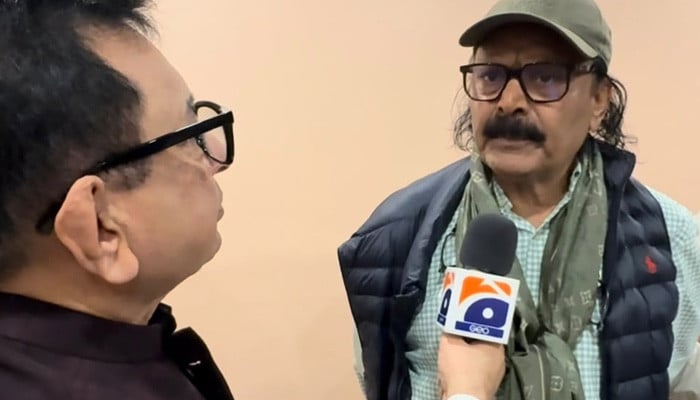
DALLAS: Federal Minister and Chairman of the Parliamentary Committee on Kashmir Rana Muhammad Qasim Noon has said that lasting peace in South Asia cannot be achieved without a resolution of the Kashmir dispute, adding that most of the demands raised in Azad Jammu and Kashmir (AJK) have already been accepted and that the remaining issues should be addressed through dialogue and political engagement.
Speaking exclusively to Geo News and Jang during his visit to Dallas, Texas, Noon discussed the recent situation in AJK, the demands of the outlawed Joint Awami Action Committee (JAAC), concerns among overseas Kashmiris, the broader Kashmir dispute, the prime minister’s visit to the United States and the United Nations, civil-military relations, and the prospects of political dialogue with the Pakistan Tehreek-e-Insaf (PTI).
Asked about anger among overseas Kashmiris over the recent unrest and loss of lives in AJK, Noon said that some aspects of the situation were being portrayed abroad in a manner that did not, in his view, fully reflect conditions on the ground.
He described the dispute as an “internal matter”, saying that disagreements and tensions could arise within any household but could also be resolved through engagement.
The federal minister said a new government had taken office in AJK and expressed hope that the situation would gradually improve.
Noon urged overseas Kashmiris to view the developments “rationally and objectively”, saying Kashmiris were Pakistan’s brothers and that, in his words: “Pakistaniyat and Kashmiriyat are not separate from each other.”
“Differences can arise even between a father and a son,” he said, arguing that political or administrative disagreements should not be interpreted as a rupture in the broader relationship.
On the demands raised by the proscribed JAAC, Noon said that a large majority had already been accepted. He alleged that certain elements were exaggerating the situation and claimed that external forces were attempting to exploit the unrest for their own purposes.
He said Pakistan continued to stand with Kashmiris “politically, morally, geographically, religiously and socially”, and reiterated Islamabad’s longstanding position that Kashmir remained an integral part of Pakistan’s national agenda.
Noon said the situation in AJK could not be equated with conditions in Indian Illegally Occupied Jammu and Kashmir (IIOJK), where, he said, a large military presence remained deployed and human rights violations had been widely reported.
Referring to his recent visit to the United States as part of the prime minister’s delegation, Noon said Prime Minister Shehbaz Sharif had raised the Kashmir issue “in a forceful manner” at the United Nations General Assembly (UNGA).
Noon said the prime minister had presented Pakistan’s position clearly before the world and had, in his view, emerged as a statesman on major regional and international issues.
Noon also said that recent Pakistan-India tensions had once again brought international attention to the Kashmir dispute.
Asked about the status of discussions in the AJK, he said a new government had been formed, ministries had been constituted and the presidential election had taken place.
He expressed confidence that the remaining issues could now be settled through consultation and dialogue among all stakeholders.
On possible talks with the PTI, Noon said political differences should be resolved through dialogue.
“Dialogue should take place, issues should be resolved. Dialogue is the only solution,” he said.