
March is here, and you know what that means: The Madness is upon us.
What better way to get ready for the men’s NCAA tournament than warming up with a couple of weeks of conference tournament action?
Champ Week never disappoints. In 2024, we saw five bid thieves crash the Big Dance, while 51 of the 63 conference tournaments in 2023 and 2025 were won by Nos. 1 or 2 seeds. And while we can likely agree that past trends are not necessarily indicative of future results, it’s fun to analyze which conference tournaments have featured the most and least chaos in recent history.
Because the membership of many conferences has changed with realignment, the primary focus will be on results from the past five seasons, though some trends that go further back were too juicy to ignore.
Because there are many ways to characterize the volatility of a specific conference tournament, here is a sampling of the factors that were taken into consideration:
-
Average seed of the champion
-
Combined average seed of the finalists
-
How often the top-seeded teams lose their first game
-
How often a lower-seeded team makes a deep run
Now let’s break it down, starting with the conference tournaments that have been friendly to higher seeds in recent years.
Note: Conferences ordered under each category by tournament start date. Averages shown are since 2021, unless otherwise noted.

TOURNAMENTS THAT HAVE FAVORED HIGHER SEEDS

West Coast Conference
No conference tournament has been more predictable than the WCC — and that’s not just over the past five years.
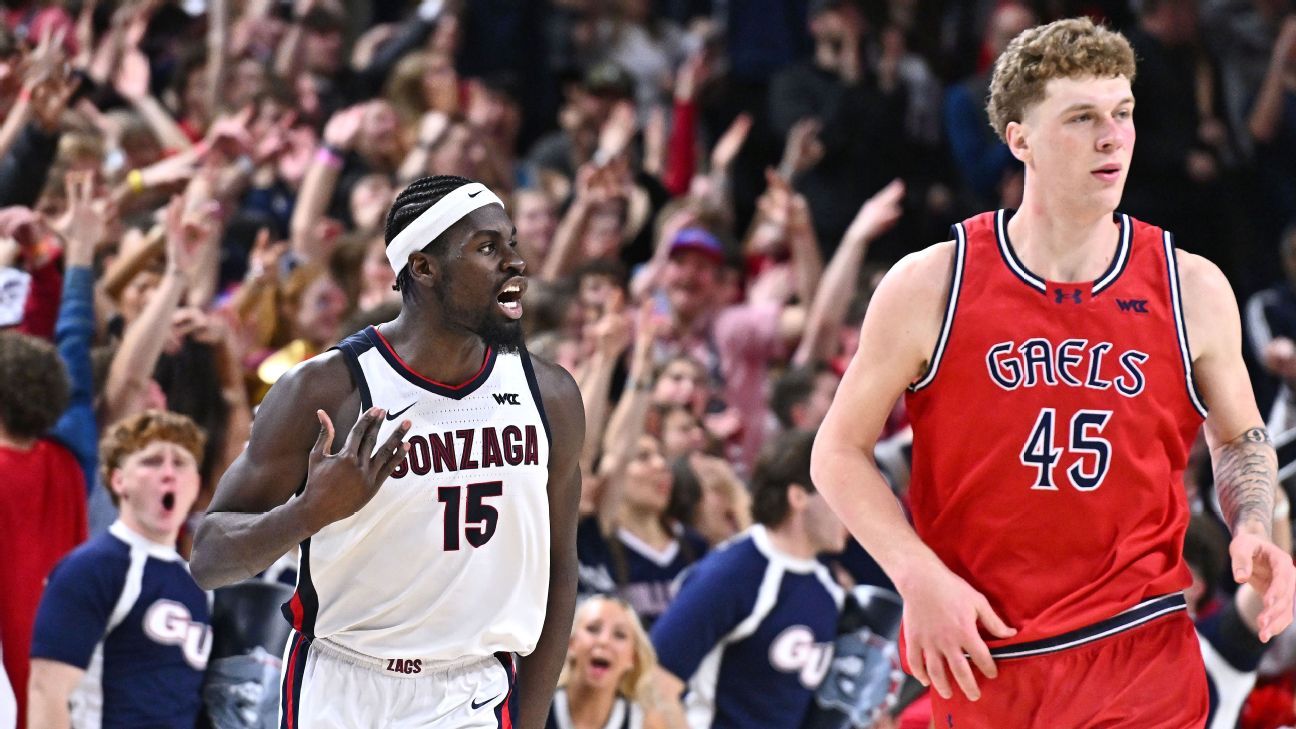
The top two seeds have met in the finals in 16 of the past 17 WCC tournaments. In 13 of those 16, it has been Gonzaga vs. Saint Mary’s. The only other team to make the finals in that span is BYU, which is no longer a conference member. (And by the way, the top two seeds in this year’s edition are Gonzaga and Saint Mary’s once again.)
Gonzaga, in its final season in the WCC before joining the new-look Pac-12 in 2026-27, has reached the championship game a ridiculous 28 consecutive years; the Bulldogs are always a No. 1 or 2 seed.
While the top two seeds have received a bye to the semis in 18 of the past 23 WCC tourneys, other leagues also reward their best teams this way without anywhere close to the same predictability.

Missouri Valley Conference
Despite a traditional bracket setup — there are no byes to the semis in Arch Madness — the top two seeds have faced off in the title game three straight times and in four of the past five years.
Drake has won the past three MVC tournaments, but the Bulldogs have their work cut out for them as this year’s 9-seed. They would have to beat the 1-seeded Belmont in the quarterfinals, which has been a near-impossibility in the MVC: The Nos. 1 and 2 seeds have lost in the quarters only once each in the past 27 tourneys — and it happened in the same year (2020).

America East
The higher seeds playing host has its benefits here: The championship game has been 1-vs.-2 or 1-vs.-3 in 10 of the past 11 seasons — including 2020, when the matchup was set before the tournament was cut short due to the COVID-19 pandemic.
The America East and Summit League have the longest current streaks of the No. 1 seed raising the trophy (four straight seasons).

Southland Conference
Since changing the format to give the top two seeds a bye to the semifinals in 2013, the Southland tournament hasn’t featured many surprises: At least one of the top two seeds has reached the championship game every year since.
The No. 1 seed has won in three straight years, and either the 1- or 2-seed has raised the trophy 10 of the past 13 tournaments. The most notable upset during this stretch came in 2022, when No. 4 seed Texas A&M-Corpus Christi (7-7 in Southland play) upset the top two seeds en route to the title.

Big 12
Four different programs have won the past four championships, but each have been Nos. 1 or 2 seeds, and only once in the past 10 tournaments has the runner-up been seeded fourth or worse.
Iowa State is the only school in Big 12 tournament history (since 1997) to win the title seeded lower than No. 3, and it has done it three times: twice as a No. 4 and once as a No. 5.

Ivy League
It’s important to note that only the Ivy’s top four teams qualify for the tournament, so the title game has been No. 1 vs. No. 2 in five of the past six seasons. The No. 2 seed had won five consecutive Ivy Madness titles until last year, when top-seeded Yale earned the conference’s auto-bid by beating — you guessed it — 2-seed Cornell.
Want more predictability? Yale has been a fixture, winning four of the past five tournaments and reaching the championship game six of the seven times the event has been held.
The tournament is hosted by a different league institution each year, and each of the past three times the host school qualified for the tourney, it won. This year’s host? Cornell, which will be the No. 4 seed.
TOURNAMENTS THAT HAVE FAVORED LOWER SEEDS

Sun Belt
The Sun Belt is the only conference in which the No. 1 seed has not made it to the championship game in the past five years (2019 is the last time it happened).
This is Year 2 of the most interesting bracket you’ll see during Champ Week, which takes place over seven days and was likely conceived to improve the chances of top seeds earning the automatic bid. That didn’t work last year, as the Nos. 1 and 2 seeds lost their first game. In fact, the 1-seed has lost its first game in the Sun Belt tourney an astounding four of the past five years.
This season, there was no clear top team in conference play. Troy went 12-6 to earn the No. 1 seed, but there was a remarkable six-way tie for second place at 11-7, so it wouldn’t be surprising at all if these trends continue.
An unintended consequence of the quirky Sun Belt bracket: No. 7 seed Arkansas State has to win five games to earn the automatic bid, while No. 2 seed Marshall has to win only two — despite the fact that both teams had the same record in Sun Belt play.

Metro Atlantic Athletic Conference
Not to be outdone by the ACC, the MAAC has been a free-for-all. At least one team seeded fourth or worse has reached the title game in eight straight tournaments. Last year, a 6-seed (Mount St. Mary’s) grabbed the auto-bid; in 2023, 11-seed Marist won three games to reach the finals; and in 2021, we had a rare 9-vs.-7 matchup in the championship game (Iona over Fairfield).
Of the 10 finalists from the past five years, eight different seeds have been represented. The No. 1 seed has struggled mightily, losing twice in the quarterfinals (2021 and 2022) and twice in the semifinals (2024 and 2025). It has been 10 years since the last title game between the top two seeds.

Coastal Athletic Association
It might seem like the CAA tournament has been chalky, with Nos. 1 and 2 seeds representing the past three champs, but the bigger picture is more complicated.
From 2012 to 2019, every team that reached the finals was seeded third or better. There were very few surprises and, more often than not, it was a 1-vs.-2 matchup for the title. Over the past five years, though, there has been plenty of variability: Only once has a No. 1 seed advanced to the championship, and at least one team seeded fourth or worse has made it. There was a 6-vs.-8 championship in 2021, No. 7 Stony Brook lost to top-seeded Charleston in overtime in 2024, and No. 12 Delaware won four games before falling just short of the title in 2025.

ACC
The ACC tournament has featured interesting results in recent years. You likely remember 10-seed NC State winning five games in five days to steal a bid in 2024. And the three years before that, teams seeded fourth (Duke), seventh (Virginia Tech) and fourth (Georgia Tech) emerged as surprise champions.
When you see lower-seeded champs like this, you might expect it’s because they faced another Cinderella type, but that has not been the case. In fact, the runner-up has been a No. 1 or No. 2 seed in five straight years. Last year was an outlier, as the top two seeds met in the title game for only the second time since 2012, with Duke defeating Louisville.
TOURNAMENTS WITH MIXED RESULTS

Patriot League
It’s a different structure in the Patriot League — the higher seed hosts each game throughout — but there are similarities to the SoCon for the eventual champs and runners-up.
The past five Patriot champions have been 1- or 2-seeds. Meanwhile, four of the past five losers in the title game were seeded fifth, sixth, sixth and ninth. Last year, 5-seed Navy knocked off 1-seed Bucknell in the semifinals. This year, the shoe is on the other foot: Navy will have the bull’s-eye as the No. 1 seed trying to earn its first NCAA tournament bid since 1998 after a dominant regular season (17-1).

Southern Conference
No conference screams “mixed results” like the SoCon.
When 6-seed Wofford won the 2025 championship game, it snapped a streak of seven straight years in which the No. 1 seed won the title (including 2020). Wofford was the sixth different program to win the tournament in as many years.
The SoCon tourney rarely lacks drama, as the average seed of the runner-up (5.6) is tied for the second highest in the past five years. Where things have gone sideways is in the 2-vs.-7 and 3-vs.-6 quarterfinal matchups:
-
The No. 7 seed has beaten the No. 2 seed in each of the past three years, and five of the past six.
-
No. 7 seeds have reached the championship game an incredible four times in those six years.
-
The No. 6 seed has beaten the No. 3 seed in four of the past six years.
MORE TRENDS
-
Atlantic 10 Conference (A-10): The past six titles have been won by the No. 1 or No. 6 seed (three each). Eight of the past 11 championships have been won by a team seeded third or worse. And No. 2 seeds have reached the title game in seven of the past 11 years but have no championships to show for it.
-
The No. 1 or No. 2 seed has won 13 of the past 14 Big Sky tournaments, but last year was the first time they both reached the final since 2016.
-
The Big Ten has gone 17 straight tournaments without a 1-vs.-2 matchup in the title game (the last was in 2007). The next-longest drought is eight straight (MAAC).
-
We have had four different Big West tournament champions in as many years. The last time a team seeded fifth or worse made it to the title game was 2015.
-
Conference USA (C-USA) and the Northeast Conference (NEC) have had a different school win their tournaments eight straight times, tying for the second-longest streak in the past 100 seasons of college basketball. Only the Southern Conference (nine straight from 1927 to 1935) had a longer run. There is no doubt that changes in conference membership have played a role for both.
-
Also in the NEC: A No. 3 seed (Saint Francis) won the tournament in what was the first time a 3-seed reached the title game since 2013. Last year also marked the first time the No. 2 seed didn’t lose in the championship game since 2019, snapping a streak of five straight years (including 2020, when the conference completed its tournament).
-
Ohio Valley Conference (OVC): The top two seeds get byes to the semifinals, but exactly one of them has lost its first game in three of the past four years — this year’s top two seeds are Tennessee State and Morehead State. The No. 1 seed has just one championship in the past five years.
-
The No. 1 seed in the Southwestern Athletic Conference (SWAC) has won the title only once in the past five years and has lost its first game in two of the past three years.

