Jeremy Fowler
Close
Jeremy Fowler
senior NFL national reporter
- Jeremy Fowler is a senior national NFL writer for ESPN, covering the entire league including breaking news. Jeremy also contributes to SportsCenter both as a studio analyst and a sideline reporter covering for NFL games. He is an Orlando, Florida native who joined ESPN in 2014 after covering college football for CBSSports.com.

Multiple Authors
ATLANTA — The ink was barely dry on the Chicago Bears‘ initial 53-man roster when general manager Ryan Poles cast doubt on whether nickel corner Kyler Gordon would ever play another down of football in Chicago.
“I don’t know,” Poles said when asked about Gordon’s future with the Bears on Sept. 1, before adding he still had hope.
Those three words spoke loudest about a frustrating situation inside Halas Hall. The Bears had planned for Gordon, 26, to become a cornerstone in Dennis Allen’s defense. But he didn’t participate in any team drills during the 2026 offseason because of a right calf injury. He spent all of training camp on the physically unable to perform (PUP) list before being moved to reserve/PUP, which meant he would have to miss at least the first four games. He wasn’t even in the building to start the season while rehabbing independently.
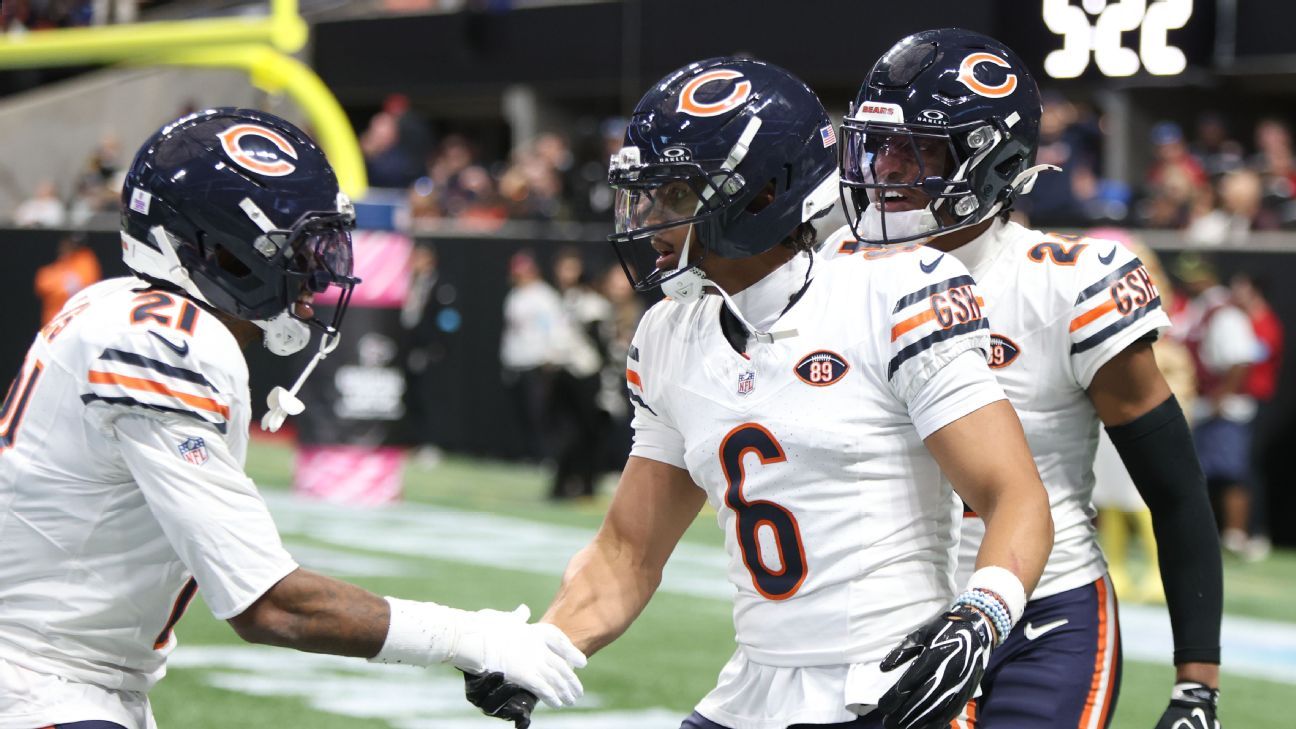
The best way to quell concerns — at least in the short term — about dependability was to return to the lineup and dominate, which he wasted little time doing Sunday in Atlanta. Gordon, who was activated Saturday, became the first Bears defensive back with three sacks in a game since Todd Bell in 1983 as Chicago held off the Falcons, 31-23. Gordon became the third Bears player since sacks became official in 1982 to record three sacks and two forced fumbles in a game.
Gordon had a lot to think about as he stood by himself during the anthem inside Mercedes-Benz Stadium. The highest-paid slot cornerback in the NFL — $13.3 million per year after signing an extension on April 15, 2025 — Gordon had played in just five of Chicago’s previous 25 games (21%). And while his teammates kept the faith, the injuries created some doubt about his dependability.
“I mean, it is what it is,” Gordon said. “I can’t control what someone else says.
“But at the end of the day, I’m going out there and do my job and do [it to] my best ability and be the best player and the leader at my spot.”
Gordon’s talent was never doubted. He was Poles’ first draft pick, No. 39 overall in 2022 out of Washington, and Poles rewarded him with the three-year, $40 million extension with $31.25 million guaranteed. His skills were on display Sunday, but Gordon has a bigger hurdle to clear: staying healthy.
No stranger to soft tissue injuries, Gordon has dealt with multiple hamstring, calf and groin ailments. He has also had a concussion and a fracture in his right hand.
“He was ready to play,” Bears coach Ben Johnson said. “I talked with Kyler yesterday morning, and [said], ‘Hey, I think we want to activate you. Are you ready to go?’ And he said, ‘Absolutely,’ and he sure enough was. So, huge spark there for us on the defense.
“We’ve got to make sure that we keep him on that right track. We’ve tried to limit his role a little bit, just making sure he was in good football shape. But those snaps that he had were huge ones for us today.”
Trying to find the cause of Gordon’s injuries
Two stints on injured reserve in 2025 prompted the Bears and Gordon to investigate the root of his health problems. Was it overtraining or undertraining? Was it the type of training he was doing on his own? Was an underlying injury issue to blame for what Poles classified in July as “a delay” in his recovery?
In the offseason, the team organized a virtual meeting, according to a source with direct knowledge of the call, with its decision-makers, trainers, strength and conditioning and other support staff, as well as with people Gordon had hired to work with away from Halas Hall. The purpose was to get all parties on the same page with a plan for Gordon’s rehabilitation and offseason training.
But frustrations continued as Gordon showed up to offseason workouts in late May with a calf injury.
WELCOME BACK, KYLER GORDON
📺: FOX https://t.co/mLaoOqQgPt
— Chicago Bears (@ChicagoBears) October 18, 2026
To fully understand the recurring soft-tissue ailments, the Bears then sent him to specialist, according to a source familiar with the request.
Gordon learned during the rehab process that the issue was not just his calf, but “something wrong with the way the glute was firing that created a posterior chain issue,” according to a source. That caused the calf to strain as well as the hamstring.
Unlike during the previous offseason, Gordon stayed in the Chicagoland area to rehab and train. He worked with Montel Fleming, known as “Dr. Moe,” on body alignment and injury prevention. Fleming also works with other Bears players, from Jaylon Johnson to defensive back Cam Lewis and running back D’Andre Swift.
The Bears told Gordon’s camp during the offseason that he could work with “your guy, come back when you’re ready,” a source with knowledge of the situation recalled. But those on both sides admit that building consensus on how to attack a delicate injury was, at times, frustrating. One issue for Chicago, per a team source, was that multiple players with severe injuries — offensive tackle Ozzy Trapilo (torn patellar tendon), pass rusher Dayo Odeyingbo (torn Achilles) and linebacker Noah Sewell (torn Achilles) — returned to the team and the field before Gordon.
Poles said on Sept. 1: “Any time you have an injury and you’re coming back from something there’s discomfort that you have to push through and that’s what it comes down to. So we haven’t been able to get over that hump and we’re not progressing as fast as we’d like.”
But Gordon’s injury was much more complicated than a calf strain, a source added.
That Gordon was away from the team — front offices and coaching staffs typically prefer their players rehab injuries at the team facility — was an additional layer to consider.
And the Bears’ messaging about Gordon’s injury was hard to ignore. In June, while citing Gordon’s on-field impact as undeniable, Ben Johnson pointed out that “you can only develop trust [as a player] by being available.” That seemingly applied public pressure on Gordon, as did Poles’ “I don’t know” comment. A source involved believes the team was attempting to “light a fire” under Gordon with those comments.
Asked Sunday if his team and the Bears’ medical staff are on the same page as far as working with Fleming, Gordon said: “Think that’d be a question for Coach.”
Gordon tried to find the positives in what he went through last season, when he played in just three regular-season games and both postseason contests.
“I’ve just never been through that before,” he said. “So obviously just learning to have that delusional optimism and just use that.
“So it’s been great. Learned a lot and now we’re here. So God’s great.”
Gordon didn’t say he was vindicated, or needed to be
If there was doubt outside the locker room, it wasn’t shared by Gordon’s teammates.
“My dog came back after all the talk, all the chatter, worked his ass off, came back and balled,” Jaylon Johnson said.
When asked what it meant to have Gordon back, defensive end Daniel Hardy said: “Everything, man. That guy came out here and put his heart and soul on tape. Phenomenal athlete.
“He was working his butt off trying to get back to us and y’all could see it out there. He wasn’t just chilling at home. He was out there grinding and working and getting his body healthy so he could come back and be the star that he is.”
Receiver Rome Odunze played with Gordon at Washington and still gets caught by surprise by his teammate.
“You think you’ve seen it all from that guy and then he goes out there and does some stuff like that,” Odunze said. “He’s one of those players that gets you up out of your seat for sure. The way he moves, his ability to impact the game is incredible.
“So, super glad to have him back.”
A Bears defense that had allowed 6.2 yards per play (30th in NFL) and ranked 28th in explosive play rate allowed (7.6%) prior to his return Sunday believes Gordon could fix some of the unit’s biggest vulnerabilities.
The Falcons entered the game averaging 361.8 yards per game and were held to 257. Gordon’s impact off the nickel blitz was a major factor.
“Because he’s the best in the league at it,” Jaylon Johnson said.
For Hardy, Gordon’s impact went beyond the box score.
“It’s just the fact that our brother is back,” Hardy said. “We’ve all spent a lot of time together and we’re really close in that locker room.
“And to see him fight his way back onto the field, it was great to see.”
As far as whether he felt vindicated in the face of doubt, Gordon chose to look ahead.
“That’s just the nature of the world,” he said. “I don’t see everything. So I got a pretty close [group], so I don’t really hear things unless people, my friends told me or something like that.
“But on to the next.”