Last Updated:
While HNIs and NRIs remain major participants, a growing segment of homebuyers comprises first-generation wealth creators such as entrepreneurs, techies in cities such as Bengaluru




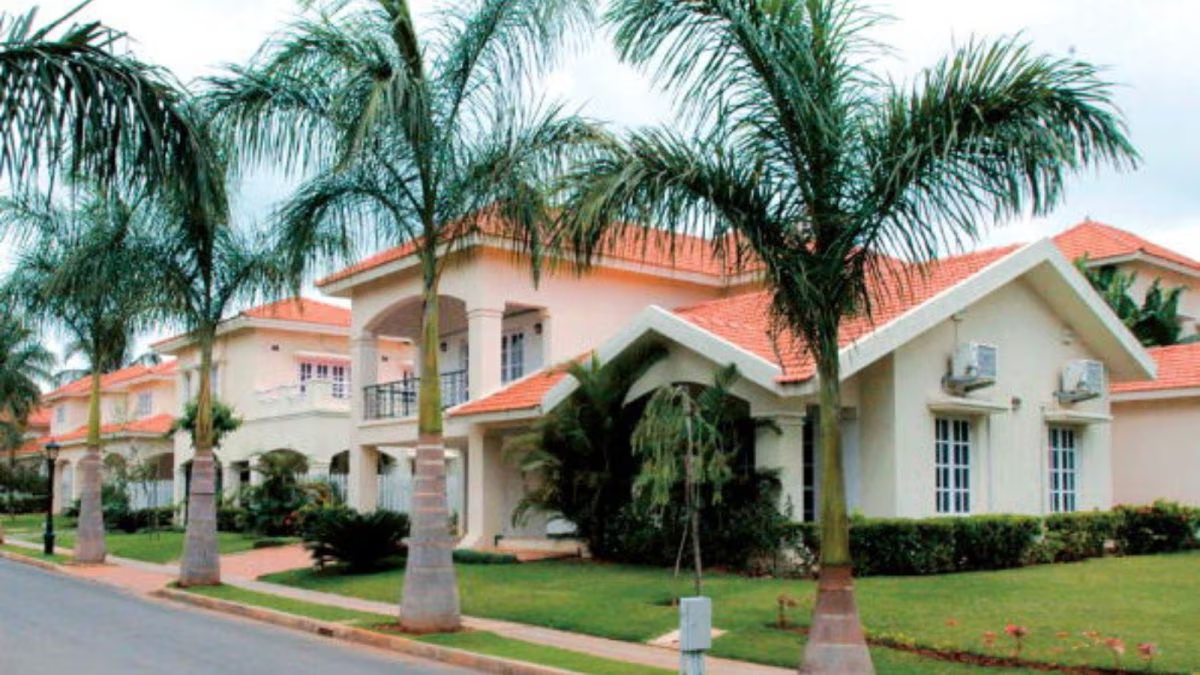
Premium residential real estate continues to attract HNIs not merely as an investment, but as a stabilising allocation. (Getty Images)
India’s luxury housing market is no longer a niche corner of the real estate sector. In the first half of 2025, sales of homes priced above Rs 4 crore rose by 27%, while premium housing units priced above Rs 1 crore accounted for nearly 62% of the overall market share. In cities like Bengaluru, luxury and high-end units dominated nearly 86% of new launches in the first quarter of 2025.
The numbers suggest more than a cyclical uptick. They point to a structural shift. Is this surge being driven by genuine end-user demand from affluent Indians upgrading their lifestyles, or is it primarily a case of wealth reallocation, with high-net-worth individuals parking capital in property amid global uncertainty?
What The Numbers Reveal
The scale of growth is difficult to ignore. Bengaluru’s luxury home prices rose by 42% in 2025, one of the sharpest increases among major Indian metros. Even mid- and premium-segment homes priced between Rs 40 lakh and Rs 1.5 crore saw 62% price appreciation, leading national rankings.
Hyderabad recorded a staggering 117% increase in properties priced above Rs 1 crore over 2024–2025. South India, particularly Bengaluru and Hyderabad, has emerged as the epicentre of this premium housing momentum. IT-driven income growth, rising start-up liquidity events, and an expanding base of high-net-worth individuals have transformed these cities into luxury residential hubs.
From Delhi NCR to Mumbai, the share of high-value homes in overall launches has steadily increased. Developers are clearly responding to demand that is skewing upward, even as affordability concerns persist in the lower and mid-income segments.
“What we are witnessing is less a short-term surge and more a structural evolution in the way Indian homebuyers define value. Yes, rising incomes, entrepreneurial wealth creation, and increasing NRI participation are driving measurable growth. Sales of homes priced above Rs 4 crore have risen nearly 28% year-on-year in early 2025. Homes above Rs 1.5 crore now account for roughly 25% of total residential sales across the top seven cities. The luxury residential market is projected to cross $100 billion by 2029-2030, growing at a Compound Annual Growth Rate (CAGR) of nearly 21.8%. But beyond these numbers lies a deeper shift. Luxury today is no longer a function of address and finishes. It is a function of intentional living — space, privacy, personalization, and the ability to shape one’s environment… The current momentum reflects not just wealth expansion, but aspiration maturity,” said Pavan Kumar, CEO & Founder, White Lotus Group – a construction company in Bengaluru.
Who Is Buying?
The profile of buyers in India’s luxury housing market has evolved significantly over the past five years.
One segment consists of first-generation affluent professionals — technology executives, start-up founders, senior consultants — who are upgrading from premium apartments to larger villas or low-density gated communities. The post-pandemic shift towards home-as-sanctuary has accelerated this trend.
Another significant segment includes high-net-worth individuals and non-resident Indians reallocating wealth into tangible assets. In an environment marked by equity volatility, geopolitical, and currency fluctuations, real estate offers both psychological comfort and portfolio diversification.
“While HNIs and NRIs remain significant participants, a growing segment comprises first-generation wealth creators — entrepreneurs, technology leaders, and senior professionals, particularly in cities such as Bengaluru. Many are globally exposed, yet consciously choosing to consolidate their presence here. This buyer is discerning and measured. They are less drawn to overt opulence and more inclined toward what may be described as quiet luxury; environments that offer privacy, design depth, and long-term habitability. They evaluate not only the home, but the community, governance standards, and developer credibility. Their aspiration is not display, but alignment — a residence that reflects permanence, intention, and sanctuary,” explained Kumar.
There is also evidence of second-home buying — legacy investments for family wealth preservation — particularly in cities with strong rental demand or lifestyle appeal. For many buyers, luxury property is not merely a residence; it is an asset class, status marker, and hedge rolled into one.
Vishal Vincent Tony, Managing Director, Bengaluru-based Aratt Developers, said, “Luxury homebuyers are increasingly end-users rather than speculative investors. Buyer segments include start-up founders, senior tech executives, global Indians, and second-generation business owners. Bengaluru and Hyderabad see strong participation from technology professionals, while Delhi-NCR and Mumbai attract industrialists and legacy wealth. NRIs remain influential, particularly in premium projects, driven by currency advantages and improved regulatory transparency. Buyers prioritise security, community living, and long-term asset stability.”
Are HNIs Parking Capital In Property Amid Global Uncertainty?
The surge in luxury housing is not occurring in isolation. Several macro and behavioural drivers have converged.
The pandemic reshaped how urban India perceives living spaces. Demand has shifted towards larger homes with private workspaces, outdoor areas, and access to wellness amenities. Gated communities with concierge services, fitness centres, co-working lounges, and green spaces are no longer aspirational add-ons; they are expectations.
“Periods of global volatility tend to redirect capital towards assets that offer both tangibility and long-term resilience. In that context, premium residential real estate continues to attract high-net-worth individuals not merely as an investment, but as a stabilising allocation,” pointed out Kumar.
He further said industry data indicates that over 60% of investors view luxury housing as a preferred long-term wealth preservation vehicle. “However, what we are observing, particularly in Bengaluru, is not indiscriminate capital deployment. It is deliberate positioning”.
Many HNIs and NRIs seek to establish “deeper roots in the country”, he added. They prefer “understated, well-located homes that offer privacy, permanence, and strong maintenance ecosystems.”
At the same time, relatively stable interest rates compared to global markets have made borrowing conditions predictable. While mortgage rates are not historically low, they have not deterred affluent buyers with strong liquidity.
Real estate is also being viewed as a hedge against inflation. In periods of currency volatility and uncertain stock market performance, high-value property offers a tangible store of wealth. For tech professionals and entrepreneurs who have benefited from liquidity events or stock options, property purchases represent both diversification and lifestyle consolidation.
“Indian HNIs are increasing allocations to residential real estate as a wealth-preservation strategy. The Knight Frank Wealth Report 2024 notes India’s ultra-high-net-worth population is projected to grow 50.1% from 13,263 in 2023 to 19,908 by 2028, among the fastest globally,” said Tony.
What Are Developers Focusing On In Bengaluru, Hyderabad, Pune, Delhi-NCR & Mumbai?
Beyond pricing, the definition of luxury itself is evolving. Developers in Bengaluru and Hyderabad are increasingly focusing on low-density planning, sustainability certifications, and architecture-led communities rather than sheer scale.
“Developers in major metros are prioritising premium gated communities, branded residences, and amenity-rich projects. Delhi-NCR recorded 72% luxury price growth (2022–2025), prompting large township and expressway-linked developments. Mumbai, India’s costliest market at Rs 1.82 lakh per sq ft, focuses on ultra-luxury towers and sea-facing residences. Bengaluru focuses on a tech-driven economy, strong white-collar migration, and an expanding start-up ecosystem that caters to high-income professionals. Pune and Hyderabad are expanding villa communities and peripheral luxury corridors due to land availability and infrastructure growth. Across cities, developers prioritise larger layouts, sustainability features, and mixed-use ecosystems combining residential, retail, and workspace components to attract affluent end-users,” explained Tony.
In Bengaluru, several design-oriented developers are prioritising fewer units per acre, extensive landscaping, and sustainable materials.
“In Bengaluru, particularly North Bengaluru, infrastructure expansion and sustained wealth creation are driving demand for larger 3BHK-plus homes, integrated townships, and lower-density communities. As a predominantly end-user-driven market, Bengaluru offers structural stability, and developers here are increasingly prioritising liveability — ventilation, spatial efficiency, community planning, and long-term maintenance alongside scale,” highlights Kumar.
Buyers are no longer purchasing square footage alone. This design-led approach suggests that at least part of the demand is genuine end-user driven rather than purely speculative.
How Do Home Designs And Costs Differ In These Cities?
Kumar explained that luxury housing design and pricing differ “meaningfully across cities” due to factors such as land economics, density, and demand.
“In Bengaluru, relatively greater land availability allows for larger layouts, better ventilation, landscaped buffers, and community-centric planning. Importantly, buyers here are increasingly willing to pay a premium for thoughtful design… Pricing in key micro-markets reflects this shift towards design-led value.
“In Mumbai, pricing remains predominantly land-driven, where scarcity dictates premium valuations even for compact residences. In Delhi-NCR, luxury is often expressed through scale and opulence — larger formats, expansive facades, and statement living. Pune, meanwhile, is emerging as a burgeoning premium destination, with rising professional incomes and infrastructure development supporting steady appreciation.”
Meanwhile, Tony points out the differences among luxury housing in Bengaluru, Hyderabad, Pune, Delhi-NCR, and Mumbai in terms of structure, configuration, density, and ticket size. “Mumbai, with average luxury pricing at Rs 40,200 per sq ft, favours vertical high-rise residences due to land scarcity. Delhi-NCR, averaging Rs 23,100 per sq ft, offers larger floor plates, independent villas, and low-density gated communities. Bengaluru (Rs 16,700 per sq ft) and Pune (Rs 15,200 per sq ft) offer larger unit sizes within integrated townships, often featuring co-working lounges and tech-enabled amenities. Hyderabad typically delivers spacious villas at comparatively lower entry thresholds, supported by peripheral land availability. Variations reflect land economics, infrastructure maturity, urban density, and buyer lifestyle priorities rather than just price alone.”
Will There Be A Correction In Home Prices?
The luxury surge is not without broader implications. Rising land prices in premium micro-markets can spill over into adjacent neighbourhoods, accelerating gentrification.
“A broad correction in luxury home prices appears unlikely in the near term because supply remains disciplined and demand is largely end-user driven. Developers are launching projects in calibrated phases aligned with booking velocity rather than speculative inventory build-up. Prime micro-markets continue to benefit from infrastructure upgrades, limited land availability, and strong buyer preference for established corridors. While some peripheral locations may witness temporary price adjustments due to localised oversupply, core luxury zones are expected to remain resilient. Instead of a sharp correction, the market is more likely to experience price stabilisation and moderate growth as interest rates, construction costs, and supply pipelines gradually normalise,” said Tony.
Rapid price appreciation inevitably raises concerns about overheating. A 42% annual increase in Bengaluru’s luxury prices may not be indefinitely sustainable.
Oversupply risks exist in certain micro-markets where developers are clustering high-ticket launches. Speculative buying, particularly by investors expecting quick capital gains, could amplify volatility if market sentiment shifts.
Global economic slowdown, currency instability, or tightening liquidity conditions could also temper demand, especially among NRI buyers. Real estate cycles tend to lag financial markets; corrections, when they occur, can be gradual but prolonged.
Meanwhile, Kumar said the question is not about price correction but where the equilibrium lies.
“We have already moved past the phase of broad-based double-digit expansion. What we are seeing now is price discovery stabilising around strong micro-markets with genuine end-user depth. That is a sign of maturation, not overheating. Premium housing in particular is being supported by structural demand — entrepreneurial wealth creation, global capital inflows, and infrastructure-led urban expansion. Nearly 70% of developers expect over 5% price growth in 2026, which suggests continued momentum, albeit measured. If adjustments occur, they are likely to be selective and location-specific. The Indian residential market today is more regulated, better capitalised, and fundamentally more disciplined than in previous cycles,” stressed Kumar.
What First-Time Homebuyers Should Do?
Kumar advises homebuyers to make the purchase based on clarity and not urgency. “Beyond financial preparedness, the deeper consideration is alignment between the property and one’s long-term life trajectory. A residence shapes daily experience, community, and stability over decades; it is rarely a short-term instrument. Buyers should therefore evaluate more than design and location.”
Tony underlines that financial discipline is critical for homebuyers. “They should ensure repayment comfort across interest rate cycles and avoid stretching budgets for aspirational features. Evaluating developer credibility, construction quality, and regulatory compliance reduces execution risk. Location fundamentals such as connectivity, social infrastructure, and future urban planning should outweigh cosmetic amenities. Buyers should also consider resale liquidity and rental potential to preserve flexibility,” Tony added.
What’s Next In The Luxury Housing Market?
The next phase of India’s luxury housing story will hinge on several factors. Continued IT sector growth and start-up liquidity events will sustain Bengaluru and Hyderabad’s momentum. NRI inflows, influenced by currency movements and global interest rates, could further shape high-end demand.
Tony said branded residences, sustainability, and integrated living ecosystems will keep the luxury segment sustainable. It already represents 30% of housing sales, signalling structural growth. “Future demand will be shaped by infrastructure expansion, smart-city initiatives, and rising ultra-HNI wealth. Mumbai’s ultra-luxury deals exceeding Rs 100 crore illustrate increasing domestic capital concentration. Buyers will prioritise wellness amenities, ESG compliance, and technology-enabled homes. Peripheral luxury corridors near new transit lines will emerge as key growth zones. Developers who combine design innovation, sustainability, and community infrastructure will define the next decade of India’s premium housing market.”
The pipeline of new launches will reveal whether developers are confident in long-term absorption. At the same time, evolving consumer definitions of luxury will determine product design trends.
Kumar highlights that the next phase of luxury housing will be defined by “intentional living rather than visible opulence”.
He said, “Sustainability will also move from checklist compliance to long-term responsibility; projects that age well, conserve resources, and maintain value over time will lead. Going forward, success in premium housing will depend on combining design depth, personalization, and environmental sensitivity into developments that feel thoughtful, not manufactured.”
 Click here to add News18 as your preferred news source on Google.
Check JEE Mains Result 2026 Link Here
February 21, 2026, 09:00 IST

Stay Ahead, Read Faster
Scan the QR code to download the News18 app and enjoy a seamless news experience anytime, anywhere.